Question
For solving pair of equation, in this exercise use the method of elimination by equating coefficients :$41x + 53y = 135;53x + 41y = 147$

Answer

$41x + 53y = 135 \dots...(1)$
$53x + 41y = 147 \dots...(2)$
Adding equation $(1)$ and $(2)$
$41x + 53y = 135$
$+ 53x + 41y = 147$
$94x + 94y = 282$
Dividing by $94,$
$x + y = 3\dots ....(3)$
Subtracting equation $(2)$ from $(1)$
$41x + 53y = 135$
$- 53x + 41y = 147 $
$- - - $
$- 12x + 12y = - 12$
Dividing by $12,$
$- x + y = -1\dots....(4)$
Adding $(3)$ and $(4)$
$x + y = 3$
$+ - x + y = -1$
$2y = 2$
$y = 1$
From $(3)$
$x + y = 3$
$x + 1 = 3$
$x = 2$

Need a full question paper?

Generate a complete, print-ready paper with questions like this in minutes — across 16+ boards, with answer keys.
Start Generating Free

Similar questions

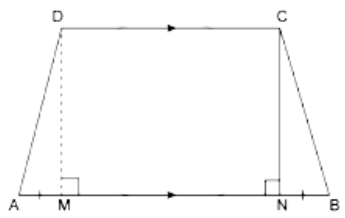
The cross section of a tunnel perpendicular to its length is a trapezium $\text{ABCD}$ as shown in the figure. $AM = BN; AB = 4.4\ m, CD = 3\ m$ The height of a tunnel is $2.4\ m$. The tunnel is $5.4\ m$ long.Calculate the cost of painting the internal surface of the tunnel $($excluding the floor$)$ at the rate of $Rs. 5$ per $m^2$.
Image
A shopkeeper fixes the selling price of his goods at $60\%$ above the cost price. He sells half of this stock at this price, a quarter of his stock at a discount of $25\%$ on the original selling price, and the rest at a discount of $50\%$ on the original selling price. Find the gain percent altogether.
In parallelogram $\text{ABCD, P}$ is a point on side $AB$ and $Q$ is a point on side $BC$.Prove that:$(i) \triangle CPD$ and $\triangle AQD$ are equal in the area.$(ii)$ Area $(\triangle AQD) =$ Area $(\triangle APD) +$ Area $(\triangle CPB)$
The cost of papering the four walls of a room at $75$ paise per square meter $Rs. 240.$ The height of the room is $5$ meters. Find the length and the breadth of the room, if they are in the ratio $5 : 3.$
Simplify the following:$\sqrt[3]{x^4 y^2} \div \sqrt[6]{x^5 y^{-5}}$
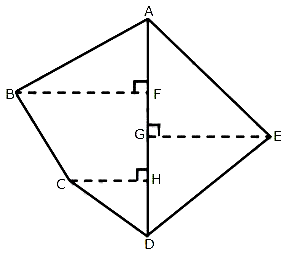
The following diagram shows a pentagonal field $\text{ABCDE}$ in which the lengths of $AF, FG, GH$, and $HD$ are $50\ m, 40\ m, 15\ m$ and $25\ m$ respectively; and the lengths of perpendiculars $BF, CH$ and $EG$ are $50\ m, 25\ m$ and $60\ m$ respectively. Determine the area of the field.
Image
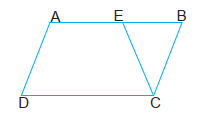
Case Study : Rajbeer is a farmer. He has a plot of land in the shape of a quadrilateral ABCD as shown in the figure. In $A B C D, A B \| C D$ and $A D \| B C$. He divided the field into two parts, viz, triangle BCE and trapezium CDAE by making an embankment CE such that $CE = AD$.
Based on the above information, answer the following questions :
1. ABCD is a :
(a) Rectangle
(b) Parallelogram
(c) Square
(d) Trapezium
2. $\angle A$ is equal to:
(a) $\angle D$
(b) $\angle B$
(c) $\angle C$
(d) $\angle E$
3. $\angle DCE$ is equal to:
(a) $\angle E$
(b) $\angle A$
(c) $\angle D$
(d) $\angle B$
4. Which of the following is correct?
(a) $\triangle AEC \cong \triangle EAD$
(b) $\triangle ACE \cong \triangle AED$
(c) $\triangle CEA \cong \triangle EAD$
(d) none of these
5. Diagonal DE is equal to:
(a) diagonal DB
(b) diagonal AC
(c) DC
(d) BC
Solve the following equations graphically$:\ x-2 y=2 , \frac{x}{2}-y=1$
A kite is flying at a height of 120 m from the level ground. It is attached to a string inclined at $60^{\circ}$ to the horizontal. Find the length of the string. (Take $\sqrt{3}$ = 1.73)
If $3 \tan \theta=4$, prove that $\frac{\sqrt{\sec \theta-\operatorname{cosec} \theta}}{\sqrt{\sec \theta-\operatorname{cosec} \theta}}=\frac{1}{\sqrt{7}}$.