MCQ
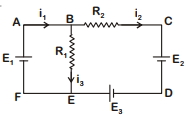
For the circuit given below, the Kirchoff's loop rule for the loop $BCDEB$ is given by the equation
  • A
    $- i _{2} R _{2}+ E _{2}+ E _{3}+ i _{3} R _{1}=0$
  • B
    $- i _{2} R _{2}+ E _{2}- E _{3}+ i _{3} R _{1}=0$
  • $i _{2} R _{2}+ E _{2}- E _{3}- i _{3} R _{1}=0$
  • D
    $i _{2} R _{2}+ E _{2}+ E _{3}+ i _{3} R _{1}=0$
Answer

Correct option: C.
$i _{2} R _{2}+ E _{2}- E _{3}- i _{3} R _{1}=0$
c
In a loop BCDEB by KVL

$v _{ a }- i _{2} R _{2}- E _{2}+ E _{3}+ i _{3} R _{1}= v _{ B }$

$i _{2} R _{2}+ E _{2}- E _{3}- i _{3} R _{1}=0$

Need a full question paper?

Generate a complete, print-ready paper with questions like this in minutes — across 16+ boards, with answer keys.

Start Generating Free

Similar questions

A photon of $1.7 \times 10^{-13}$ Joules is absorbed by a material under special circumstances. The correct statement is
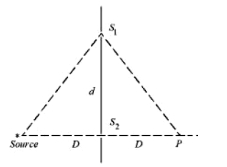
In a double slit experiment shown in figure, when light of wavelength $400 \mathrm{~nm}$ is used, dark fringe is observed at $P$. If $D=0.2 \mathrm{~m}$. the minimum distance between the slits $S_1$ and $S_2$ is ____________$mm$.
The work function of a photoelectric material is 3.3 eV. The threshold frequency will be equal to
Demagnetisation of magnets can be done by:
We consider the Thomson model of the hydrogen atom in which the proton charge is distributed uniformly over a spherical volume of radius $0.25 \,\mathring A$. Applying the Bohr condition in this model, the ground state energy (in $eV$ ) of the electron will be close to
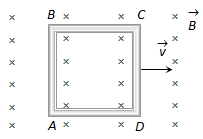
A conducting square loop of side L and resistance R moves in its plane with a uniform velocity v perpendicular to one of its sides. A magnetic induction B constant in time and space, pointing perpendicular and into the plane of the loop exists everywhere. The current induced in the loop is
If the mass of neutron $=1.7\times 10−27\ kg$ . Then the de broglie wavelength of neutron of energy $3eV$ is:
When a battery is connected across a series combination of self inductance $L$ and resistance $ R$, the variation in the current $i$ with time $t$ is best represented by
$(i)$ The wavelength of microwaves is greater than that of $UV$-rays.

$(ii)$ The wavelength of $IR$ rays is less than that of $UV$-rays.

$(iii)$ The wavelength of microwaves is lesser than that of $IR$ rays.

$(iv)$ Gamma rays have shortest wavelength in the electromagnetic spectrum.

Of the above statements

Two sources of light emit with a power of $200 \mathrm{~W}$. The ratio of number of photons of visible light emitted by each source having wavelengths $300\  \mathrm{nm}$ and $500 \mathrm{~nm}$ respectively, will be :