MCQ
For the given reaction

$\begin{array}{*{20}{c}}
  {{\,\,R_1}} \\ 
  | \\ 
  {R - C - X} \\ 
  | \\ 
  {{\,\,R_2}} 
\end{array}\xrightarrow{{HOH}}\begin{array}{*{20}{c}}
  {{\,\,R_1}\,\,\,\,} \\ 
  {|\,\,\,\,} \\ 
  {R - C - OH} \\ 
  {|\,\,\,\,\,} \\ 
  {{\,\,R_2}\,\,\,\,} 
\end{array}$

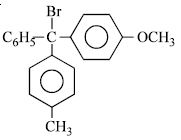
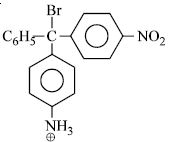
Which substrate will give maximum racemisation ?

  • A
    $\begin{array}{*{20}{c}}
      {\,\,\,\,\,\,\,\,\,\,\,\,\,\,C{H_3}} \\ 
      {\,\,\,\,\,\,|} \\ 
      {{C_6}{H_5} - C - Br} \\ 
      {\,\,\,\,\,|} \\ 
      {\,\,\,\,\,\,\,\,\,\,\,\,\,\,{C_2}{H_5}} 
    \end{array}$
  • B
    $\begin{array}{*{20}{c}}
      {\,\,\,\,\,\,\,\,\,\,\,\,\,\,\,\,\,\,\,\,\,\,\,\,\,\,\,\,C{H_3}} \\ 
      {\,\,\,\,\,\,\,\,\,\,\,\,\,\,\,\,\,\,\,\,\,|} \\ 
      {C{H_2} = CH - C - Br} \\ 
      {\,\,\,\,\,\,\,\,\,\,\,\,\,\,\,\,\,\,\,\,\,|} \\ 
      {\,\,\,\,\,\,\,\,\,\,\,\,\,\,\,\,\,\,\,\,\,\,\,\,\,\,\,\,\,\,\,{C_2}{H_5}} 
    \end{array}$

  • D

Answer

Correct option: C.

c

Need a full question paper?

Generate a complete, print-ready paper with questions like this in minutes — across 16+ boards, with answer keys.

Start Generating Free

Similar questions

The electronic configuration of $\mathrm{Cu}$ (II) is $3 \mathrm{~d}^9$ whereas that of $\mathrm{Cu}(\mathrm{I})$ is $3 \mathrm{~d}^{10}$. Which of the following is correct?
Ethylene oxide when treated with Grignard reagent yields
What is $X$ and $Y$ in the given reactions ?

$2X_2 (g) + 2H_2O (l) \to 4H^+ (aq) + 4X^-(aq) + O_2 (g)$

$Y_2 (g) + H_2O (l) \to HY(aq) + HOY(aq)$

Given below are two statements: one is labelled as Assertion $A$ and the other is labelled as Reason $R$.

Assertion $A :$ Dipole-dipole interactions are the only non-covalent interactions, resulting in hydrogen bond formation.

Reason $R$ : Fluorine is the most electronegative element and hydrogen bonds in $HF$ are symmetrical.

In the light of the above statements, choose the most appropriate answer from the options given below.

In the following reaction  ${C_6}{H_5}C{H_2}Br\,\xrightarrow[{2.\,{H_3}{O^ + }}]{{1.\,Mg,\,Ether}}\,X\,\,,$ the product $'X '$ is
The tendency of $ 3d-$ metal ions to form stable complexes is due to their
Sodium benzene sulphonate reacts with $ NaOH$  and then on acidic hydrolysis, it gives
A cell constructed by coupling a standard copper electrode and a standard magnesium electrode has emf of $2.7$ volts. If the standard reduction potential of copper electrode is $+ 0.34 $ volt that of magnesium electrode is .............. $\mathrm{V}$
For $(i)\, I^-,\, (ii)\, Cl^-,\, (iii)\, Br^-,$ the increasing order of nucleophilicity would be
What minimum decomposition potential is necessary to produce $Cl_2$ gas in following reaction ................ $\mathrm{V}$ 

Given :( $\frac{{2.303RT}}{F} = 0.06)$

$s{n^{ + 2}}\left( {1M} \right) + 2C{l^ - }\left( {2M} \right) \rightleftharpoons s{n_{\left( s \right)}} + C{l_2}\left( {1\,atm} \right)$

Given : ${E^o}_{s{n^{ + 2}}/sn} =  - 0.14$      ${E^o}_{C{l_2}/C{l^- }} = 1.4\,V$