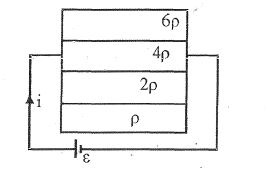
For the network shown in the figure the value of the current $i$ is
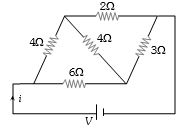
AIPMT 2005, Medium
Download our app for free and get started
The given network is a balanced Wheatstone bridge. It's equivalent resistance will be $R = \frac{{18}}{5}\,\Omega $
So current from the battery $i = \frac{V}{R} = \frac{V}{{18/5}} = \frac{{5V}}{{18}}$

Download our appand get started for free
Experience the future of education. Simply download our apps or reach out to us for more information. Let's shape the future of learning together!No signup needed.*
Similar Questions
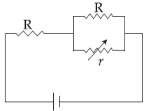
- 1In the circuit shown, the resistance $r$ is a variable resistance. If for $r = fR,$ the heat generation in $r$ is maximum then the value of $f$ isView Solution
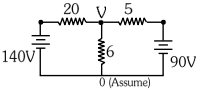
- 2The value of current in the $6 \,\Omega$ resistance is $....\,A$View Solution
- 3Two cities are $150\,\, km$ apart. Electric power is sent from one city to another city through copper wires. The fall of potential per $km$ is $8\,\, volt$ and the average resistance per km is $0.5 \,\,\Omega .$ The power loss in the wire isView Solution
- 4How much energy in kilowatt hour is consumed in operating ten $50\, watt$ bulbs for $10$ hours per day in a month ($30$ days).View Solution
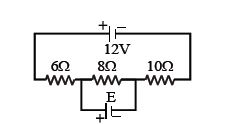
- 5In the circuit shown, the current through $8\,ohm$ issame before and after connecting $E$. The value of $E$ is .................... $\mathrm{V}$View Solution
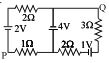
- 6In the circuit shown, what is the potential difference $V_{PQ}$? ................ $V$View Solution
- 7An electric bulb rated for $500\, watts$ at $100\, volts$ is used in a circuit having a $200-volt$ supply. The resistance $R$ that must be put in series with the bulb, so that the bulb draws $500\, W$ is .................. $\Omega$View Solution
- 8The charge flowing through a resistance $R$ varies with time $t$ as $ Q=at-bt^2 $ where $a$ and $b$ are positive constants . The total heat produced in $R$ isView Solution
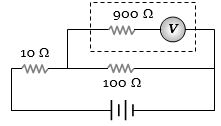
- 9The potential difference across the $100\,\Omega$ resistance in the following circuit is measured by a voltmeter of $900 \,\Omega$ resistance. The percentage error made in reading the potential difference isView Solution
- 10If resistivity of all four wire connected in parallel is different as given in figure and all other dimensions of wire are same then current $i$ is (resistance of wire having resistivity $\rho $ is $R_0$ )View Solution