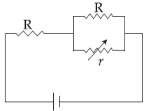
In the circuit shown, the resistance $r$ is a variable resistance. If for $r = fR,$ the heat generation in $r$ is maximum then the value of $f$ is
JEE MAIN 2016, Diffcult


Download our appand get started for free
Experience the future of education. Simply download our apps or reach out to us for more information. Let's shape the future of learning together!No signup needed.*
Similar Questions
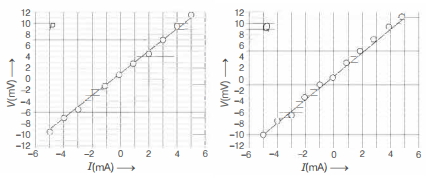
- 1Two students $P$ and $Q$ perform an experiment to verify Ohm's law for a conductor with resistance $R$. They use a current source and a voltmeter with least counts of $0.1 mA$ and $0.1 \,mV$, respectively. The plots of the variation of voltage drop $V$ across $R$ with current $I$ for both are shown below. The statement which is most likely to be correct?View Solution
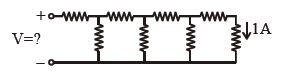
- 2Each element in the finite chain of resistors shown in the figure is $\,1\,\Omega $ . A current of $1\, A$ flows through the final element. Then what is the potential difference $V$ across input terminals of the chain .................. $\mathrm{volt}$View Solution
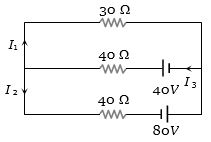
- 3In the given circuit the current $I_1$ is .............. $A$View Solution
- 4Heat produced in a wire of resistance $R$ due to current flowing at constant potential difference is proportional toView Solution
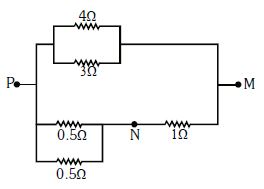
- 5In the circuit shown, the current through the $4\,\Omega $ resistor is $1\, amp$ when the points $P$ and $M$ are connected to a d.c. voltage source. The potential difference between the points $M$ and $N$ is ............... $volt$View Solution
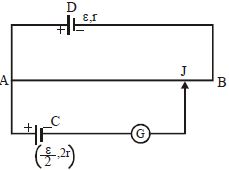
- 6At room temperature $\left(27^{\circ} \mathrm{C}\right)$, the resistance of a heating element is $50 \Omega$. The temperature coefficient of the material is $2.4 \times 10^{-4}{ }^{\circ} \mathrm{C}^1$. The temperature of the element, when its resistance is $62 \Omega$, is $\qquad$ ${ }^{\circ} \mathrm{C}$.View Solution
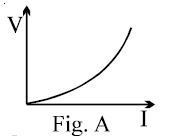
- 7The variation of current $(I)$ and voltage $(V)$ is as shown in figure $A$. The variation of power $P$ with current $I$ is best shown by which of the following graphView Solution
- 8Two wires $A$ and $B$ made of same material and having their lengths in the ratio $6 : 1$ are connected in series. The potential difference across the wires are $3\,V$ and $2\,V$ respectively. If $r_A$ and $r_B$ are the radii of $A$ and $B$ respectively, then $\frac{{{r_B}}}{{{r_A}}}$ isView Solution
- 9View SolutionPotential gradient is defined as
- 10In the figure, the potentiometer wire $AB$ of length $L$ and resistance $9r$ is joined to the cell $D$ of $emf$ $\varepsilon $ and internal resistance $r$. The cell $C's$ $emf$ is $\frac{\varepsilon }{2}$and its internal resistance is $2r$. The galvanometer $G$ will show no deflection when the length $AJ$ isView Solution