MCQ
For the reaction$PC{l_5}(g) \to PC{l_3}(g) + C{l_2}(g)$
  • A
    $\Delta H = \Delta E$
  • $\Delta H > \Delta E$
  • C
    $\Delta H < \Delta E$
  • D
    None of these

Answer

Correct option: B.
$\Delta H > \Delta E$
(b)$PC{l_5}(g) \to PC{l_3}(g) + C{l_2}(g)$
For this reaction $\Delta ng = 2 - 1 = 1$
$\Delta ng$ is positive, i.e., there is an increase in the number of gaseous moles then $\Delta H > \Delta E$

Need a full question paper?

Generate a complete, print-ready paper with questions like this in minutes — across 16+ boards, with answer keys.
Start Generating Free

Similar questions

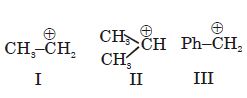
Arrange the Carbocations in decreasing order of stability
In which of following option is wrong about stability of diatomic molecules
At $700\, K$, the equilibrium constant ${K_p}$ for the reaction $2S{O_{3(g)}}$ $\rightleftharpoons$ $ 2S{O_{2(g)}} + {O_{2(g)}}$ is $1.80 \times {10^{ - 3}}$ and $kP_a$ is $14$, ($R = 8.314\, Jk^{-1} \,mol^{-1}$). The numerical value in moles per litre of ${K_c}$ for this reaction at the same temperature will be
Internal energy does not include
Correct Lewis acidity order of $BX_3$ is
The suffix of the principal group, the prefixes for the other groups and the name of the parent in the structure

$\begin{array}{*{20}{c}}
  {HO - C{H_2} - CH - CH = C - C{H_2} - C - C - OH} \\ 
  {\,\,\,\,\,\,\,\,\,\,\,\,\,\,\,\,|\,\,\,\,\,\,\,\,\,\,\,\,\,\,\,\,\,\,\,\,\,\,\,\,\,\,\,\,\,\,|\,\,\,\,\,\,\,\,\,\,\,\,\,\,\,\,\,\,\,\,\,\,\,\,\,\,\,\,\,||\,\,\,\,\,\,\,||} \\ 
  {\,\,\,\,\,\,\,\,\,\,\,\,\,\,\,C{H_3}\,\,\,\,\,\,\,\,\,\,\,\,\,\,\,\,\,\,\,\,\,Cl\,\,\,\,\,\,\,\,\,\,\,\,\,\,\,\,\,\,\,\,\,\,\,\,\,\,\,O\,\,\,\,\,\,O\,} 
\end{array}$

For the reaction $CO ( g )+ Cl _{2}( g ) \rightleftharpoons COCl _{2}( g )$ , $\frac{ K _{ p }}{ K _{ c }}$ is equal to
Two equilibria, $AB \rightleftharpoons {A^ + } + {B^ - }$ and $AB + {B^ - } \rightleftharpoons AB_2^ - $ are simultaneously maintained in a solution with equilibrium constants, $K_1$ and $K_2$ respectively. The ratio of $[A^+]$ to $[AB_2^-]$ in the solution is
Cathode rays or cathode ray particles are:
Among the following species which two have trigonal pyramidal shape ?

$(I)$ $NI_3$                    $(II)$ $I_3^-$   

$(III)$ $SO_3^{-2}$         $(IV)$ $NO_3^-$