MCQ
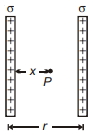
For two infinitely long charged parallel sheets, the electric field at $P$ will be
  • A
    $\frac{\sigma}{2 x}-\frac{\sigma}{2(r-x)}$
  • B
    $\frac{\sigma}{2 \varepsilon_0 x}+\frac{\sigma}{2 \pi(r-x) \varepsilon_0}$
  • C
    $\frac{\sigma}{\varepsilon_0}$
  • $0$

Answer

Correct option: D.
$0$
d
(d)

$E_N=E_1-E_2=\frac{\sigma}{2 \varepsilon_0}-\frac{\sigma}{2 \varepsilon_0}=0$

Need a full question paper?

Generate a complete, print-ready paper with questions like this in minutes — across 16+ boards, with answer keys.
Start Generating Free

Similar questions

A straight wire of length $L$ is bent into a semicircle. It is moved in a uniform magnetic field with speed $v$ with diameter perpendicular to the field. The induced emf between the ends of the wire is
The ratio of the longest to shortest wavelengths in Brackett series of hydrogen spectra is
A double slit experiment is performed by using light of wavelength of $6000\,\mathring A$. If distance of screen is $1\,m$ and slits are $0.1\, cm$ apart then calculate angular position of $10^{th}$ bright fringe
Consider a capacitor $-$ charging circuit. Let $Q_1$ be the charge given to the capacitor in a time interval of $10 ms$ and $\mathrm{Q}_2$ be the charge given in the next time interval of $10 ms$ . Let $10 mC$ charge be deposited in time interval $\mathrm{t}_1$ and another $10 mC$ charge be deposited in the next time interval $\mathrm{t}_2$.
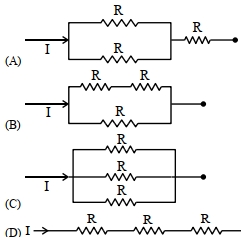
Different combination of $3$ resistors of equal resistance $R$ are shown in the figures.
The increasing order for power dissipation is:
A proton and an electron are accelerated by the same potential difference. Let $\lambda_\text{e}$ and $\lambda_\text{p}$ denote the de Broglie wavelengths of the electron and the proton respectively.
Statement $-1$ : A nucleus having energy $E _{1}$ decays $\beta^{-}$ emission to daughter nucleus having energy $E _{2}$ but the $\beta^{-}$rays are emitted with a continuous energy spectrum having end point energy $E _{1}- E _{2}$

Statement $-2$ : To conserve energy and momentum in $\beta$ decay at least three particles must take part in the transformation.

A common emitter amplifier is designed with NPN transistor (a = 0.99). The input impedance is 1 KW and load is 10 KW. The voltage gain will be
Two identical light sources $S_1$ and $S_2$ emit light of same wavelength $\lambda$. These light rays will exhibit interference if
An electron is projected along the axis of a circular conductor carrying some current. Electron will experience force