MCQ
For two statements are given$-$one labelled Assertion and the other labelled Reason. Select the correct answer to these questions from the codes $(a), (b), (c) $ and $(d)$ as given below.
Assertion: Chlamydia trachomatis is a human pathogen that causes trachoma, sexually transmitted and perinatal infection.
Reason: Chlamydia trachomatis has $\text{DEFGHIJK}$ serotypes.
  • A
    Both assertion and reason are true, and reason is the correct explanation of assertion.
  • Both assertion and reason are true, but reason is not the correct explanation of assertion.
  • C
    Assertion is true, but reason is false.
  • D
    Both assertion and reason are false.

Answer

Correct option: B.
Both assertion and reason are true, but reason is not the correct explanation of assertion.

Need a full question paper?

Generate a complete, print-ready paper with questions like this in minutes — across 16+ boards, with answer keys.

Start Generating Free

Similar questions

For two statements are given-one labelled Assertion and the other labelled Reason. Select the correct answer to these questions from the codes $(a), (b), (c)$ and $(d)$ as given below.
Assertion: Chasmogamous flowers require pollinating agents.
Reason: Cleistogamous flowers do not expose their sex organs.
For question, two statements are given$-$one labelled Assertion and the other labelled Reason. Select the correct answer to these questions from the codes $(a), (b), (c)$ and $(d)$ as given below.
Assertion: $R-$type of Pneumococcus is non$-$virulent.
Reason: $R-$type of Pneumococcus can be virulent by having transformation with $S -$type of Pneumococcus.
For question, two statements are given$-$one labelled Assertion and the other labelled Reason. Select the correct answer to these questions from the codes $(a), (b), (c)$ and $(d)$ as given below.
 Assertion: The concept of one gene$-$one enzyme was changed to one gene$-$one polypeptide.
Reason: Each enzyme may consist of two or more different polypeptides.
For question two statements are given $-$ one labelled Assertion and the other labelled Reason. Select the correct answer to these questions from the codes $(a), (b), (c)$ and $(d)$ as given below.
Assertion : Cuscuta is an example of holoparasite.
Reason : Cuscuta does not depend on other plants for nutrition requirements.
For question two statements are given-one labelled Assertion and the other labelled Reason. Select the correct answer to these questions from the codes $\text{(a), (b), (c)}$ and $(d)$ as given below.
Assertion: Complementary genes are non-allelic genes.
Reason: Complementary genes interact to produce a completely new trait.
Read the following and answer any four questions from $(i)$ to $(v)$ given below:
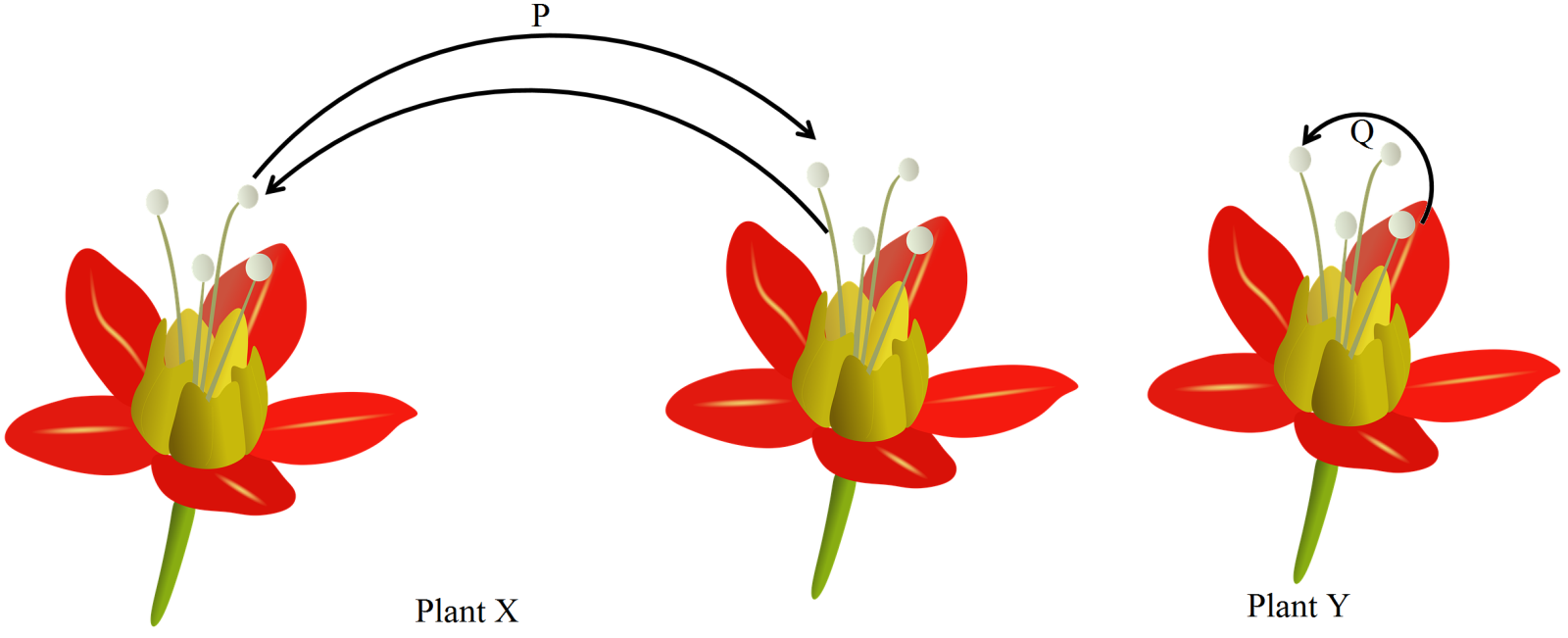
In angiosperms, the pollen grains are being transferred from the anther to the stigma and is termed pollination. This phenomenon was first discovered by Camerarius $(1694)$ in the end of seventeenth century. Pollen grains are immobile. They cannot reach the stigma by themselves. An external agent is required for this. The pollination is mainly of two types$-$self pollination and cross pollination. The diagram given below shows two plants of the same species showing different types of pollination.
  1. What is transferred between the plants in the process indicated by arrow $P?$
  1. Ova.
  2. Pollen.
  3. Nutrients.
  4. Seeds.
  1. Which of the following statements is correct regarding processes $P, Q$ and $R?$
  1. Processes $P, Q$ and $R$ introduce genetic variability in the offspring of sexually reproducing plants $X$ and $Y.$
  2. Wind serves as agent for process $Q$ if plants $X$ and $Y$ belong to Genus Salvia.
  3. Flowers of plants $X$ and $Y$ need to produce odour and nectar for completion of processes $P$ and $Q$ if they are entomophilous.
  4. If plants $X$ and $Y$ belong to Genus Cannabis, then their flowers need to produce sticky and heavy pollens in very small amount for accomplishment of process $Q.$
  1. Identify the processes $P, Q$ and $R.$
S. No $P$ $Q$ $R$
$(a)$
Geitonogamy
Xenogamy
Autogamy
$(b)$
Allogamy
Chasmogamy
Cleistogamy
$(c)$
Autogamy
Geitonogamy
Xenogamy
$(d)$
Geitonogamy
Allogamy
Autogamy
  1. In Catliarantl1us, the growth of style brings the stigma in contact of ripe anthers present on the mouth of corolla tube. This is an example of:
  1. Homogamy.
  2. Cleistogamy.
  3. Geitonogamy.
  4. Xenogamy.
  1. Which of the given processes represents a type of pollination that would result in greater adaptability of the particular species to potential environmental changes?
  1. $P.$
  2. $Q.$
  3. $R.$
  4. All of these.
For question, two statements are given$-$one labelled Assertion and the other labelled Reason. Select the correct answer to these questions from the codes $(a), (b), (c)$ and $(d)$ as given below.
Assertion :Mucous membrane immobilises the micro$-$organisms in the body
Reason: Microorganisms and dust particles entering the respiratory tract are trapped in the mucus.
Read the following and answer any four questions from $(i)$ to $(v)$ given below:
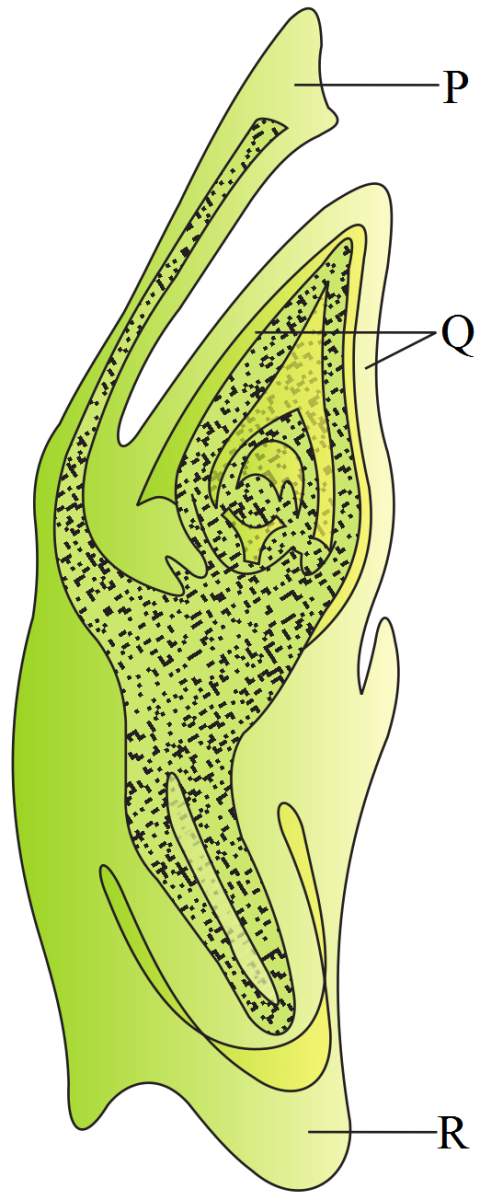
Embryo develops at the micropylar end of the embryo sac, where the zygote is situated. Most zygotes divided only after certain amount of endosperm is formed. The early stages of embryo development are similar in both monocotyledons and dicotyledons. The zygote gives rise to the proembryo and subsequently to the globular heart-shaped and mature embryo. A typical dicotyledonous embryo consists of an embryonal axis and two cotyledons. Embryo of monocotyledons possess only one cotyledon.
  1. True embryo develops as a result of fusion of:
  1. Two polar nuclei of embryo sac.
  2. An egg cell and a male gamete.
  3. Synergid and male gamete.
  4. A male gamete and antipodals.
  1. Refer to the given diagram of the embryo of an angiospermous plant with parts labelled $P, Q$ and $R$. Select the correct statement$(s)$ regarding this.
  1. Part $'P\ '$ supplies nutrition to the developing embryo.
  2. Part $'Q\ '$ is the protective sheath of radicle and root cap.
  3. Part $'R\ '$ is the protective sheath of shoot apex and leaf primordia.
  4. The embryo shown in the diagram is present in members of Family Poaceae.
  1. $(IV)$ only.
  2. $(II)$ and $(III)$ only.
  3. $(I)$ and $(IV)$ only.
  4. $(I), (II), (III)$ and $(IV).$
  1. Which of the given statements are true?
  1. During the development of a dicot embryo, heart$-$shaped embryo is followed by globular embryo.
  2. The part of embryonal axis above the level of cotyledons is epicotyl, while the part below the level of cotyledons is hypocotyl.
  3. Monocot seeds possess a single cotyledon, represented by scutellum.
  1. $(I)$ and $(II).$
  2. $(II)$ and $(III).$
  3. $(I)$ and $(III).$
  4. $(I), (II)$ and $(III).$
  1. Consider the following parts of an embryonal axis of a dicot seed.
  1. Hypocotyl.
  2. Epicotyl.
  3. Radicle.
  4. Plumule.
In which of the following the above parts are correctly arranged from top to base?
  1. $(III) \rightarrow (I) \rightarrow (II) \rightarrow (IV).$
  2. $(II) \rightarrow (I) \rightarrow (III) \rightarrow (IV).$
  3. $(IV) \rightarrow (II) \rightarrow (I) \rightarrow (III).$
  4. $(III) \rightarrow (IV) \rightarrow (II) \rightarrow (I).$
  1. In grass family, the cotyledon, is called:
  1. Epiblast.
  2. Plumule.
  3. Scutellum.
  4. Perisperm.
For question, two statements are given$-$one labelled Assertion and the other labelled Reason. Select the correct answer to these questions from the codes $(a), (b), (c)$ and $(d)$ as given below.
Assertion : It is considered advantageous to give the polio vaccine orally.
Reason: The oral polio vaccine prevents reinfection by causing intestinal immunity.
GM crops help to reduce the _______ losses.