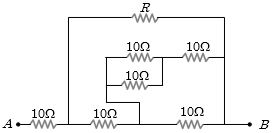
For what value of $R$ the net resistance of the circuit will be $18\, ohms$ ............... $\Omega$
Medium
Download our app for free and get started
(c) $R_{e q}=10+\frac{16 R}{16+R}$
$18=10+\frac{16 R}{16+R} \Rightarrow 8=\frac{16 R}{16+R}$
$128+8 R=16 R \Rightarrow 8 R=128$
$R=16 \Omega$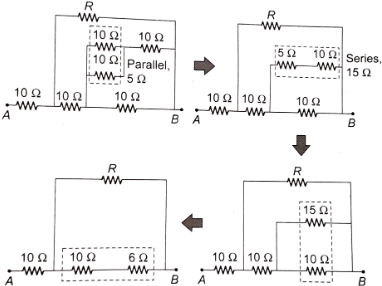

Download our appand get started for free
Experience the future of education. Simply download our apps or reach out to us for more information. Let's shape the future of learning together!No signup needed.*
Similar Questions
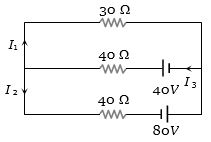
- 1View SolutionIn charging a battery of motor-car, the following effect of electric current is used
- 2A set of $n$ equal resistors, of value $R$ each, are connected in series to a battery of emf $E$ and internal resistance $R.$ The current drawn is $I.$ Now, the $n$ resistors are connected in parallel to the same battery. Then the current drawn from battery becomes $10\,I.$ The value of $n$ isView Solution
- 3The equivalent resistance of a group of resistances is $R$. If another resistance is connected in parallel to the group , its new equivalent becomes $R_1$ and if it is connected in series to the group , its new equivalent becomes $R_2$ we have :View Solution
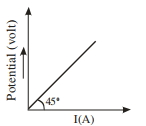
- 4The variation of applied potential and current flowing through a given wire is shown in figure. The length of wire is $31.4 \,cm$. The diameter of wire is measured as $2.4 \,cm$. The resistivity of the given wire is measured as $x \times 10^{-3} \,\Omega cm$. The value of $x$ is_______ [Take $\pi=3.14]$View Solution
- 5A battery having $e.m.f.$ $5\,\,V$ and internal resistance $0.5$ $\Omega$ is connected with a resistance of $4.5 \,\Omega$ then the voltage at the terminals of battery is ............. $V$View Solution
- 6View SolutionGiven three equal resistors, how many different combination of all the three resistors can be made
- 7View SolutionThe fact that the conductance of some metals rises to infinity at some temperature below a few Kelvin is called
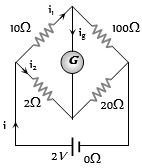
- 8In the circuit shown below the resistance of the galvanometer is $20\, \Omega$ . In which case of the following alternatives are the currents arranged strictly in the decreasing orderView Solution
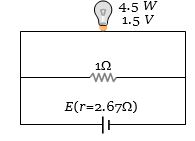
- 9A torch bulb rated as $4.5\, W$, $1.5\, V$ is connected as shown in the figure. The $e.m.f.$ of the cell needed to make the bulb glow at full intensity is ................ $V$View Solution
- 10In the given circuit the current $I_1$ is .............. $A$View Solution