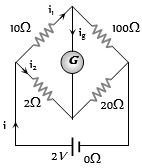
In the circuit shown below the resistance of the galvanometer is $20\, \Omega$ . In which case of the following alternatives are the currents arranged strictly in the decreasing order
Medium
Download our app for free and get started
(b) $i \propto \frac{1}{R}$
$P+Q>R+S$
$i=i_{1}+i_{2}$
$i>i_{2}>i_{1}>i_{g}$

Download our appand get started for free
Experience the future of education. Simply download our apps or reach out to us for more information. Let's shape the future of learning together!No signup needed.*
Similar Questions
- 1An electric wire of length ‘$I$’ and area of cross-section $a$ has a resistance $R\, ohms$. Another wire of the same material having same length and area of cross-section $4a$ has a resistance ofView Solution
- 2A metal wire of specific resistance $64 \times {10^{ - 6}}\,ohm - cm$ and length $198\, cm$ has a resistance of $7\, ohm$, the radius of the wire will be ............. $cm$View Solution
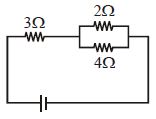
- 3View SolutionThe current in the adjoining circuit will be
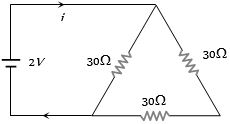
- 4If power in $3\,\Omega $ is $27\,W$ then what is the power in $2\,\Omega $ ................. $W$View Solution
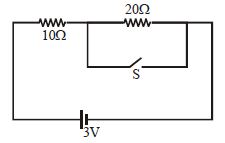
- 5Consider the circuit shown in fig. The current through the $10\,\Omega $ resistor when switch $'s'$ is $(a)$ open $(b)$ closed.View Solution
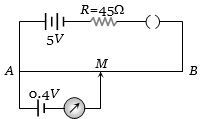
- 6In given figure, the potentiometer wire $AB$ has a resistance of $5$ $\Omega$ and length $10\, m$. The balancing length $AM$ for the $emf$ of $0.4\, V$ is ............... $m$View Solution
- 7A primary cell has an $e.m.f.$ of $1.5\,volts$, when short-circuited it gives a current of $3$ amperes. The internal resistance of the cell is .............. $ohm$View Solution
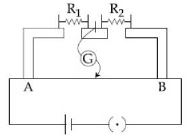
- 8In the experimental setup of meter bridge shown in the figure, the null point is obtained at a distance of $40\,cm$ from $A$. If a $10\,\Omega $ resistor is connected in series with $R_1$, the null point shifts by $10\,cm$. The resistance that should be connected in parallel with $\left( {{R_1} + 10} \right)\,\Omega $ such that the null point shifts back to its initial position is .............. $\Omega$View Solution
- 9Two indentical electric lamps marked $500\, W, \,\,220\, V$ are connected in series and then joined to a $110\, V$ line. The power consumed by each lamp isView Solution
- 10If two wires having resistance $R$ and $2R$. Both joined in series and in parallel then ratio of heat generated in this situation, applying the same voltage,View Solution