MCQ
For what value of unknown resistance $X,$ the potential difference between $B$ and $D$ will be zero in the circuit shown in the figure
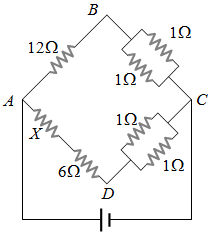
  • A
    $4 \Omega$
  • $6 \Omega$
  • C
    $2 \Omega$
  • D
    $5 \Omega$

Answer

Correct option: B.
$6 \Omega$
$6 \Omega$

Need a full question paper?

Generate a complete, print-ready paper with questions like this in minutes — across 16+ boards, with answer keys.
Start Generating Free

Similar questions

Adielectric medium $e_r$ is filled in half of the space between the plates of a parallel plate capacitor. If the capacitance of the part filled with air is C then the capacitance of the entire capacitor system will be :
Which of the following statement is false(a) Heat produced in a conductor is proportional to its resistance(b) Heat produced in a conductor is proportional to the square of the current(c) Heat produced in a conductor is proportional to charge(d) Heat produced in a conductor is proportional to the time for which current is passed


If instantaneous magnetic flux in a coil is $BA \cos \omega t$, then magnitude of induced emf in the coil is :
Four wires of equal length and of resistances 10 ohms each are connected in the form of a square. The equivalent resistance between two opposite corners of the square is(a) 10 ohm(b) 40 ohm(c) 20 ohm(d) 10/4 ohm
       
Average energy stored in a pure inductance $L$ when a current $i$ flows through it, is
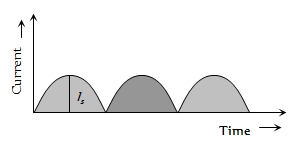
The output current versus time curve of a rectifier is shown in the figure. The average value of the output current in this case is
Which one of the following devices makes use of the electrons to strike certain substances to produce fluorescence(a) Thermionic valve(b) Photoelectric cell(c) Cathode ray oscilloscope(d) Electron gun
   
   
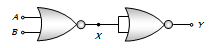
Assertion   : The following circuit represents $'OR\ '$ gate

Reason : For the above circuit $Y=\bar{X}=\overline{\overline{A+B}}=A+B$
A plane electromagnetic wave with a single frequency moves in vacuum in the positive x direction. Its amplitude is uniform over the yz plane its wavelength:
Which of the following statement is not correct about two parallel conductors carrying equal currents in the same direction?