For which of the following dependence of drift velocity $v$ on electric field $E$ is ohm's law obeyed
Easy


Download our appand get started for free
Experience the future of education. Simply download our apps or reach out to us for more information. Let's shape the future of learning together!No signup needed.*
Similar Questions
- 1If a $0.1\%$ increase in length due to stretching, the percentage increase in its resistance will be ............ $\%$View Solution
- 2At room temperature, copper has free electron density of $8.4 \times {10^{28}}$ per ${m^3}$. The copper conductor has a cross-section of $10^{-6} \,m^2$ and carries a current of $5.4\, A$. The electron drift velocity in copper isView Solution
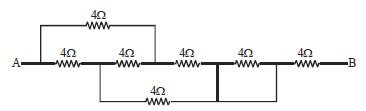
- 3Equivalent resistance between $A$ and $B$ is ............ $\Omega$View Solution
- 4View SolutionWhich of the following statements is false?
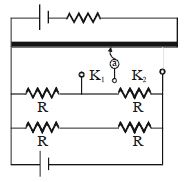
- 5In potentiometer experiment when $K_1$ is closed balance length is $100\,cm$. Then what will be balancing length when $K_2$ is closed ................ $\mathrm{cm}$View Solution
- 6There are $8$ equal resistances $R$. Two are connected in parallel, such four groups are connected in series, the total resistance of the system will beView Solution
- 7An electric kettle has two heating coils. When one coil is used, water in the kettle boils in $5$ minutes, while when second coil is used, same water boils in $10\,\min$. If the two coils, connected in parallel are used simultaneously, the same water will boil in timeView Solution
- 8View SolutionWhich of the adjoining graphs represents ohmic resistance
- 9View SolutionIdentify the set in which all the three materials are good conductors of electricity
- 10Calculate the amount of charge flowing in $2$ minutes in a wire of resistance $10$ $\Omega$ when a potential difference of $20\,V$ is applied between its ends ............ $C$View Solution