Force constant of a spring is $K$ . If half part is detached then force constant of the remaining spring will be
Easy
Download our app for free and get started
$\mathrm{K} \propto \frac{1}{\ell}$
$\frac{\mathrm{K'}}{\mathrm{K}} \propto \frac{\ell}{\ell / 2} \Rightarrow \mathrm{K}^{\prime}=2 \mathrm{K}$

Download our appand get started for free
Experience the future of education. Simply download our apps or reach out to us for more information. Let's shape the future of learning together!No signup needed.*
Similar Questions
- 1Two particles undergo $SHM$ along parallel lines with the same time period $(T)$ and equal amplitudes. At a particular instant, one particle is at its extreme position while the other is at its mean position. They move in the same direction. They will cross each other after a further timeView Solution
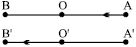
- 2The velocity of a particle executing SHM varies with displacement $( x )$ as $4 v ^2=50- x ^2$. The time period of oscillations is $\frac{x}{7} s$. The value of $x$ is $............$ $\left(\right.$ Take $\left.\pi=\frac{22}{7}\right)$View Solution
- 3The maximum velocity of a simple harmonic motion represented by $y = 3\sin \,\left( {100\,t + \frac{\pi }{6}} \right)$is given byView Solution
- 4A body of mass $1\,kg$ is executing simple harmonic motion. Its displacement $y(cm)$ at $t$ seconds is given by $y = 6\sin (100t + \pi /4)$. Its maximum kinetic energy is ..... $J$View Solution
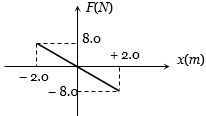
- 5A body of mass $0.01 kg$ executes simple harmonic motion $(S.H.M.)$ about $x = 0$ under the influence of a force shown below : The period of the $S.H.M.$ is .... $s$View Solution
- 6View SolutionIdentify the function which represents a periodic motion.
- 7Three simple harmonic motions in the same direction having the same amplitude a and same period are superposed. If each differs in phase from the next by ${45^o}$, thenView Solution
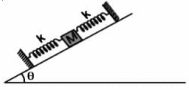
- 8View SolutionIn the adjacent figure, if the incline plane is smooth and the springs are identical, then the period of oscillation of this body is
- 9A simple perdulum performs simple harmonic motion about $x=0$ with an amplitude $a$ and time period $T$. The speed of the pendulum at $x=a/2$ will beView Solution
- 10The amplitude of a simple pendulum, oscillating in air with a small spherical bob, decreases from $10\, cm$ to $8\, cm$ in $40\, seconds$ . Assuming that Stokes law is valid, and ratio of the coefficient of viscosity of air to that of carbon dioxide is $1.3$ . The time in which amplitude of this pendulum will reduce from $10\, cm$ to $5\, cm$ in carbon dioxide will be close to ..... $s$ $(ln\, 5 = 1.601,ln\, 2 = 0 .693)$View Solution