The amplitude of a simple pendulum, oscillating in air with a small spherical bob, decreases from $10\, cm$ to $8\, cm$ in $40\, seconds$ . Assuming that Stokes law is valid, and ratio of the coefficient of viscosity of air to that of carbon dioxide is $1.3$ . The time in which amplitude of this pendulum will reduce from $10\, cm$ to $5\, cm$ in carbon dioxide will be close to ..... $s$ $(ln\, 5 = 1.601,ln\, 2 = 0 .693)$
JEE MAIN 2014, Medium
Download our app for free and get started
As we know,
$x=x_{0} e^{-b t/ 2 m}$
From question,
$8=10 \mathrm{e}^{-\frac{40 \mathrm{b}}{2 \mathrm{m}}}$ $...(i)$
Similarly, $5=10 e^{-\frac{b t}{2 m}}$ $...(ii)$
Solving eqns $(i)$ and $(ii)$ we get
$t \cong 142 s$

Download our appand get started for free
Experience the future of education. Simply download our apps or reach out to us for more information. Let's shape the future of learning together!No signup needed.*
Similar Questions
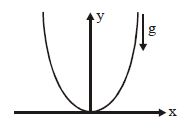
- 1A particle of mass $5 × 10^{-5}\ kg$ is placed at lowest point of smooth parabola $x^2 = 40y$ ( $x$ and $y$ in $m$ ). If it is displaced slightly such that it is constrained to move along parabola, angular frequency of oscillation (in $rad/s$) will be approximately:-View Solution
- 2${T}_{0}$ is the time period of a simple pendulum at a place. If the length of the pendulum is reduced to $\frac{1}{16}$ times of its initial value, the modified timeView Solution
- 3The displacements of two particles executing $S.H.M.$ on the same line are given. as $y_1=a \sin \left(\frac{\pi}{2} t+\phi\right)$ and $y_2=b \sin \left(\frac{2 \pi}{3} t+\phi\right)$. The phase difference between them at $t=1 \,s$ is .........View Solution
- 4A simple pendulum is placed at a place where its distance from the earth's surface is equal to the radius of the earth. If the length of the string is $4 \mathrm{~m}$, then the time period of small oscillations will be ____ $s$. $\left[\right.$ take $\left.\mathrm{g}=\pi^2 \mathrm{~ms}^{-2}\right]$View Solution
- 5The maximum velocity and the maximum acceleration of a body moving in a simple harmonic oscillator are $2\,m/s$ and $4\,m/{s^2}.$ Then angular velocity will be ..... $rad/sec$View Solution
- 6A ball suspended by a thread swings in a vertical plane so that its magnitude of acceleration in the extreme position and lowest position are equal. The angle $(\theta)$ of thread deflection in the extreme position will be :View Solution
- 7If the time period of a two meter long simple pendulum is $2\, s$, the acceleration due to gravity at the place where pendulum is executing $S.H.M.$ isView Solution
- 8A particle of mass $m$ is released from rest and follows a parabolic path as shown. Assuming that the displacement of the mass from the origin is small, which graph correctly depicts the position of the particle as a function of time $?$View Solution
- 9View SolutionIdentify the function which represents a nonperiodic motion.
- 10A body executes $SHM$ under the influence of one force and has a period $T_1\, second$ and the same body executes $SHM$ with period $T_2\, second$ when under the influence of another force. When bothforces act simultaneously and in the same direction, then the time period of the same body isView Solution