MCQ
Force necessary to pull a circular plate of $5\, cm$ radius from water surface for which surface tension is $75\, dynes/cm,$  is
  • A
    $30\,dyne$
  • B
    $60 \,dynes$
  • C
    $750 \,dynes$
  • $750 \,\pi \,dynes$

Answer

Correct option: D.
$750 \,\pi \,dynes$
d
(d) The total length of the circular plate on which the force will act $ = 2\pi R$

Force to pull $ = 2\pi RT = 2 \times \pi \times 5 \times 75 = 750\pi \, dynes$

Need a full question paper?

Generate a complete, print-ready paper with questions like this in minutes — across 16+ boards, with answer keys.
Start Generating Free

Similar questions

If a glass prism is dipped in water, its dispersive power:
Simple harmonic motion is such a harmonic motion in which the restoring force F is directly proportional to :
$Assertion$ : A tennis ball bounces higher on hills than in plains.
$Reason$ : Acceleration due to gravity on the hill is greater than that on the surface of earth
An engineer is given a fixed volume $V_m$ of metal with which to construct a spherical pressure vessel. Interestingly, assuming the vessel has thin walls and is always pressurized to near its bursting point, the amount of gas the vessel can contain, $n$ (measured in moles), does not depend on the radius $r$ of the vessel : instead it depends only on $V_m$ (measured in $m^3$) the temperature $T$ (mensured in $K$). the ideal gas constant $R$ (measured in $J/(K\ mol$ )), and the tensile strength of the metal $\sigma $ (measured in $N/m^2$ ) . Which of the following gives $n$ in terms of these parameters?
The intensity level due to two waves of the same frequency in a given medium are $1\, bel$ and $5\, bel$. Then the ratio of amplitudes is
Two metallic wires $P$ and $Q$ have same volume and are made up of same material. If their area of cross sections are in the ratio $4: 1$ and force $F_1$ is applied to $\mathrm{P}$, an extension of $\Delta l$ is produced. The force which is required to produce same extension in $Q$ is $\mathrm{F}_2$.The value of $\frac{\mathrm{F}_1}{\mathrm{~F}_2}$ is__________.
Two moles of monoatomic gas is expanded from $(P_0, V_0)$ to $(P_0 , 2V_0)$ under isobaric condition. Let $\Delta Q_1$, be the heat given to the gas, $\Delta W_1$ the work done by the gas and $\Delta U_1$ the change in internal energy. Now the monoatomic gas is replaced by a diatomic gas. Other conditions remaining the same. The corresponding values in this case are $\Delta Q_2 , \Delta W_2 , \Delta U_2$ respectively, then
A vibrating string of certain length $l$ under a tension $T$ reasonates with a mode corresponding to the first overtone (third harmonic) of an air column of length $75$ $cm$ inside a tube closed at one end. The string also generates $4$ beats per second when excited along with a tuning fork of frequency $n$. Now when the tension of the string is slightly increased the number of beats reduces to $2$ per second. Assuming the velocity of sound in air to be $340$ $m/s$, the frequency $n$ of the tuning fork in $Hz $ is
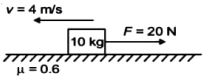
A block of mass $10 kg$ is moving on a rough surface as shown in figure. The frictional force acting on block is ...... $N$
A train whistling at constant frequency is moving towards a station at a constant speed $V$ . The train goes past a stationary observer on the station. The frequency $n'$ of the sound as heard by the observer is plotted as a function of time $t$ (Fig.) . Identify the expected curve