Forty electric bulbs are connected in series across a $220\, V$ supply. After one bulb is fused, the remaining $39$ are connected again in series across the same supply. The illumination will be
AIPMT 1989, Easy


Download our appand get started for free
Experience the future of education. Simply download our apps or reach out to us for more information. Let's shape the future of learning together!No signup needed.*
Similar Questions
- 1A potentiometer wire of length $L$ and a resistance $r$ are connected in series with a battery of e.m.f. $E_0$ and a resistance $r_1$. An unknown e.m.f. $E$ is balanced at a length $l$ of the potentiometer wire. The e.m.f. $E$ will be given byView Solution
- 2The heat developed in an electric wire of resistance $R$ by a current $I$ for a time $t$ isView Solution
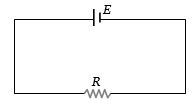
- 3Consider the circuit given here with the following parameters $E.M.F.$ of the cell = $12\, V$. Internal resistance of the cell $ = 2\,\Omega $. Resistance $R = 4\,\Omega $ Which one of the following statements in trueView Solution
- 4Two indentical electric lamps marked $500\, W, \,\,220\, V$ are connected in series and then joined to a $110\, V$ line. The power consumed by each lamp isView Solution
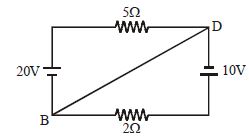
- 5Calculate the current in wire $BD$ ................ $A$View Solution
- 6For a wire $\frac{R}{l}=\frac{1}{2}$ and length of wire is $l=5\, cm .$ If potential difference $1\, V$ is applied across it, current through wire will be: $( R =$ Resistance $)$ (in $A$)View Solution
- 7$5$ amperes of current is passed through a metallic conductor. The charge flowing in one minute in coulombs will beView Solution
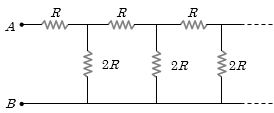
- 8An infinite ladder network is arranged with resistances $R$ and $2 R$ as shown. The effective resistance between terminals $A$ and $B$ isView Solution
- 9A charged particle having drift velocity of $7.5 \times 10^{-4}\, ms ^{-1}$ is an electric field of $3 \times 10^{-10}\, Vm ^{-1}$ has a mobility in $m ^{2} V ^{-1} s ^{-1}$ ofView Solution
- 10In the circuit shown below, The reading of the voltmeter $V$ is ...........View Solution