$5$ amperes of current is passed through a metallic conductor. The charge flowing in one minute in coulombs will be
Easy
Download our app for free and get started
(d) Charge $=$ Current $×$ Time $=$ $5 × 60 = 300\, C$

Download our appand get started for free
Experience the future of education. Simply download our apps or reach out to us for more information. Let's shape the future of learning together!No signup needed.*
Similar Questions
- 1When the power delivered by a $100\,volt$ battery is $40\,watts$ the equivalent resistance of the circuit is ........... $ohms$View Solution
- 2Resistance of the wire is measured as $2\,\Omega$ and $3\,\Omega$ at $10^{\circ}C$ and $30^{\circ}C$ respectively. Temperature cocoefficient of resistance of the material of the wire is............$^{\circ}C ^{-1}$View Solution
- 3An insulating pipe of cross-section area $'A'$ contains an electrolyte which has two types of ions $\rightarrow$ their charges being $-e$ and $+2e$. $A$ potential difference applied between the ends of the pipe result in the drifting of the two types of ions, having drift speed $= v$ ($-ve$ ion) and $v/4$ ($+ve$ ion). Both ions have the same number per unit volume $= n$. The current flowing through the pipe isView Solution
- 4A $60\, watt$ bulb operates on $220\,V$ supply. The current flowing through the bulb isView Solution
- 5Three resistors each of $4\,\Omega $ are connected together to form a network. The equivalent resistance of the network cannot be ............ $\Omega$View Solution
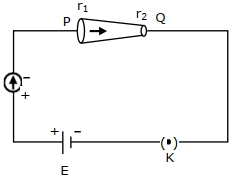
- 6In the given figure, a battery of emf $E$ is connnected across a conductor $P Q$ of length $'Y'$ and different area of cross-sections having radii $r_{1}$ and $r_{2}\left(r_{2}\,<\,r_{1}\right)$.View Solution
Choose the correct option as one moves from $P$ to $Q$ :
- 7In a building there are $15$ bulbs of $45\; \mathrm{W}, 15$ bulbs of $100\; \mathrm{W}, 15$ small fans of $10 \;\mathrm{W}$ and $2$ heaters of $1 \;\mathrm{kW}$. The voltage of electric main is $220\; \mathrm{V}$. The minimum fuse capacity (rated value) of the building will be: .......... $A$View Solution
- 8A $220\, volt$ and $800\, watt$ electric kettle and three $220\, volt$ and $100\, watt$ bulbs are connected in parallel. On connecting this combination with $220\, volt$ electric supply, the total current will be ................ $ampere$View Solution
- 9The power rating of an electric motor which draws a current of $3.75\, amperes$ when operated at $200\, V$ is aboutView Solution
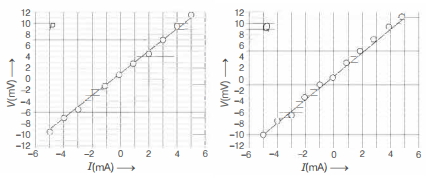
- 10Two students $P$ and $Q$ perform an experiment to verify Ohm's law for a conductor with resistance $R$. They use a current source and a voltmeter with least counts of $0.1 mA$ and $0.1 \,mV$, respectively. The plots of the variation of voltage drop $V$ across $R$ with current $I$ for both are shown below. The statement which is most likely to be correct?View Solution