MCQ
Forward biasing is that in which applied voltage:
- AIncreases potential barrier.
- BCancels the potential barrier.
- CIs equal to 1.5volt.
- DNone of these.
Generate a complete, print-ready paper with questions like this in minutes — across 16+ boards, with answer keys.
A symmetric double convex lens is cut in two equal parts by a plane containing the principal axis. If the power of the original lens was 4D, the power of a divided lens will be:
In the case of bar magnet, lines of magnetic induction
|
(a) Start from the north pole and end at the south pole |
|
(b) Run continuously through the bar and outside |
|
(c) Emerge in circular paths from the middle of the bar |
|
(d) Are produced only at the north pole like rays of light from a bulb |
Line spectrum was first of all theoretically explained by
|
(a) Swan |
(b) Fraunhofer |
(c) Kirchoff |
(d) Bohr |
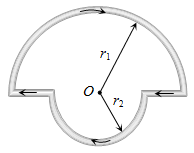
In the figure shown there are two semicircles of radii  and
and  in which a current i is flowing. The magnetic induction at the centre O will be
|
(a) |
(b) |
(c) |
(d) |
Find out the value of current through 2Ω resistance for the given circuit

|
(a) 5 A |
(b) 2 A |
(c) Zero |
(d) 4 A |
Assertion : X-rays cannot be diffracted by means of grating.
Reason : X-rays does not obey Bragg's law.
|
(a) If both assertion and reason are true and the reason is the correct explanation of the assertion. |
|
(b) If both assertion and reason are true but reason is not the correct explanation of the assertion. |
|
(c) If assertion is true but reason is false. |
|
(d) If the assertion and reason both are false. |
In the following Wheatstone bridge P/Q = R/S. If key K is closed, then the galvanometer will show deflection

|
(a) In left side |
(b) In right side |
(c) No deflection |
(d) In either side |


