MCQ
Four numbers are chosen at random ( without replacement ) from the set $\{1,2,3,..,20\}$

Statement $-1 :$ The probability that the chosen numbers when arranged in some order will form an $A.P.$ is $\frac{1}{{85}}$ . 

Statement $-2 :$ If the four chosen numbers form an $A.P.$, then the set of all possible values of common difference is $\left( { \pm 1, \pm 2, \pm 3, \pm 4, \pm 5} \right)$ છે.

  • A
    Statement $-1$ is true, Statement $-2$ is true; Statement $-2$ is a correct explanation for Statement $-1$
  • B
    Statement $-1$ is true, Statement $-2$ is true; Statement $-2$ is not a correct explanation for Statement $-1$
  • C
    Statement $-1$ is false, Statement $-2$ is true
  • Statement $-1$ is true, Statement $-2$ is false
Answer

Correct option: D.
Statement $-1$ is true, Statement $-2$ is false
d
(c) : Number of $A.P's$ with common difference $1=17$

Number of $A.P.'s$ with common difference $2=14$

Number of $A.P.'s$ with common difference $3=11$

Number of $A.P.'s$ with common difference $4=8$

Number of $A.P.'s$ with common difference $5=5$

Number of $A.P.'s$ with common difference $6 = \frac{2}{{57}}$

The total number of ways $n(S) = {\,^{20}}{{\rm{C}}_4}$

The desired probability $= \frac{{57}}{{^{20}{{\rm{C}}_4}}}$

$ = \frac{{57 \times 24}}{{20 \times 19 \times 18 \times 17}} = \frac{1}{{85}}$

Now statement- $2$ is false and statement- $1$ is true.

Need a full question paper?

Generate a complete, print-ready paper with questions like this in minutes — across 16+ boards, with answer keys.

Start Generating Free

Similar questions

Let $\lambda \in Z, \vec{a}=\lambda \hat{i}+\hat{j}-\hat{k}$ and $\vec{b}=3 \hat{i}-\hat{j}+2 \hat{k}$. Let $\overrightarrow{ c }$ be a vector such that $(\vec{a}+\vec{b}+\vec{c}) \times \vec{c}=\overrightarrow{0}, \vec{a} \cdot \vec{c}=-17$ and $\vec{b} \cdot \vec{c}=-20$ Then $|\overrightarrow{ c } \times(\lambda \hat{i}+\hat{j}+\hat{ k })|^2$ is equal to
$\int_{}^{} {\frac{{{{(1 + \log x)}^2}}}{x}} \;dx = $
The value of $\tan \left( {{{\tan }^{ - 1}}\frac{1}{2} - {{\tan }^{ - 1}}\frac{1}{3}} \right)$ is
Function $f(x) = \frac{{\left| {x - 1} \right|}}{{{x^2}}}$ is monotonic decreasing in-
If $y = {(\tan x)^{\cot x}}$, then ${{dy} \over {dx}} =$
${\cot ^{ - 1}}\left[ {\frac{{\sqrt {1 - \sin x} + \sqrt {1 + \sin x} }}{{\sqrt {1 - \sin x} - \sqrt {1 + \sin x} }}} \right] = $
Let $y = y ( x )$ be the solution of the differential equation $\cos x \frac{d y}{d x}+2 y \sin x=\sin 2 x$ $x \in\left(0, \frac{\pi}{2}\right) .$ If $y (\frac{\pi}{3})=0,$ then $y (\frac{\pi}{4})$ is equal to 
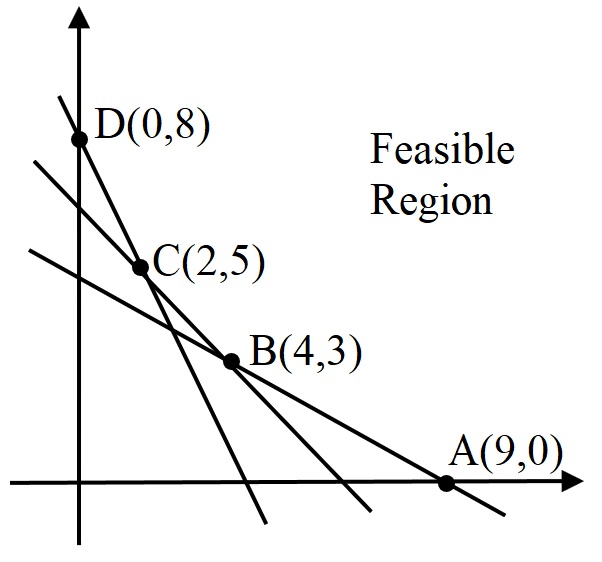
The feasible region for an LPP is shown shaded in the following figure. Minimum of Z = 4x + 3y occurs at the point.

Choose the correct answer from the given four options.

If $\text{P}(\text{A}\cap\text{B})=\frac{7}{10},$ and $\text{P}(\text{B})=\frac{17}{20},$ then $\text{P}\Big(\frac{\text{A}}{\text{B}}\Big)$ equas:

  1. $\frac{14}{17}$

  2. $\frac{17}{20}$

  3. $\frac{7}{8}$

  4. $\frac{1}{8}$

If $f\left( {\frac{{3x - 4}}{{3x + 4}}} \right) = x + 2,\,x \ne -\frac{4}{3}$ , and $\int {f\left( x \right)dx = A\,\log \left| {1 - x} \right| + Bx + C} $ , then the ordered pair $(A,B) $ is equal to : (where $C$ is a constant of integration)