Question
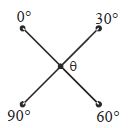
Four rods of same material and having the same cross section and length have been joined, as shown. The temperature of junction of four rods will be........ $^oC$
Answer

$\frac{{{\rm{KA}}(90 - \theta )}}{l} = \frac{{{\rm{KA}}(\theta  - 30)}}{l} + \frac{{{\rm{KA}}(\theta  - {\rm{0}})}}{l} + \frac{{{\rm{KA}}(\theta  - 60)}}{l}$

$90-\theta=3 \theta-90^{\circ}$

$\theta=45^{\circ}$ $C$

Need a full question paper?

Generate a complete, print-ready paper with questions like this in minutes — across 16+ boards, with answer keys.
Start Generating Free

Similar questions

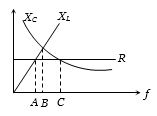
The figure shows variation of $R, X_L$ and $X_C$ with frequency f in a series $L, \,C, \,R $ circuit. Then for what frequency point, the circuit is inductive
An organ pipe is closed at one end has fundamental frequency of $1500 Hz$. The maximum number of overtones generated by this pipe which a normal person can hear is :
When a certain length of wire is turned into one circular loop, the magnetic induction at the centre of coil due to some current flowing is ${B_1}$ If the same wire is turned into three loops to make a circular coil, the magnetic induction at the center of this coil for the same current will be
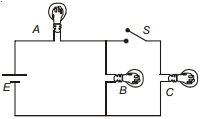
Three identical bulbs are connected as shown in figure. When switch $S$ is closed, the power consumed in bulb $B$ is $P$. What will be the power consumed by the same bulb when switch $S$ is opened?
The electric potential $V(x)$ in a region around the origin is given by $V(x) = 4x^2\,volts$ . The electric charge enclosed in a cube of $1\,m$ side with its centre at the origin is (in coulomb)
The initial velocity of a particle is $u\left(\right.$ at $t=0$ ) and the acceleration a is given by $\alpha t^{3 / 2}$. Which of the following relations is valid?
If $\lambda_1$ and $\lambda_2$ denote the wavelengths of de Broglie waves for  electrons in the first and second Bohr orbits in a hydrogen atom, then $\lambda_1/\lambda_2$ is equal to 
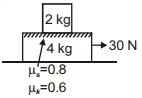
Figure shows two block system, $4 \,kg$ block rests on a smooth horizontal surface, upper surface of $4 \,kg$ is rough. A block of mass $2 \,kg$ is placed on its upper surface. The acceleration of upper block with respect to earth when $4 \,kg$ mass is pulled by a force of $30 \,N$, is ......... $m / s ^2$
A ball is released from the top of a tower of height $h$ meters. It takes $T\, seconds$ to reach the ground. What is the position of the ball at $\frac{T}{3}\, second$
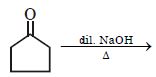
major product is ?