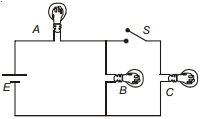
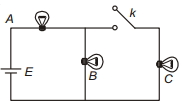
Three identical bulbs are connected as shown in figure. When switch $S$ is closed, the power consumed in bulb $B$ is $P$. What will be the power consumed by the same bulb when switch $S$ is opened?
Medium


Download our appand get started for free
Experience the future of education. Simply download our apps or reach out to us for more information. Let's shape the future of learning together!No signup needed.*
Similar Questions
- 1In a potentiometer arrangement, a cell of emf $1.20\, V$ gives a balance point at $36\, cm$ length of wire. This cell is now replaced by another cell of emf $1.80\, V$. The difference in balancing length of potentiometer wire in above conditions will be $....cm$.View Solution
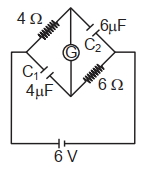
- 2A galvanometer $(G)$ $\Omega$ of 2 risistance is connected in the givn circuit the raito of charge in $C_1$ and $C_2$ is:View Solution
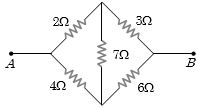
- 3Five resistances are connected as shown in the figure. The effective resistance between the points $A$ and $B$ isView Solution
- 4Two resistances equal at $0\,^oC$ with temperature coefficient of resistance $\alpha _1$ and $\alpha _2$ joined in series act as a single resistance in a circuit. The temperature coefficient of their single resistance will beView Solution
- 5Two cells of $e.m.f.$ $E_1$ and $E_2$ are joined in series and the balancing length of the potentiometer wire is $625$ $cm$. If the terminals of $E_1$ are reversed, the balancing length obtained is $125 \,cm$. Given $E_2 > E_1$, the ratio $E_1: E_2$ will beView Solution
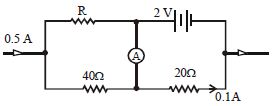
- 6In the circuit shown in the figure, no current flows through the ideal ammeter. If the internal resistance of the cell is negligible, the value of unknown resistance $R $ is .............. $\Omega$View Solution
- 7A cell having an emf $\varepsilon$ and internal resistance $r$ is connected across a variable external resistance $R.$ As the resistance $R$ is increased, the plot of potential difference $V$ across $R$ is given byView Solution
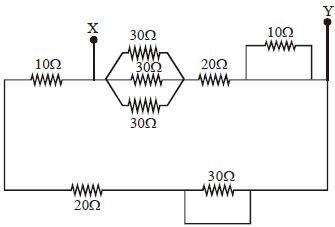
- 8Net resistance between $X$ and $Y$ is ............... $\Omega$View Solution
- 9View SolutionTo draw maximum current from a combination of cells, how should the cells be grouped
- 10At what temperature will the resistance of a copper wire become three times its value at $0\,^oC$ ................. $^oC$ (Temperature coefficient of resistance for copper = $4 × 10^{-3} \,per\, \,^oC$ )View Solution