Question
From the following cumulative frequency table , find :
Median
Lower quartile
Upper quaetile
 
Marks (less than ) 10 20 30 40 50 60 70 80 90 100
Cumulative frequency 5 24 37 40 42 48 70 77 79 80

Answer

Marks (less than) Cumulative frequency
10 5
20 24
30 37
40 40
50 42
60 48
70 70
80 77
90 79
100 80
Number of terms= 80
Median= $40^{th}$term

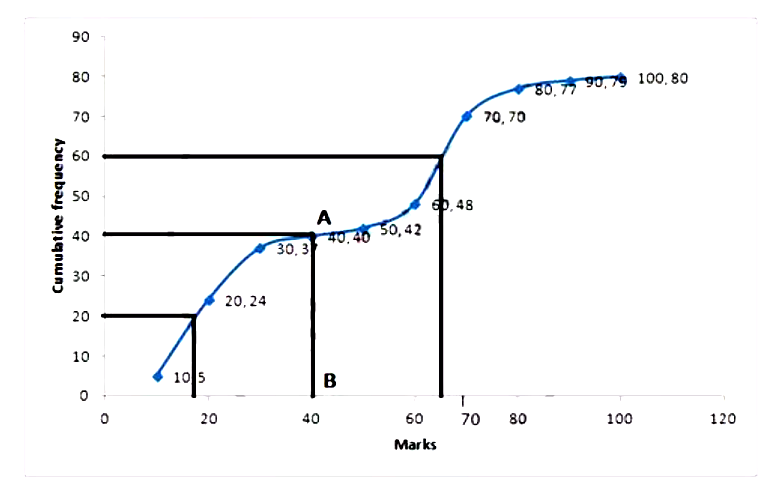
Median= Through $40^{th}$ term mark draw a line parallel to the x-axis which meets the curve at A. from A, Draw a perpendiculer to axis which meets it at B.
Value of B is the median - 40
Lower quartile $(Q_1) = 20^{th}$ term=18
Upeer Quartile $(Q_3) = 60^{th}$ term = 66

Need a full question paper?

Generate a complete, print-ready paper with questions like this in minutes — across 16+ boards, with answer keys.

Start Generating Free

Similar questions

In an examination, the ratio of passes to failures was 4 : 1. If 30 less had appeared and 20 less passed, the ratio of passes to failures would have been 5 : 1. How many students appeared for the examination
If a, b, c, d are in continued proportion, prove that:
$\sqrt{a b}-\sqrt{b c}+\sqrt{c d}=\sqrt{(a-b+c)(b-c+d)}$
Find the equation of the line which is perpendicular to the line $\frac{x}{a}-\frac{y}{b}=1$ at the point where this line meets $y-$ axis.
Without using trigonometrical tables, evaluate:$\operatorname{cosec} 257^{\circ}-\tan ^2 33^{\circ}+\cos 44^{\circ} \operatorname{cosec} 46^{\circ}-\sqrt{2} \cos 45^{\circ}-\tan ^2 60^{\circ}$
Without solving the following quadratic equation, find the value of 'm' for which the given equation has real and equal roots.
$x^2+ 2 (m - 1) x + (m + 5) = 0.$
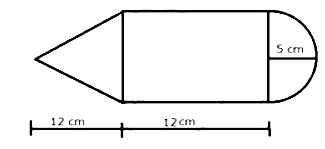
The given figure shows the cross $-$ section of a cone, a cylinder and a hemisphere all with the same diameter $10 \ cm$ and the other dimensions are as shown. Calculate: the total volume of the solid.
Draw an inscribing circle of a regular hexagon of side 5.8 cm.
Solve each of the following equations using the formula:
$\frac{x-1}{x-2}+\frac{x-3}{x-4}=3 \frac{1}{3}$
A fast train takes $3$ hours less than a slow train for a journey of $600\ kms.$ If the speed of the slow train is $1$ Okm/ hr less than the fast train, find the speed of the fast train.
A polynomial $f(x)v when divided by $(x - 1)$ leaves a remainder $3$ and when divided by $(x - 2)$ leaves a remainder of $1.$ Show that when its divided by $(x - i)(x - 2),$ the remainder is $(-2x + 5).$