Question
From the following information, calculate Inventory Turnover Ratio:
Operating Ratio and Working Capital Turnover Ratio: Opening Inventory ₹ 28,000; Closing Inventory ₹ 22,000; Purchases ₹ 46,000; Revenue from Operations, i.e., Net Sales ₹ 80,000; Return ₹ 10,000; Carriage Inwards ₹ 4,000; Office Expenses ₹ 4,000; Selling and Distribution Expenses ₹ 2,000; Working Capital ₹ 40,000.
Answer

  1. Opening Inventory = 28,000
Closing Inventory = 22,000
Average Inventory = $\frac{\text{Opening Inventory + Closing Inventory}}{2}$
$=\frac{28,000 + 22,000}{2}=₹\ 25,000$
Cost of Goods Sold = Opening Inventory + Purchases + Carriage Inwards - Closing Inventory
= 28,000 + 46,000 + 4,000 - 22,000 = 56,000
Inventory Turnover Ratio $=\frac{\text{Cost of Goods Sold}}{\text{Average Inventory }}=\frac{56,000}{25,000} = 2.24 \ \text{Times}$
  1. Operating Expenses = Office Expenses + Selling and Distribution Expenses
= 4,000 + 2,000 = 6,000
Operating Cost = Cost of Goods Sold + Operating Expenses
= 56,000 + 6,000 = 62,000
Net Sales = ₹ 80,000
Operating Ratio = $\frac{\text{Operating Cost}}{\text{Net Sales}}\times100$
$=\frac{62,000}{80,000}\times100=77.5\%$
  1. Working Capital = 40,000
Working Capital Turnover Ratio = $\frac{\text{Net Sales}}{\text{Working Capital}}$
$=\frac{80,000}{40,000}=2\text{ Times}$
Note: Sales return will not be considered as amount of net sales is provided in the question.

Need a full question paper?

Generate a complete, print-ready paper with questions like this in minutes — across 16+ boards, with answer keys.

Start Generating Free

Similar questions

From the following Statement of Profit and Loss of Star Ltd. for the years ended 31st March 2018 and 2017 prepare a comparative statement of Profit & Loss:

From the above Comparative Statement of Profit and loss for the year ended 31st March, 2017 and 31st March, 2018, compute Net Profit ratio.
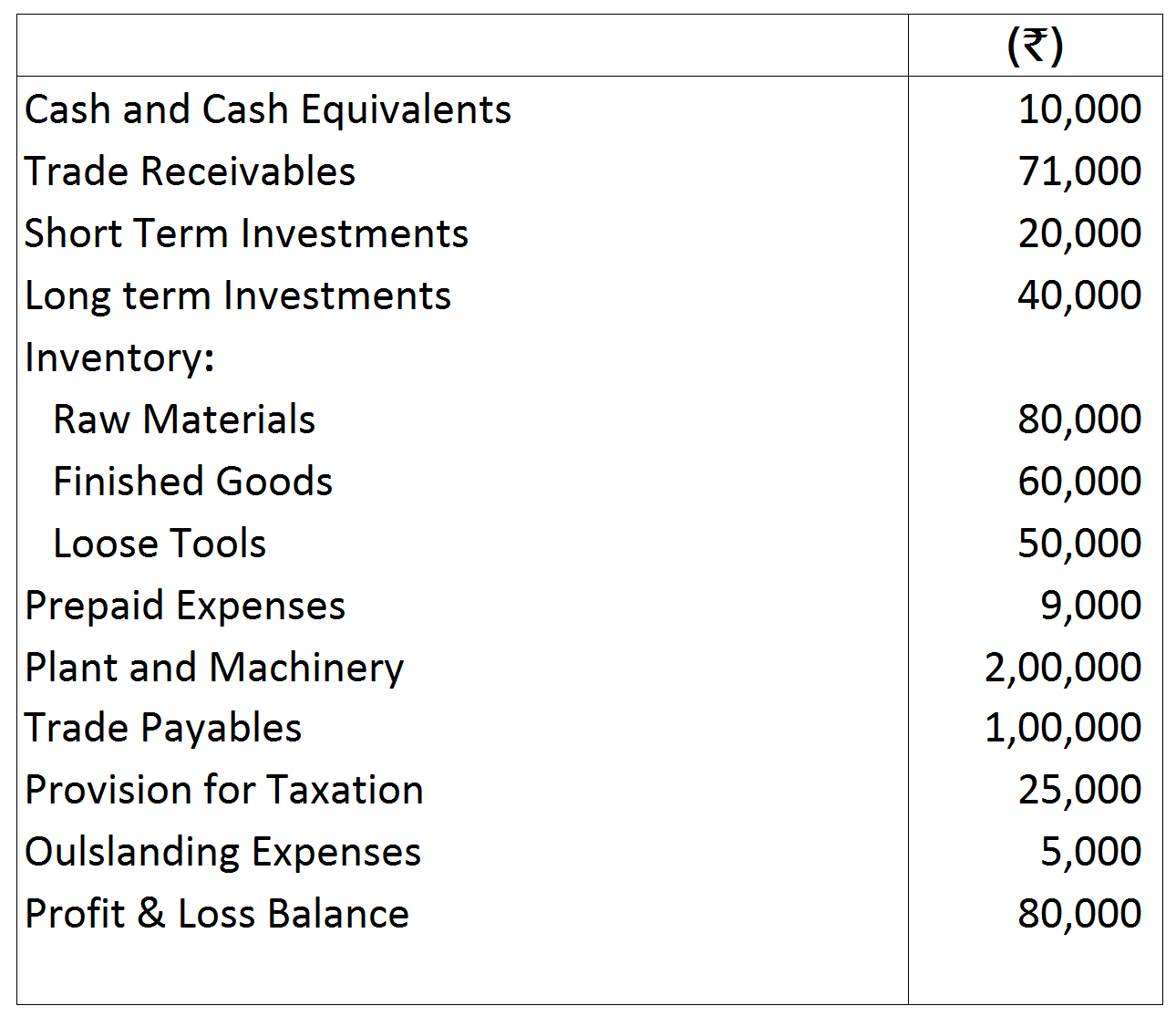
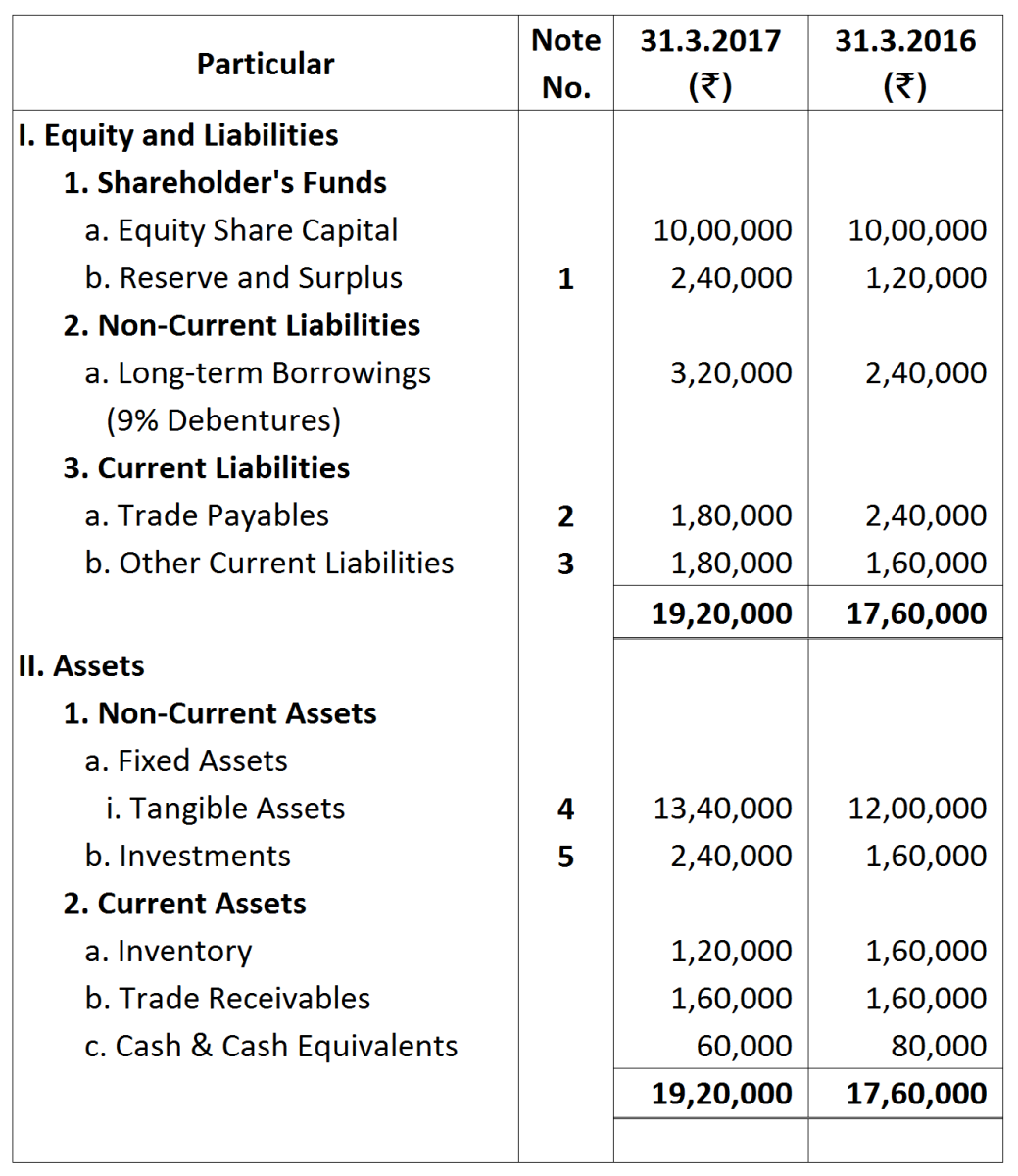
Calculate Current Ratio and Quick Ratio from the following. Also give your opinion about the short term financial position of the company:-
Describe the provisions of law relating to ‘Calls-in-Arrears’ and ‘Calls-in-Advance’.
State giving reason, whether the Current Ratio will improve or decline or will have no effect in each one of the following transactions if Current Ratio is (I) 2.5 : 1, (II) 1 : 1, (III) 0.75 : 1.
  1. Paid ₹ 50,000 to a Creditor.
  2. Sale of goods at a loss of 10%.
  3. Sale of a fixed asset for ₹ 1,00,000 (Book Value ₹ 1,20,000).
  4. Payment of outstanding salaries.
  5. Received ₹ 25,000 from a Debtor of ₹ 30,000 in full settlement of his account.
  6. Bills payable discharged on maturity.
  7. Bills Receivable drawn on debtor.
  8. Purchased goods on credit.
  9. Issued debentures to the vendors of machinery.
X Ltd. invited applications for 10,000 Equity Shares of ₹ 10 each for public subscription. The amount of these shares was payable as:
On application ₹ 1 per share, on allotment ₹ 2 per share, on first call ₹ 3 per share and on second and final call ₹ 4 per share.
All sums payable on application, allotment and calls were duly received with the following exceptions:
  1. A, who held 200 shares, failed to pay the money on allotments and calls.
  2. B, to whom 150 shares were allotted, failed to pay the money on first call and final call.
  3. C, who held 50 shares, did not pay the amount of second and final call.
The shares of A, B and C were forfeited and were subsequently reissued for cash as fully paid-up at a discount of 5%.
Pass necessary journal entries to record these transactions in the books of X Ltd.
X Limited offered to the public 10,000 equity shares of ₹ 10 each at a premium of ₹ 2 per share payable as follows:
On application ₹ 3; On allotment (including premium) ₹ 4; On first call ₹ 3 and on second and final call ₹ 2.
Applications were received for 15,000 shares.
All applications were placed under four categories and allotment was made as follows:
Category A
to applicants of 4,000 shares
in full
Category B
to applicants of 6,000 shares
4,000 shares
Category C
to applicants of 3,000 shares
2,000 shares
Category D
to applicants of 2,000 shares
Nil
Except in the cases where applications were wholly rejected, excess application money was not to be refunded but to be adjusted against moneys due on allotment and calls.
A, an applicant under category B to whom 400-shares were allotted failed to pay the allotment money and on his failure to pay the first call his shares were forfeited.
B, an applicant under category C to whom 300 shares were allotted failed to pay both the calls and his shares were also forfeited.
500 of the shares thus forfeited were re-issued to C as fullypaid for ₹ 8 per share.
Show Cash Book, Journal entries and prepare the Balance Sheet in the: books of the company; you are to assume that the whole of the A's shares were issued to C.
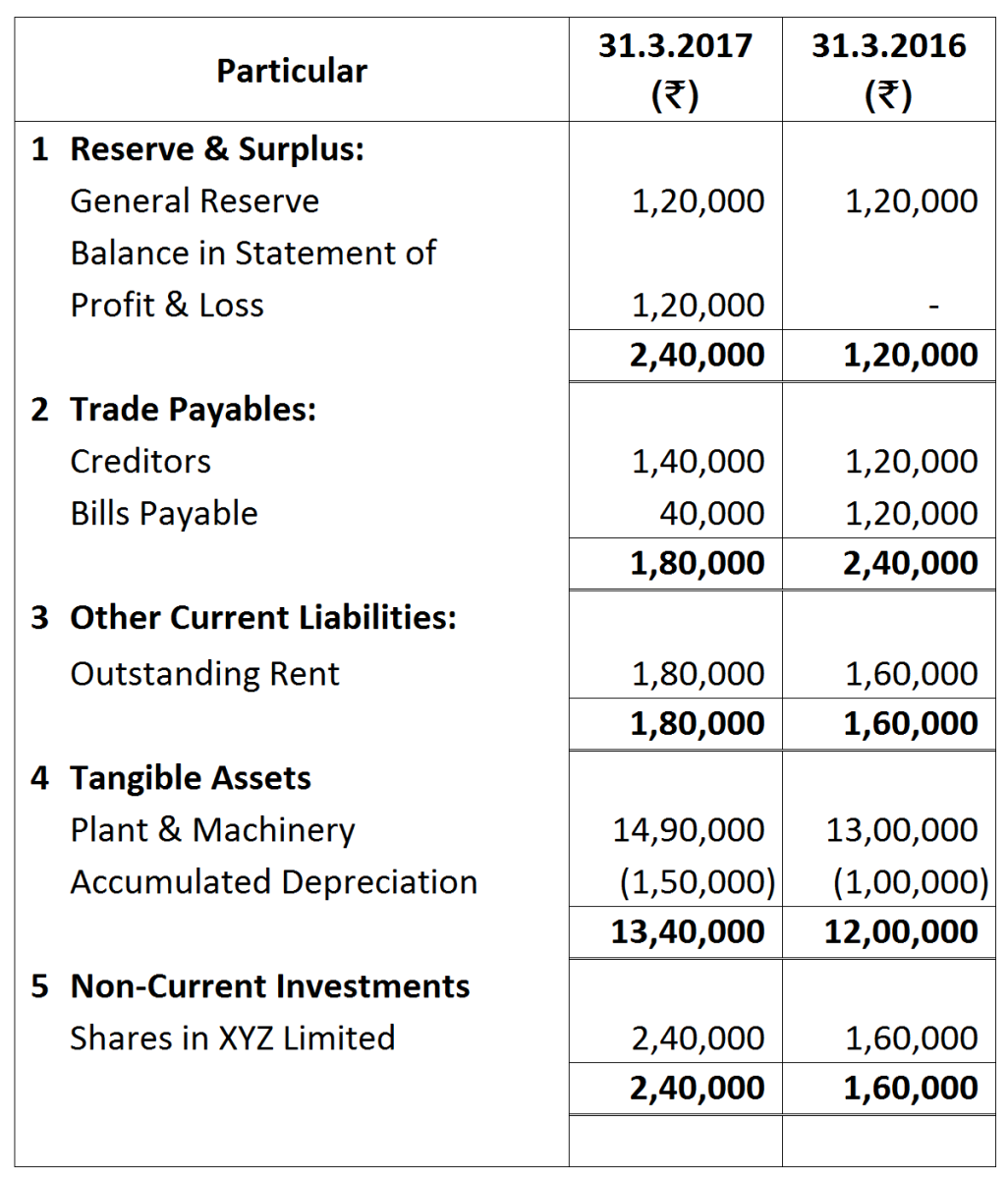
From the following Balance Sheet of Ajanta Limited as at March 31, 2017, prepare a Cash Flow Statement:

Notes to Accounts:

Additional Information:
During the year 2016-17, a machinery costing ₹ 50,000 and accumulated depreciation thereon ₹ 15,000 was sold for ₹ 32,000
9 % Debentures ₹ 80,000 were issued on April 1, 2016.
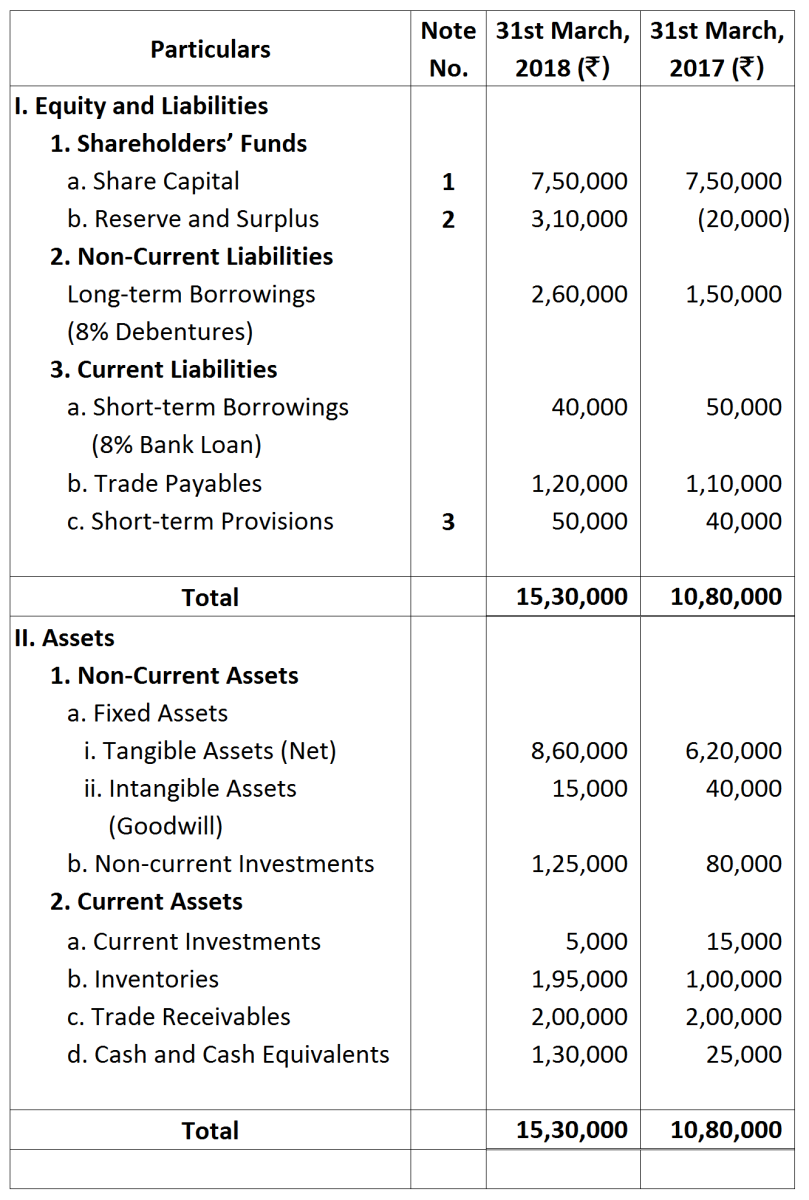
From the following Balance Sheet of Samta Ltd., as at 31st March, 2018, prepare Cash Flow Statement.
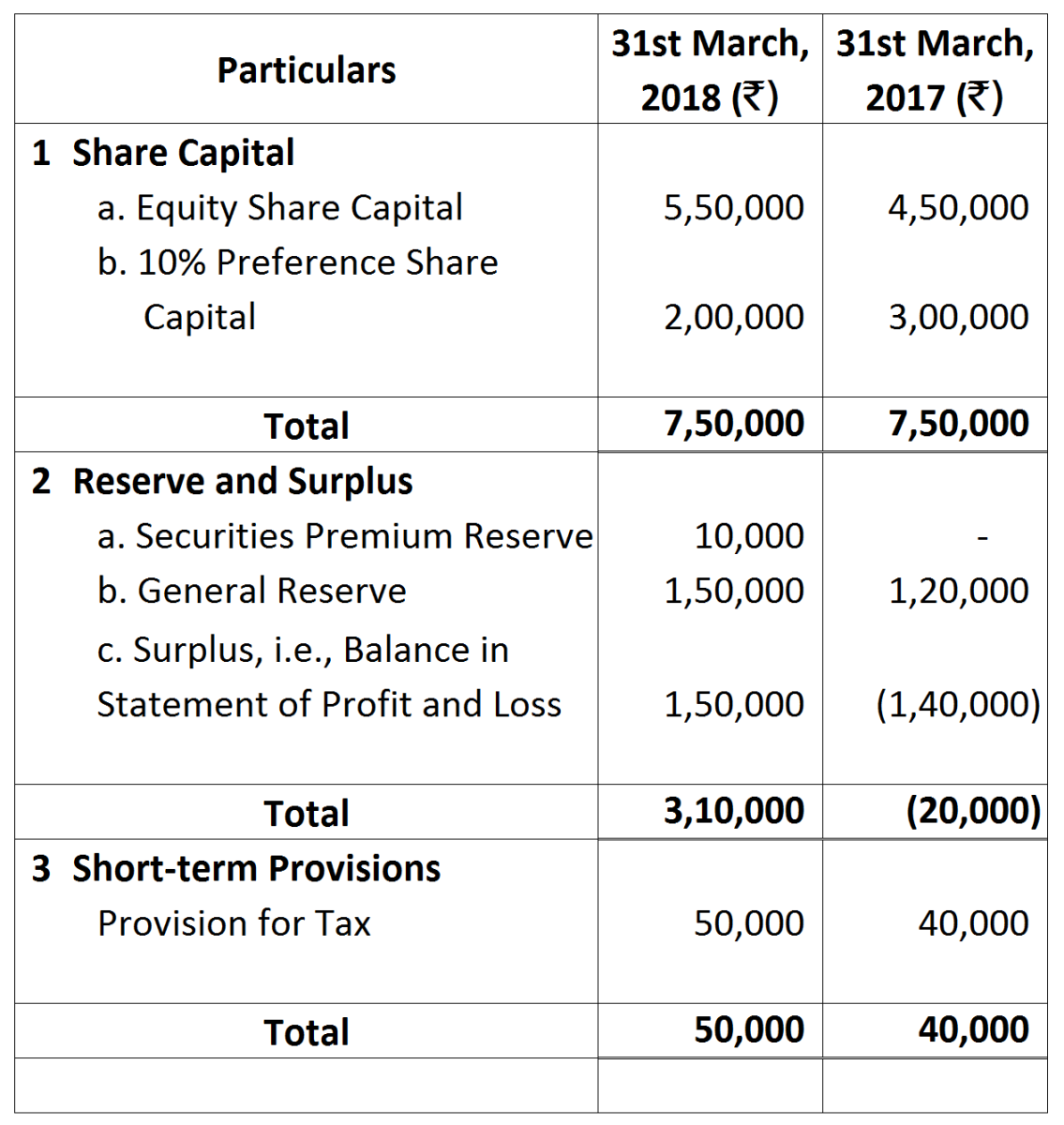
Note to Accounts:
Additional Information:
  1. During the year a piece of machinery costing ₹ 60,000 on which depreciation charged was ₹ 20,000 was sold at 50% of its book value. Depreciation provided on tangible Assets ₹ 60,000.
  2. Income tax ₹ 45,000 was provided.
  3. Additional Debentures were issued at par on 1st October, 2017 and Bank Loan was repaid on the same date.
  4. At the end of the year Preference Shares were redeemed at a premium of 5%.
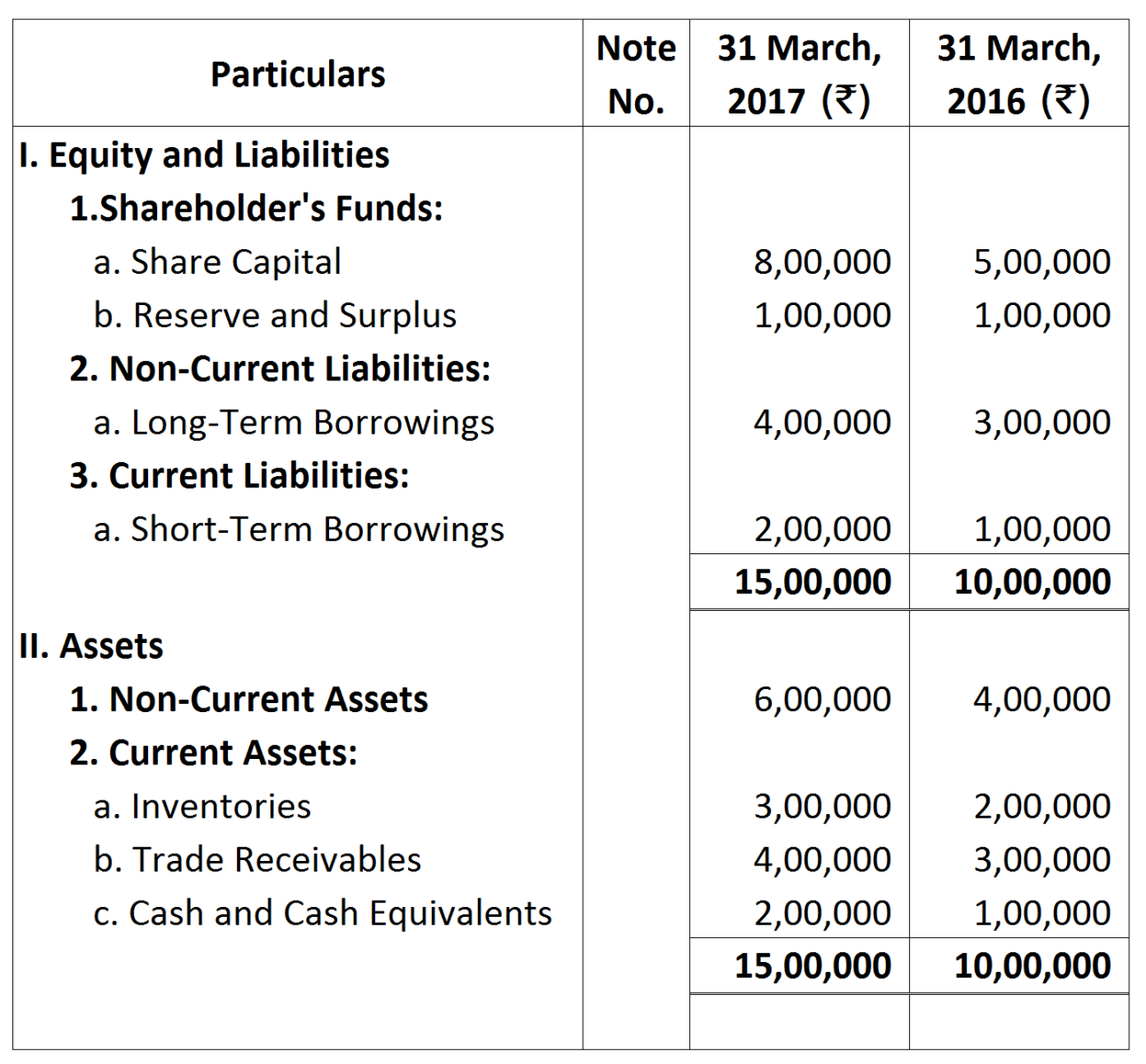
From the following Balance Sheets of Royal Industries as at 31st March, 2017 and 2016, prepare a comparative Balance Sheet: