Question
State giving reason, whether the Current Ratio will improve or decline or will have no effect in each one of the following transactions if Current Ratio is (I) 2.5 : 1, (II) 1 : 1, (III) 0.75 : 1.
  1. Paid ₹ 50,000 to a Creditor.
  2. Sale of goods at a loss of 10%.
  3. Sale of a fixed asset for ₹ 1,00,000 (Book Value ₹ 1,20,000).
  4. Payment of outstanding salaries.
  5. Received ₹ 25,000 from a Debtor of ₹ 30,000 in full settlement of his account.
  6. Bills payable discharged on maturity.
  7. Bills Receivable drawn on debtor.
  8. Purchased goods on credit.
  9. Issued debentures to the vendors of machinery.
Answer

S. No.
Effect on Current Ratio:
Reasons
If
Current
Ratio is
2.5 : 1
If
Current
Ratio is
1 : 1
If
Current
Ratio is
0.75 : 1
i.
Improve
No effect
Decline
Both the Current Assets and Current Liabilities are decreased by the same amount.
ii.
Decline
Decline
Decline
Current Assets are decreased by the amount of loss but Current Liabilities remain unchanged.
iii.
Improve
Improve
Improve
Current Assets are increased by ₹ 1,00,000 but Current Liabilities remain unchanged.
iv.
Improve
No effect
Decline
Both the Current Assets and Current Liabilities are decreased by the same amount.
v.
Decline
Decline
Decline
Current Assets are decreased by ₹ 5,000 but Current Liabilities remain unchanged.
vi.
Improve
No effect
Decline
Both the Current Assets and Current Liabilities are decreased by the same amount.
vii.
No effect
No effect
No effect
One Current Asset (Debtor) is converted into another Current Asset (B/R).
viii.
Decline
No effect
Improve
Both the Current Assets and Current Liabilities will increase by the same amount.
ix.
No effect
No effect
No effect
Neither the Current Assets nor the Current Liabilities are affected.

Need a full question paper?

Generate a complete, print-ready paper with questions like this in minutes — across 16+ boards, with answer keys.

Start Generating Free

Similar questions

From the information given below, calculate Trade Receivables Turnover Ratio:
Credit Revenue from Operations, i.e., Credit Sales ₹ 8,00,000; Opening Trade Receivables ₹ 1,20,000 and Closing Trade Receivables ₹ 2,00,000. State giving reason, which of the following would increase, decrease or not change Trade Receivables Turnover Ratio:
  1. Collection from Trade Receivables ₹ 40,000.
  2. Credit Revenue from Operations, i.e., Credit Sales ₹ 80,000.
  3. Sales Return ₹ 20,000.
  4. Credit Purchase 1, ₹ 60,000.
A Ltd was registered with a capital of ₹ 5,00,000 in shares of ₹ 10 each and issued 20,000 such shares at a premium of ₹ 2 per share, payable as ₹ 2 per share on application, ₹ 5 per share on allotment (including premium) and ₹ 2 per share on first call made three months later. All the money payable on application and allotment was duly received but when the first call was made, one shareholder paid the entire balance on his holding of 300 shares and another shareholder holding 1,000 shares failed to pay the first call money.
Pass journal entries to record the above transactions and show how they will appear in the company's Balance Sheet.
Sony Media Ltd.issued 50,000 shares of ₹ 10 each payable ₹ 3 on application, ₹ 4 on allotment and balance on first and final call. Applications were received for 1,00,000 shares and allotment was made as follows:
  1. Applicants for 60,000 shares were allotted 30,000 shares,
  2. Applicants for 40,000 shares were allotted 20,000 shares,
Anupam to whom 1,000 shares were allotted from category,
  1. Failed to pay the allotment money. Pass journal entries up to allotment.
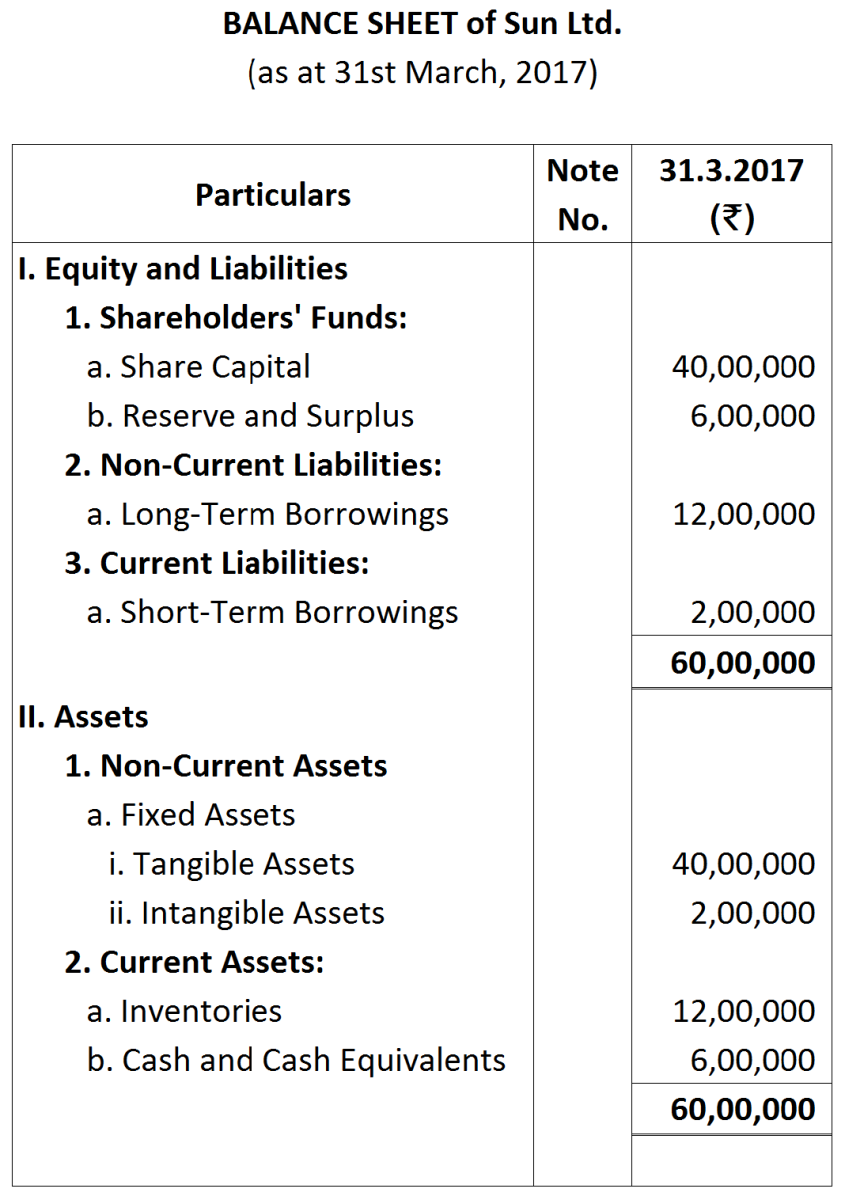
From the following Balance Sheets of Sun Ltd., as at 31st March, 2017 prepare a common size Balance Sheet.
Mohit Glass Ltd. issued 20,000 shares of ₹ 100 each at ₹ 110 per share, payable ₹ 30 on application, ₹ 40 on allotment (including Premium), ₹ 20 on first call and ₹ 20 on final call. The applications were received for 24,000 shares and allotted 20,000 shares and reject 4,000 shares and amount returned thereon. The money was duly received.
Pass necessary journal entries in the books of Varun Ltd. for the following transactions:
  1. Issued 58,000, 9% debentures of Rs. 1,000 each at a premium of 10%.
  2. Converted 350, 9% debentures of Rs. 100 each into equity shares of Rs. 10 each issued at a premium of 25%.
  3. Redeemed 450, 9% debentures of Rs. 100 each by draw of lots.
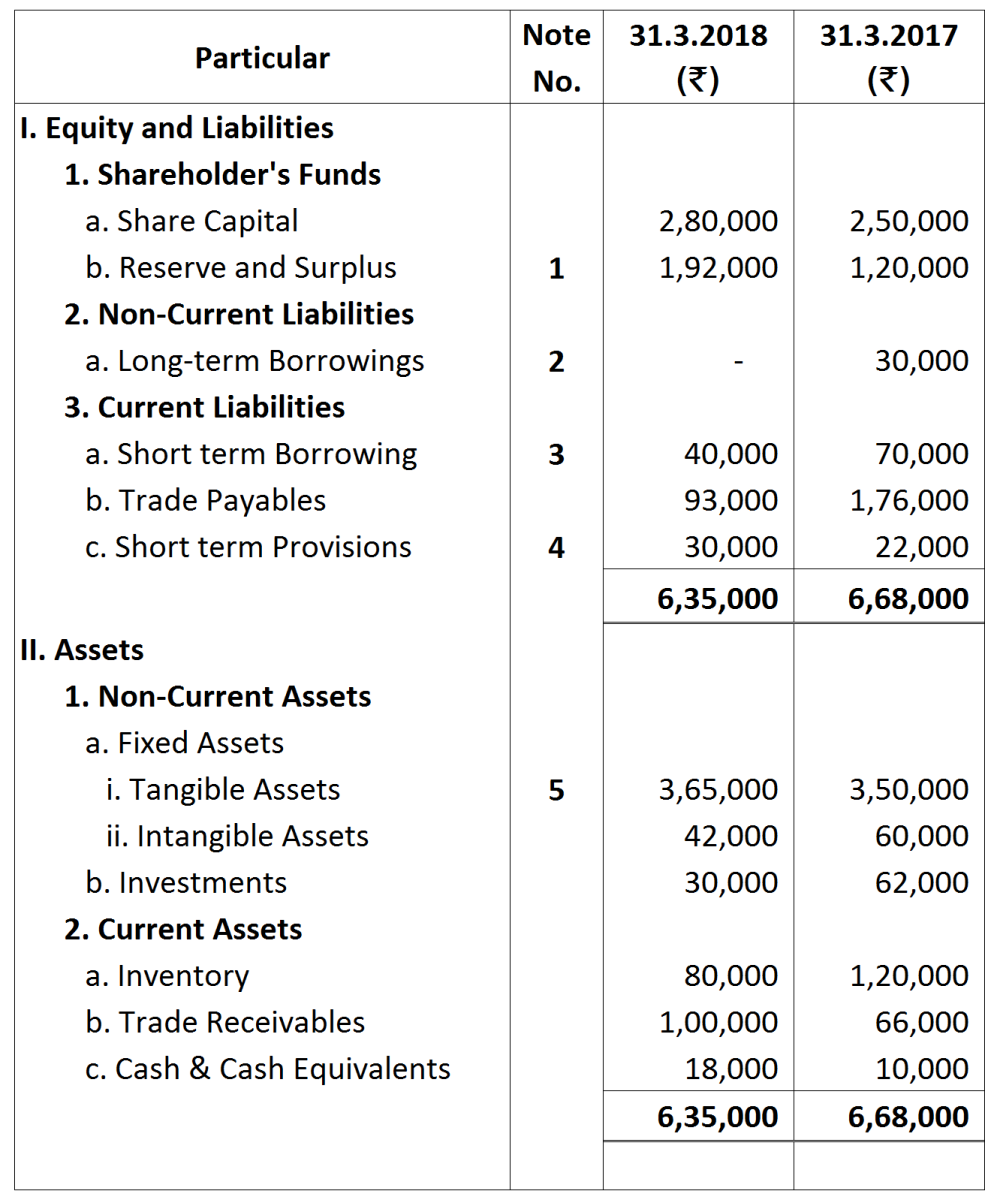
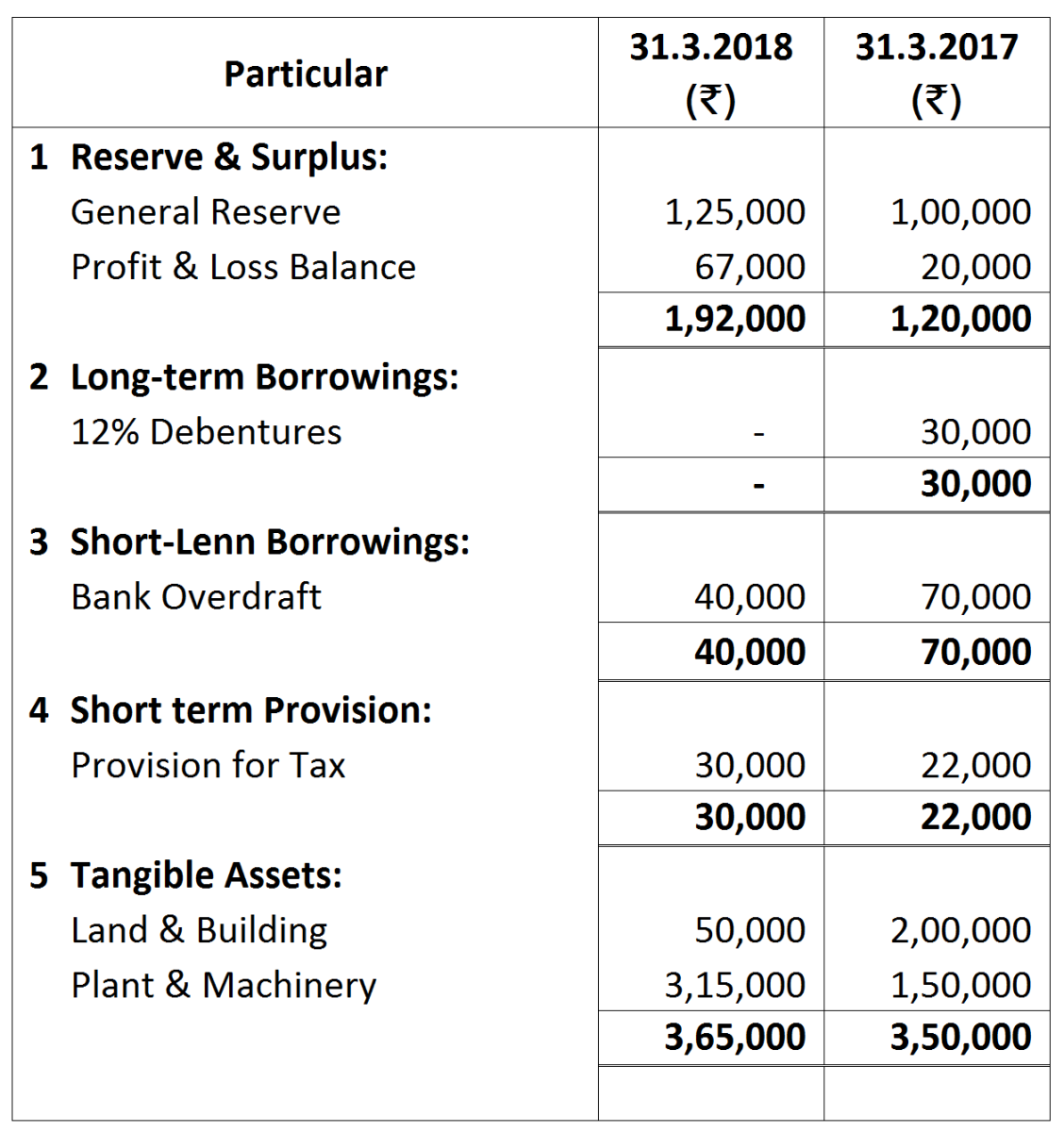
Prepare a Cash-Flow Statement from the following Balance Sheets of Garden Honey Ltd.
Notes: Debentures were redeemed on 1st April, 2017
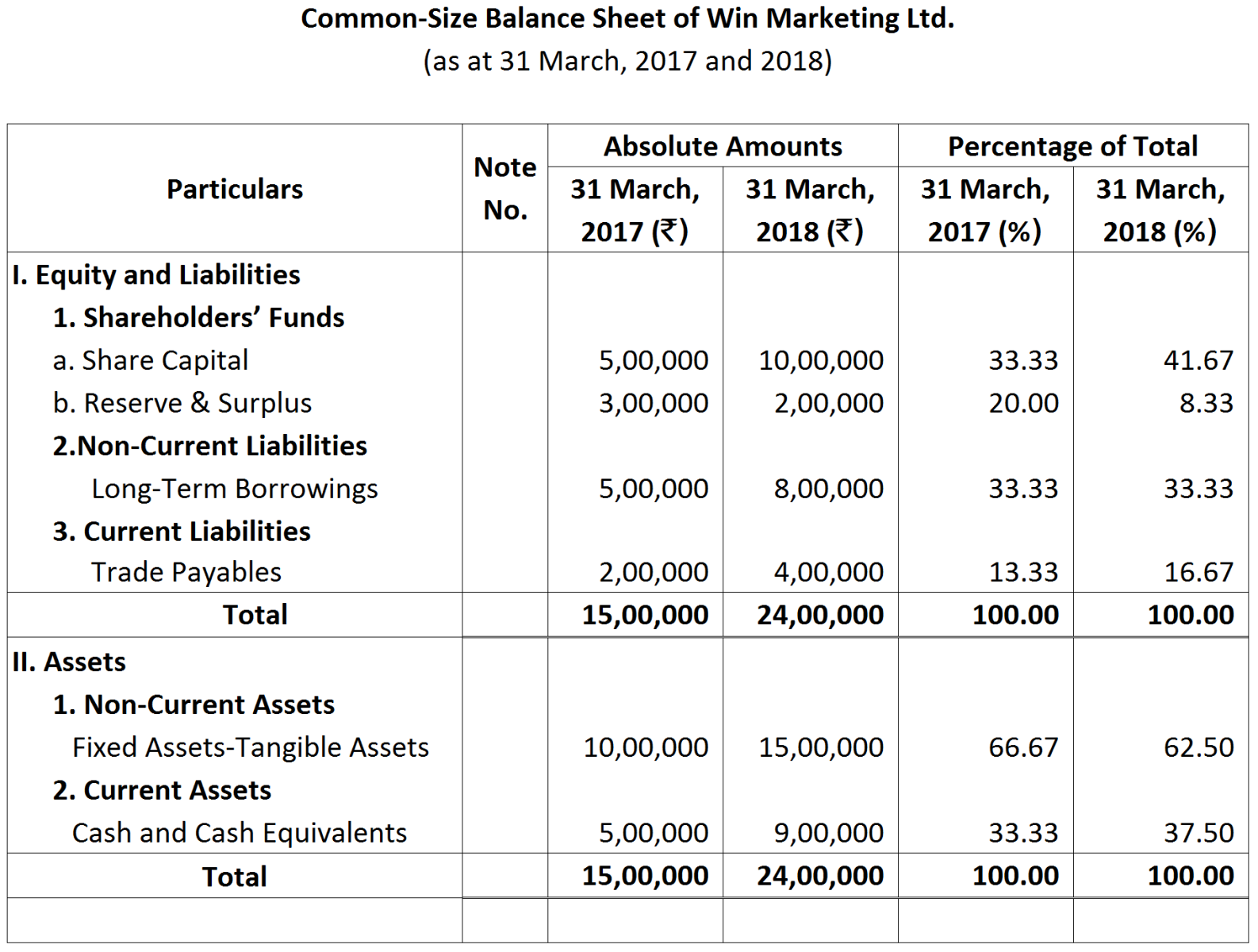
From the above Common-size Balance Sheet as at 31st March, 2018, compute current Ratio, Quick Ratio, Total Assets to Debt Ratio, and Dept to Equity Ratio.
Under which heads will the following items be shown in the Balance Sheet of a company:
  1. Bank Balance.
  2. Investments (Long-term).
  3. Outstanding Salary.
  4. Authorised Capital.
  5. Bills Payable.
  6. Unclaimed Dividends.
  7. Shares Option Outstanding Account.
  8. General Reserve.
  9. Subsidy Reserve?
R.K. Ltd. invited applications for issuing 70,000 Equity Shares off ₹ 10 each at a premium of ₹ 35 per share. The amount was payable as follows:
On Application
₹ 15 (including ₹ 12 premium)
On Allotment
₹ 10 (including ₹ 8 premium)
On First and Final Call
Balance
Applications for 65,000 shares were received and allotment was made to all the applicants. A shareholder, Ram, who was allotted 2,000 shares, failed to pay the allotment money. His shares were forfeited immediately after allotment Afterwards, the first and final call was made Sohan who had 3,000 shares failed to pay the first and final call. His shares were also forfeited. Out of the forfeited shares, 4,000 shares were re-issued at ₹ 50 per share fully paid up. The re-issued shares included all the shares of Ram.
Pass necessary journal entries for the above transactions in the books of R.K. Ltd.