Question
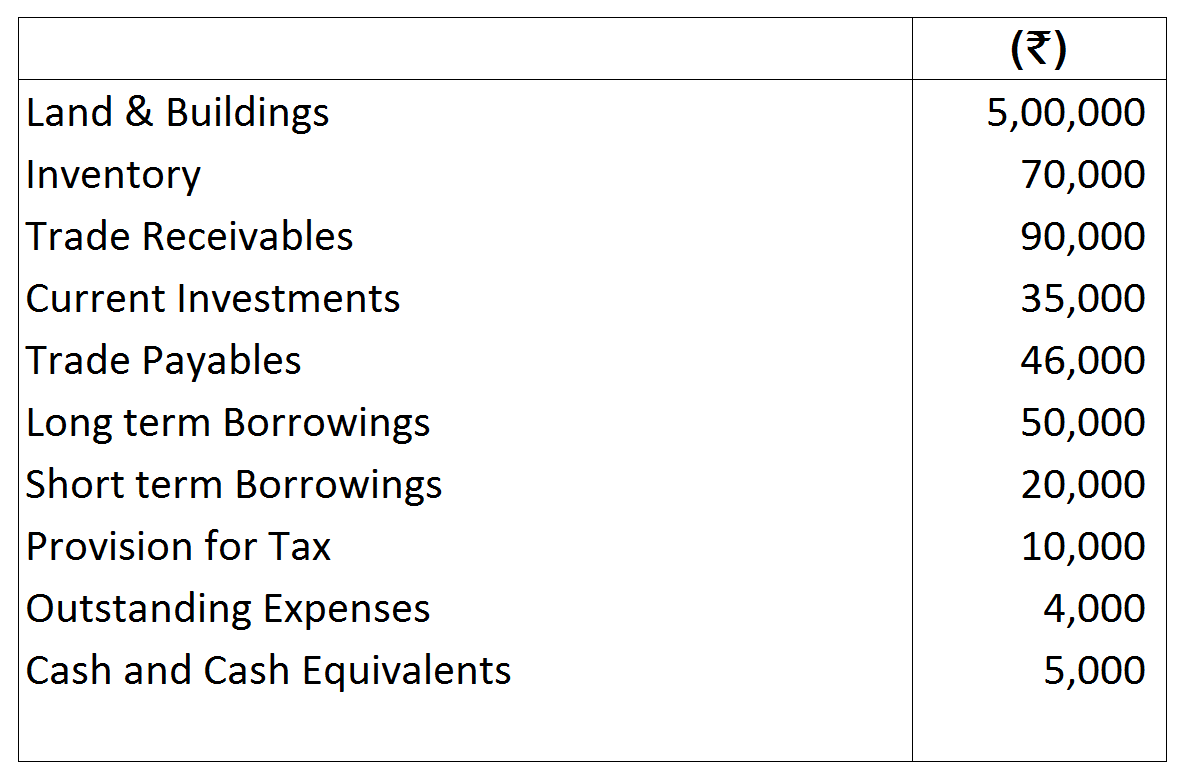
From the following particulars compute the Current Ratio:

Answer

Current Ratio $=\frac{\text{Current Assets}}{\text{Current Liabilities}}$
Current Assets = Inventory + Trade Receivables + Current Investments + Cash and Cash Equivalents.
= ₹ 70,000 + ₹ 90,000 + ₹ 35,000 + ₹ 5,000
= ₹ 2,00,000
Current Liabilities = Trade Payables + Short term Borrowings + Provision for Tax + Outstanding Expenses.
= ₹ 46,000 + ₹ 20,000 + ₹ 10,000 + ₹ 4,000
= ₹ 80,000
Current Ratio $=\frac{₹\ 2,00,000}{₹\ 80,000}=2.5:1$

Need a full question paper?

Generate a complete, print-ready paper with questions like this in minutes — across 16+ boards, with answer keys.
Start Generating Free

Similar questions

Net Profit after Interest and Tax ₹ 51,000; Shareholder's Funds ₹ 3,00,000; 15% Long-Term Debt ₹ 1,00,000. Tax Paid ₹ 34,000. Calculate Return on Investment.
Current Liabilities ₹ 20,000; Working Capital ₹ 80,000. Calculate Current Ratio:
Give the 'headings under which the following items will be shown in a company's Balance Sheet:
  1. Mining Rights.
  2. Debtors.
  3. Interest on Calls in Advance.
  4. Work-in-progress.
  5. Mortgage Loan.
  6. Bonds.
Winona Ltd. issued ₹ 80,000, 11% debentures of ₹ 100 each at a premium of 5% redeemable at a premium of 10%.
Calculate Cost Of Revenue From Oprations from the following information:
Revenue from Operation ₹ 12,00,000; Oprating Ratio 75% Operating Expenses ₹ 1,00,000.
A firm has Current Ratio of 4.5 : 1 and Quick Ratio of 3 : 1. If its inventory is ₹ 72,000, find out its total current assets and total current liabilities.
Nikhil and Ashwin Limited bought business of Agarwal Limited consisting sundry assets of ₹ 3,60,000, sundry creditors ₹ 1,00,000 for a consideration of ₹ 3,07,200. It issued 14% debentures of ₹ 100 each fully paid at a discount of 4% in satisfaction of purchase consideration. Record necessary journal entries.
Net Profit after Interest but before Tax ₹ 65,000; Shareholder's Funds ₹ 3,00,000; 15% Long-Term Debt ₹ 1,00,000. Calculate Return on Investment.
Comparison with the help of ratios is not possible if different firms follow different accounting policies.'' Comment.
Identify the transactions as belonging to:
  1. Operating Activities.
  2. Investing Activities.
  3. Financing Activities.
  4. Cash and Cash Equivalents.
  1. Cash Sale of Goods.
  2. Cash Received against Revenue from Services rendered.
  3. Cash Purchase of Goods.
  4. Cash Paid against Services Taken.
  5. Patents Purchased.
  6. Marketable Securities.
  7. Bank Overdraft.
  8. Proceeds from Issue of Debentures.
  9. Purchase of Shares.
  10. Repayment of Long-term Loan.
  11. Commission Received.
  12. Redemption of Debentures.
  13. Interest on Debentures.
  14. Interest on Investments.
  15. Income Tax Paid.
  16. Income Tax Paid on Gain of Sale of Asset.
  17. Cash Received from Debtors.
  18. Cash Paid to Creditors.