Questions · Page 1 of 4

3 Marks Question

🎯

Test yourself on this topic

50 questions · timed · auto-graded

Question 13 Marks
X Ltd. has a current ratio of 3 : 1 and quick ratio of 2 : 1. If the excess of current assets over quick assets as represented by stock is ₹ 40,000, calculate current assets and current liabilities.
Answer
Let the Current Liabilities = x
Current Ratio 3:1,so current Assets =3x
Quick Ratio 2:1, SoQuick Assets = 2x
Quick Assets = Current Assets – Stock
2x = 3x – 40,000
-1x = – 40,000
x = ₹ 40,000
Current Liabilities = ₹ 40,000
Current Assets = 3 x 40,000 = ₹ 1,20,000
View full question & answer
Question 23 Marks
O.M. Ltd. has a Current Ratio of 3.5 : 1 and Quick Ratio of 2 : 1. If the excess of Current Assets over Quick Assets as represented by Stock is ₹ 1,50,000, calculate Current Assets and Current Liabilities.
Answer
Let the Current Liabilities = x
Current Ratio 3 : 5 : 1, so current Assets =3.5x
Liquid Ratio 2 : 1, So Liquid Assets = 2x
Liquid Assets = Current Assets – Stock
2x = 3.5x – 1,50,000
-1.5x = - 1,50,000
X = $\frac{-15,00,000}{-15}=\text{₹ }1,00,000$
Current Liabilities = ₹ 1,00,000
Current Assets = 3.5 x 1,00,000 = ₹ 3,50,000
View full question & answer
Question 33 Marks
In a company, rate of Gross Profit on cost is 20%. Its Gross Profit is ₹ 4,00,000. Current Liabilities are 50% of the Current Assets, and Current Assets are ₹ 12,00,000. Calculate the Working Capital Turnover Ratio.
Answer
Working Capital turnover Ratio = Revenue from operations/ working Capital
Cost of Revenue of operations = ₹ 4,00,000/ 20 x 100
= ₹ 20,00,000
Revenue from operations = Cost of Revenue from Operations + Gross Profit
= ₹ 20,00,000 + ₹ 4,00,000 = ₹ 24,00,000
Working Capital = Current Assets- Current Liabilities
= ₹ 12,00,000 – ₹ 6,00,000 = ₹ 6,00,000
Working Capital turnover Ratio = ₹ 24,00,000/ ₹ 6,00,000 = 4 times
View full question & answer
Question 43 Marks
Under which major headings/sub-headings will the following items be shown in a Company’s Balance Sheet as per Schedule III Part I of the Companies Act, 2013?
  1. Trade Payables
  2. Provision for tax
  3. Bank Overdraft
  4. Goodwill
  5. Unclaimed Dividend
  6. Loose tools
Answer
Item
Major Head
Sub Head
Trade Payable
Current Liabilities
Trade Payables
Provision For Tax
Current Liabilities
Short-Term Provisions
Bank overdraft
Current Liabilities
Short-Term Borrowings
Goodwill
Non-Current Assets
Fixed Assets-Intangible Assets
Unclaimed Dividend
Current Liabilities
Other Current Liabilities
Loose Tools
Current Assets
Inventories
View full question & answer
Question 53 Marks
Under which major head/sub-head will the following items be presented in the Balance Sheet of a company as per Schedule III Part I of the the Companies Act, 2013?
  1. Capital Advances
  2. Income received in advance
  3. Capital work-in-progress
  4. Motor vehicles
  5. Stores and spare parts
  6. 9% Debentures
Answer
Item Major Head Sub Head
Capital Advances Non-Current Assets Long Term Loans & Advances
Income Received in advance Current liabilities Other Current Liabilities
Capital work in progress Non-Current Assets Fixed Assets
Motor Vehicle Non-Current Assets Fixed Assets -Tangible Assets
Stores & Spare Parts Current Assets Inventories
9% Debentures Non-Current Liabilities Long Term Borrowings
View full question & answer
Question 63 Marks
Opening inventory is ₹ 60,000, closing inventory is 1·5 times of opening inventory. Inventory Turnover Ratio is 6 times. Selling price is $33\frac{1}{3}\%$ above cost. Calculate the Gross Profit Ratio.
Answer
Gross profit ratio = Gross profit/ Revenue from operations × 100
Average Inventory= (Opening Inventory + Closing Inventory)/ 2
= (₹ 60,000 + ₹ 90,000)/ 2
= ₹ 75,000
Inventory turnover ratio = Cost of revenue from operations/ Average Inventory
6 = Cost of revenue from operations/ ₹ 75,000
Cost of revenue from operations = ₹ 4,50,000
Revenue from operations = Cost of Revenue from Operations + Gross profit
$= ₹\ 4,50,000 +33\frac{1}{3}\%$ of ₹ 4,50,000
= ₹ 4,50,000 + ₹ 1,50,000
= ₹ 6,00,000
View full question & answer
Question 73 Marks
Calculate the ‘Total Assets to Debt Ratio’ from the following information:
Current Assets
11,00,000
Working Capital
6,50,000
Shareholder’s Fund
7,50,000
Total Debt
19,50,000
Reserves and Surplus
2,50,000
Answer
Total Assets to Debt ratio = Total Assets/ Debt
Total Assets = Shareholders’ Funds + Total Debt
= ₹ 7,50,000 + ₹ 19,50,000
= ₹ 27,00,000
Debt = Total Debt–Current Liabilities
= ₹ 19,50,000 - ₹ 4,50,000
= ₹ 15,00,000
Total Assets to Debt ratio = ₹ 27,00,000/ ₹ 15,00,000
= 1.8 : 1
View full question & answer
Question 83 Marks
Under which major head/sub-head will the following items be presented in the Balance Sheet of a company as per Schedule III, Part I of the Companies Act, 2013?
  1. Computer software
  2. Calls-in-advance
  3. Outstanding salary
  4. Securities Premium Reserve
  5. Patents
  6. Interest accrued on Investment.
Answer
Item Major Head Sub Head
Computer software Non-Current Assets Fixed Assets-Intangible Assets
Calls in advance Current liabilities Other Current Liabilities
Outstanding salary Current Liabilities Other Current Liabilities
Securities premium reserve Shareholders funds Reserves and Surplus
Patents Non-Current Assets Fixed Assets-Intangible Assets
Interest accrued on investment Current assets Other current Assets
View full question & answer
Question 93 Marks
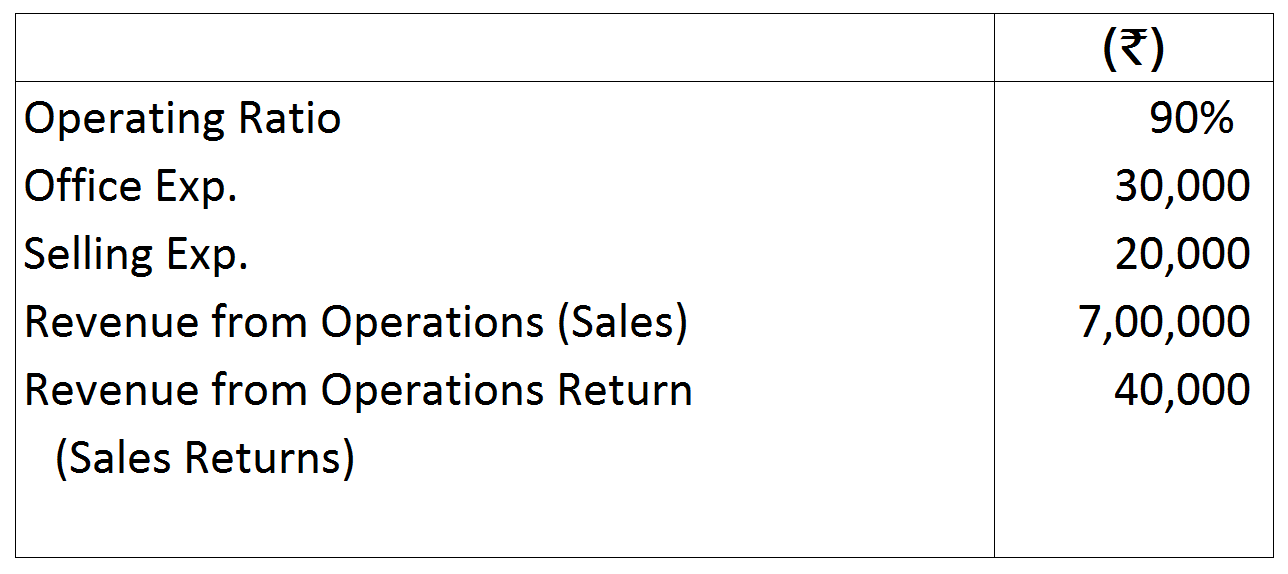
Calculate Cost of Goods Sold from the following information:
Answer
Net Revenue from Operations = Revenue from Operations - Revenue from Operations Return
= ₹ 7,00,000 - ₹ 40,000 = ₹ 6,60,000
Operating Ratio $=\frac{\text{Cost of Revenue from Operations + Operating Expenses}}{\text{Net Revenue from Operations}}\times100$
Hence, Cost of Revenue from Operations + Operating Expenses = 90% of Net Revenue from Operations
Cost of Revenue from Operations+ ₹ 30,000 + ₹ 20,000 = 90% of ₹ 6,60,000
Cost of Revenue from Operations+ ₹ 50,000 = ₹ 5,94,000
Cost of Revenue from Operations = ₹ 5,94,000 - ₹ 50,000
  = ₹ 5,44,000
View full question & answer
Question 103 Marks
From the following information, calculate Inventory Turnover Ratio:
Revenue from Operations (Sales) ₹ 4,00,000, Average Inventory: ₹ 55,000. The rate of Gross Loss on Revenue from Operations was 10%.
Answer
Revenue from Operations = ₹ 4,00,000 Gross Loss = 10% of ₹ 4,00,000 = ₹ 40,0000 Cost of Revenue from Operations = Revenue from Operations + Gross Loss = ₹ 4,00,000 + ₹ 40,000 = ₹ 4,40,000 Inventory Turnover Ratio $=\frac{\text{Cost of Goods Sold}}{\text{Average Inventory}}$$=\frac{₹\ 4,40,000}{₹\ 55,000}=8\text{ times.}$
View full question & answer
Question 113 Marks
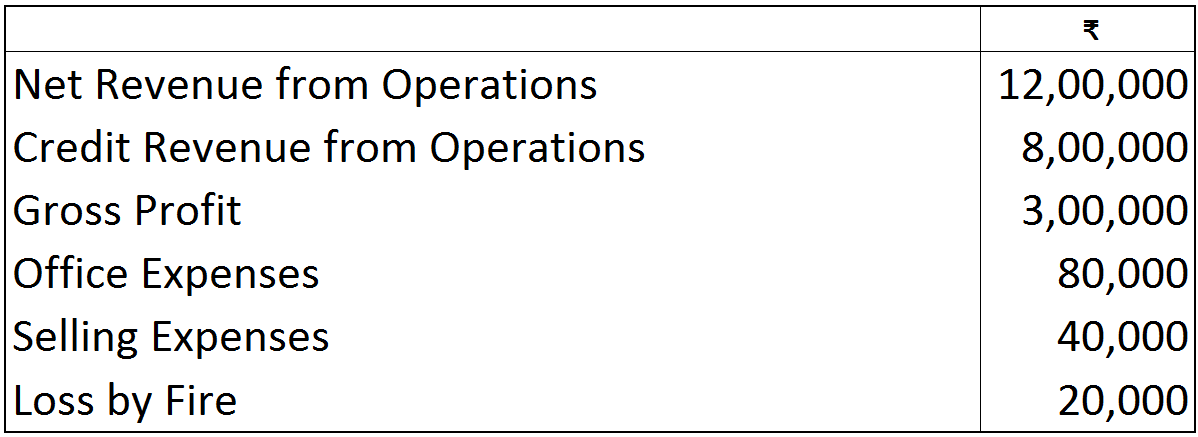
Calculate operating ratio from the following:
Answer
Operating Ratio $=\frac{\text{Cost of Revenue from Operations + Operating Expenses}}{\text{Net Revenue from Operations}}\times100$
Cost of Revenue from Operations = Net Revenue from Operations - Gross Profit
= ₹ 12,00,000 - ₹ 3,00,000 = ₹ 9,00,000
Operating Expenses = Office Expenses + Selling Expenses
= ₹ 80,000 + ₹ 40,000 = ₹ 1,20,000
Hence, Operating Ratio $=\frac{₹\ 9,00,000+₹\ 1,20,000}{₹\ 12,00,000}=85\%$
View full question & answer
Question 123 Marks
Calculate 'Return on Capital Employed' from the following detail:
Gross Profit ₹ 2,70,000; Administration Expenses ₹ 60,000; Selling Expenses ₹ 30,000; 12% Long-Term Debts ₹ 2,00,000; Tax Rate 40%; Non Current Assets ₹ 6,00,000; Current Assets ₹ 2,00,000; and Current Liabilities ₹ 50,000.
Answer
Return on Capital Employed $=\frac{\text{Net profit before Interst & Tax}}{\text{Capital Employed }}\times100$Net Profit before interest and tax = Gross Profit - Administration Exp. - Selling Exp.
= ₹ 2,10,000- ₹ 60,000- ₹ 30,000 = ₹ 1,80,000
Capital Employed = Non Current Assets+ Current Assets - Current Liabilities
= ₹ 6,00,000 + ₹ 2,00,000- ₹ 50,000
= ₹ 7,50,000
Return on Capital Employed $=\frac{₹\ 1,80,000}{₹ \ 7,50,000}\times100=24\%$
View full question & answer
Question 133 Marks
Net Profit after Interest and Tax ₹ 30,000; Fixed Assets ₹ 3,80,000; Current Assets ₹ 1,70,000; Current Liabilities ₹ 50,000; 10% Long-Term Debt ₹ 2,00,000. Tax Paid ₹ 30,000. Calculate Return on Investment
Answer
Return on Investment $=\frac{\text{Profit before interest and tax}}{\text{Capital Employed}}\times100$
Calculation of Profit before interest and tax:
 
Profit after interest and tax
=
30,000
+ Interest (10% on ₹ 2,00,000)
+ Tax
Profit before interest and tax


20,000
30,000
$\underline{\overline{\underline{80,000}}}$
Capital Employed = Fixed Assets + Current Assets - Current Liabilities
= ₹ 3,80,000 + ₹ 1,70,000 - ₹ 50,000
= ₹ 5,00,000
Return on Investment $=\frac{₹\ 80,000}{₹\ 5,00,000}\times100=16\%$
View full question & answer
Question 143 Marks
Total Debt ₹ 60,00,000; Shareholders' Funds ₹ 10,00,000; Reserves and Surplus ₹ 2,50,000; Current Assets ₹ 25,00,000; Working Capital ₹ 5,00,000. Calculate Total Assets to Debt Ratio.
[Hint: Reserves and Surplus are already included in Shareholders' Funds.]
Answer
Total Assets Debt Ratio $=\frac{\text{Total Assets}}{\text{Long-term Debt}}$
Working Capital = Current Assets - Current Liabilities
5,00,000 = 25,00,000 - Current Liabilities
Current Liabilities = ₹ 20,00,000
Long Term Debts = Total Debt - Current Liabilities
= 60,00,000 - 20,00,000 = ₹ 40,00,000
Total Assets = Total Liabilities = Total Debt + Shareholders’ Funds
= 60,00,000 + 10,00,000 = ₹ 70,00,000
Total Assets Debt Ratio $=\frac{70,00,000}{40,00,000}=7:4\text{ or }1.75:1$
View full question & answer
Question 153 Marks
From the following information, calculate Debt to Equity Ratio:
 
10,000 Equity Shares of ₹ 10 each fully paid.
1,00,000
5,000; 9% Preference Shares of 10 each fully paid.
50,000
General Reserve.
45,000
Surplus, i.e., Balance in Statement of Profit and Loss.
20,000
10% Debentures.
75,000
Current Liabilities.
50,000
Answer
Long-Term Debt = Debentures = ₹ 75,000
Shareholder’s Funds = Equity Share Capital + Preference Share Capital + General Reserve + Surplus.
= ₹ 1,00,000 + ₹ 50,000 + ₹ 45,000 + ₹ 20,000 = ₹ 2,15,000.
$\text{Debt-Equity Ratio}=\frac{\text{Long-Term Debts}}{\text{Shareholder' s Funds}}$
$=\frac{75,000}{2,15,000}=0.35:1$
View full question & answer
Question 163 Marks
Equity Share Capital ₹ 15,00,000; Gross Profit on Revenue from Operations, i.e., Net Sales $33\frac{1}{3} \ \% ;$ Cost of Revenue from Operations or cost of Goods Sold ₹ 20,00,000; Current Assets ₹ 10,00,000; Current Liabilities ₹ 2,50,000. Calculate Working Capital Turnover Ratio.
Answer
Net Sales = Cost of Goods sold + Gross ProfitNet Sales $=20,00,000+\frac{1}{3}\text{of Net Sales}$
Let Net Sales = x $\text{x}=20,00,000+\frac{1\text{x}}{3}$ Net Sales (x) $=\frac{60,00,000}{20}$ $=₹\ 30,00,000$ Working Capital = Current Assets - Current Liabilities = 10,00,000 - 2,50,000 = 7,50,000 Working Capital Turnover Ratio $=\frac{\text{Net Sales}}{\text{Working Capital}}$ $=\frac{30,00,000}{7,50,000}=4\text{ Times}$
View full question & answer
Question 173 Marks
From the following details, calculate Inventory Turnover Ratio:
 
Cost of Revenue from Operations (Cost of Goods Sold).
4,50,000
Inventory in the beginning of the year.
1,25,000
Inventory at the close of the year.
1,75,000
Answer
Inventory Tornover Ratio $=\frac{\text{Cost of Goods Sold}}{\text{Average Stock}}$Cost of Goods Sold = 4,50,000
Average Stock $=\frac{\text{Opening Stock+Closing Stock}}{2}$
$=\frac{1,25,000+1,75,000}{2}=1,50,000$
Inventory Turnover Ratio $=\frac{4,50,000}{1,50,000}=3\text{ times}$
View full question & answer
Question 183 Marks
Average Inventory carried by a trader is ₹ 60,000; Inventory turnover ratio is 10 times. Goods are sold at a profit of 10% on cost. Find out the profit.
Answer
Inventory Turnover Ratio $=\frac{\text{Cost of Revenue from Operations}}{\text{Average Inventory}}$
10 (Given) $=\frac{\text{Cost of Revenue from Operations}}{60,000\text{ (Given)}}$
Cost of Revenue from Operations = 10 x ₹ 60,000 = ₹ 6,00,000
Selling Price is 10% above cost
= ₹ 18,750 × 2 = ₹ 37,500
$\therefore$ Selling Price $=₹\ 6,00,000\times\frac{110}{100}=₹\ 6,60,000$
Hence, Gross Profit is ₹ 60,000
View full question & answer
Question 193 Marks
Current Ratio 4; Liquid Ratio 2.5; Inventory ₹ 6,00,000. Calculate Current Liabilities, Current Assets and Liquid Assets.
Answer
$\text{Current Ratio}=\frac{\text{Current Assets}}{\text{Current Liabilities}}=\frac{4}{1}$
$\text{Quick Ratio}=\frac{\text{Liquid Assets}}{\text{Current Liabilities}}=\frac{2.5}{1}$
Inventory = 6,00,000
Let Current Liabilities be = x
Current Assets = 4x
Quick Assets = 2.5x
Stock = Current Assets - Quick Assets
6,00,000 = 4x - 2.5x
x = 4,00,000
Current Assets = 4x = 4 × 4,00,000 = 16,00,000
Liquid Assets = 2.5x = 2. 5 × 4,00,000 = 10,00,000.
View full question & answer
Question 203 Marks
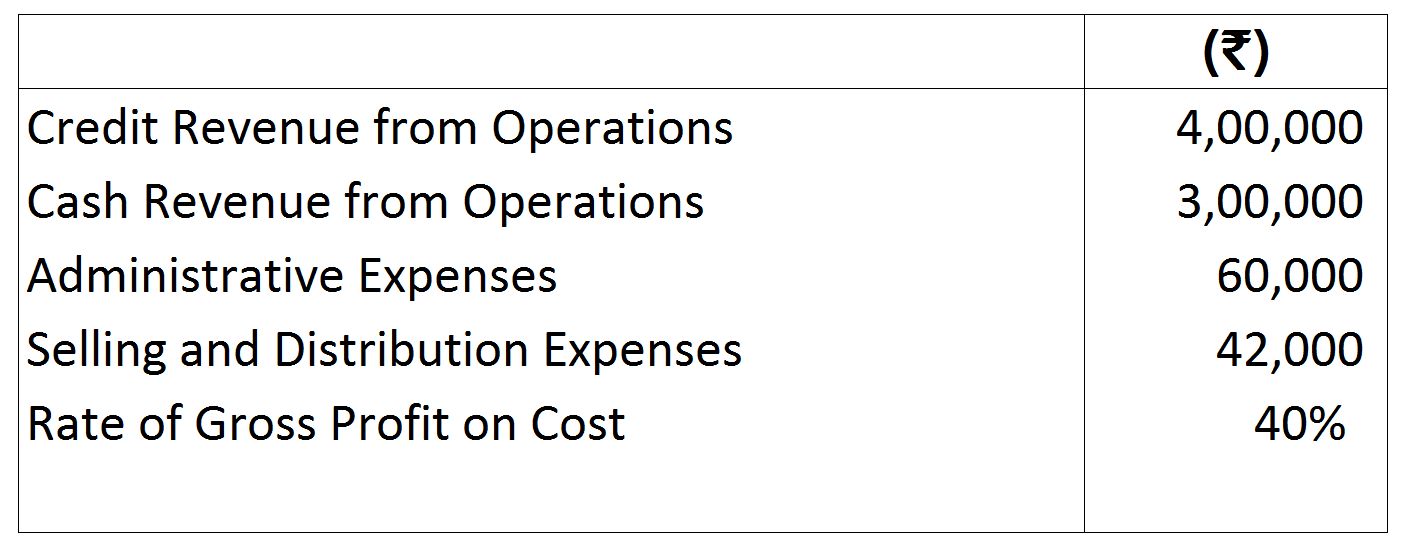
From the following information, calculate Operating Ratio:
Answer
Operating Ratio $=\frac{\text{Cost of Revenue from Operations + Operating Expenses}}{\text{Revenue from Operations}}$
Revenue from ₹ 4,00,000 + ₹ 3,00,000 = ₹ 1,00,000
Cost of Revenue from Oprations $=₹\ 7,00,000\times\frac{100}{140}=₹\ 5,00,000$
Operating Expenses = Administrative Expenses + Selling and Distribution Expenses
= ₹ 60,000 + ₹ 42,000 = ₹ 1,02,000
Operating Ratio $=\frac{₹\ 5,00,000+1,02,000}{7,00,000}=86\%$
View full question & answer
Question 213 Marks
What does too low 'Trade Receivables Turnover Ratio' indicate?
Answer
A too low trade receivables turnover ratio will indicate the liberal and inefficient credit and collection policy of the management. It shows that more money is being locked-up in trade receivables which will result in higher bad-debts, increase in cost of collection and also the loss of interest on the money due from trade receivables.
View full question & answer
Question 223 Marks
Find out the value of opening inventory from the following particulars:
Total Revenue from Operations
₹ 2,00,000
Inventory Turnover Ratio
5 Times
Gross Profit
25% on Revenue from Operations
You are informed that closing inventory is ₹ 8,000 more than the opening inventory.
Answer
Inventory Turnover Ratio $=\frac{\text{Cost of Revenue from Operations }}{\text{Average Inventory}}$ $5\text{(Given)}=\frac{\text{(Revenue from Operations - Gross Profit) }}{\text{Average Inventory}}$ $5=\frac{(₹\ 2,00,000-25\% \ \text{of}\ ₹\ 2,00,000)}{\text{Average Inventory}}$ $5=\frac{(₹\ 2,00,000-₹\ 50,000)}{\text{Average Inventory}}$ or Average Inventory $=\frac{₹\ 1,50,000}{5}=₹\ 30,000$ Opening Inventory $= ₹\ 30,000-\frac{1}{2}\ \text{of}\ ₹\ 8,000$$₹\ 30,000- ₹\ 4,000 = ₹\ 26,000$
View full question & answer
Question 233 Marks
A firm has Current Ratio of 4.5 : 1 and Quick Ratio of 3 : 1. If its inventory is ₹ 72,000, find out its total current assets and total current liabilities.
Answer
Current Ratio is 4.5 and quick ratio is 3. Difference between current ratio and quick ratio is inventory. Therefore, inventory is 4.5 - 3 = 1.5.
If Inventory is 1.5, Current Assets = 4.5
If lnventory is 1, Current Assets $=\frac{4.5}{1.5}$
Iflnventory is 72,000, Current Assets $=\frac{4.5}{1.5}\times72,000=₹2,16,000$
As Current Ratio is 4.5 : 1 and current assets are ₹ 2,16,000
$\therefore$ Current Liabilities $=\frac{₹\ 2,16,000}{4.5}=₹\ 48,000.$
View full question & answer
Question 243 Marks
Current assets of a company are ₹ 5,00,000. Current ratio is 2.5 : 1 and Liquid ratio is 1 : 1. Calculate the value of current liabilities, liquid assets and inventories.
Answer
Current Asset = 5,00,000
Current Ratio = 2.5 : 1
Quick Ratio = 1 : 1
  1. $\text{Current Ratio} = \frac{\text{Current Assets}}{\text{Current Liabilities}}$
or $\frac{2.5}{1}=\frac{5,00,000}{\text{Current Liabilities}}$

or $2.5\text{ Current Liabilities}=5,00,000$

$\text{Current Liabilities}=\frac{5,00,000}{2.5}$

$\text{Current Liabilities}=₹2,00,000$
  1. $\text{Quick Ratio}=\frac{\text{Quick Assets}}{\text{Current Liabilities}}$
or $\frac{1}{1}=\frac{\text{Quick Assets}}{2,00,000}$

2,00,000 - Quick Assets

Stock = Current Assets - Quick Assets

= 5,00,000 - 2,00,000

= ₹ 3,00,000
View full question & answer
Question 253 Marks
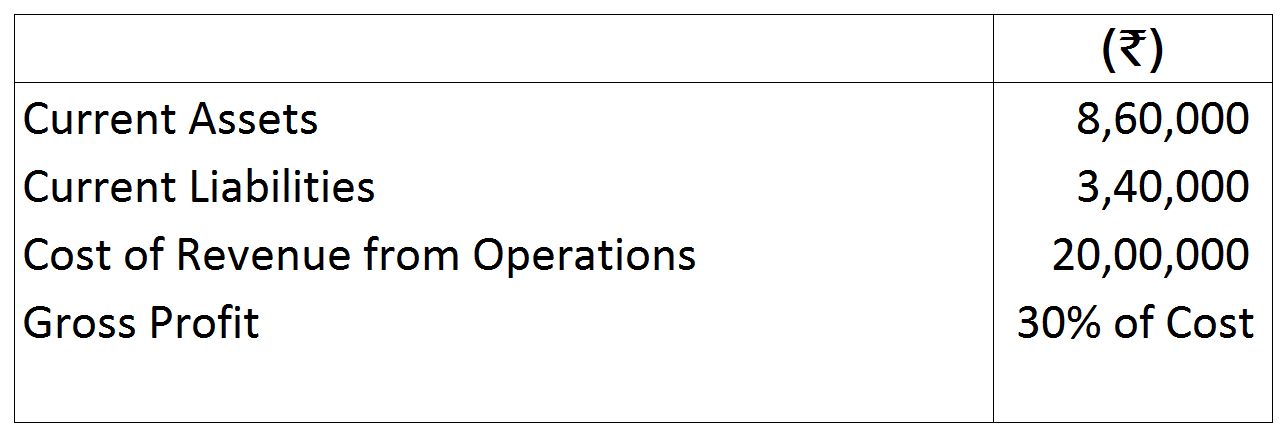
Calculate Working Capital Turnover Ratio from the following information:
Answer
Working Capital Turnover Ratio $=\frac{\text{Net Revenue from Operations}}{\text{Working Capital}}$
Net Revenue from Operations = Cost of Revenue from Operations + Gross Profit
= ₹ 20,00,000 + 30% of 20,00,000
= ₹ 20,00,000 + ₹ 6,00,000 = ₹ 26,00,000
Working Capital Current Assets - Current Liabilities
= ₹ 8,60,000- ₹ 3,40,000 = ₹ 5,20,000
Working Capital Turnover Ratio $=\frac{₹\ 26,00,000}{₹\ 5,20,000}=5\text{ Times}$
View full question & answer
Question 263 Marks
Revenue from Operations, Cash Sales ₹ 4,00,000; Credit Sales ₹ 1,00,000; Gross Profit ₹ 1,00,000 Office and Selling Expenses ₹ 50,000. Calculate Operating Ratio.
Answer
Net Sales = Case Sales + Credit Sales
= 4,00,000 + 1,00,000 = 5,00,000
Cost of Goods Sold = Net Sales - Gross Profit
= 5,00,000 - 1,00,000 = 4,00,000
Operating Expenses = Office and Selling Expenses = 50,000
Operating Cost = Cost of Goods Sold + Operating Expenses
= 4,00,000 + 50,000 = 4,50,000
Oprating Ratio = $\frac{\text{Oprating Cost}}{\text{Net Sales}}\times100$
=$\frac{4,50,000}{5,00,000}\times100=90\%$
View full question & answer
Question 273 Marks
Net Profit after Interest and Tax ₹ 51,000; Shareholder's Funds ₹ 3,00,000; 15% Long-Term Debt ₹ 1,00,000. Tax Paid ₹ 34,000. Calculate Return on Investment.
Answer
Return on Investment $=\frac{\text{Profit before interest and tax}}{\text{Capital Employed}}\times100$
Calculation of Profit before interest and tax:
 
Profit after interest and tax
=
51,000
+ Interest (15% on ₹ 1,00,000)
+ Tax
Profit before interest and tax


15,000
34,000
$\underline{\overline{\underline{1,00,000}}}$
Capital Employed = Shareholder's Funds + Long Term Debt
= ₹ 3,00,000 + ₹ 1,00,000 = ₹ 4,00,000
Return on Investment $=\frac{₹\ 1,00,000}{₹\ 4,00,000}\times100=25\%$
Note: It is assumed that Shareholder's Funds include current year's profits.
View full question & answer
Question 283 Marks
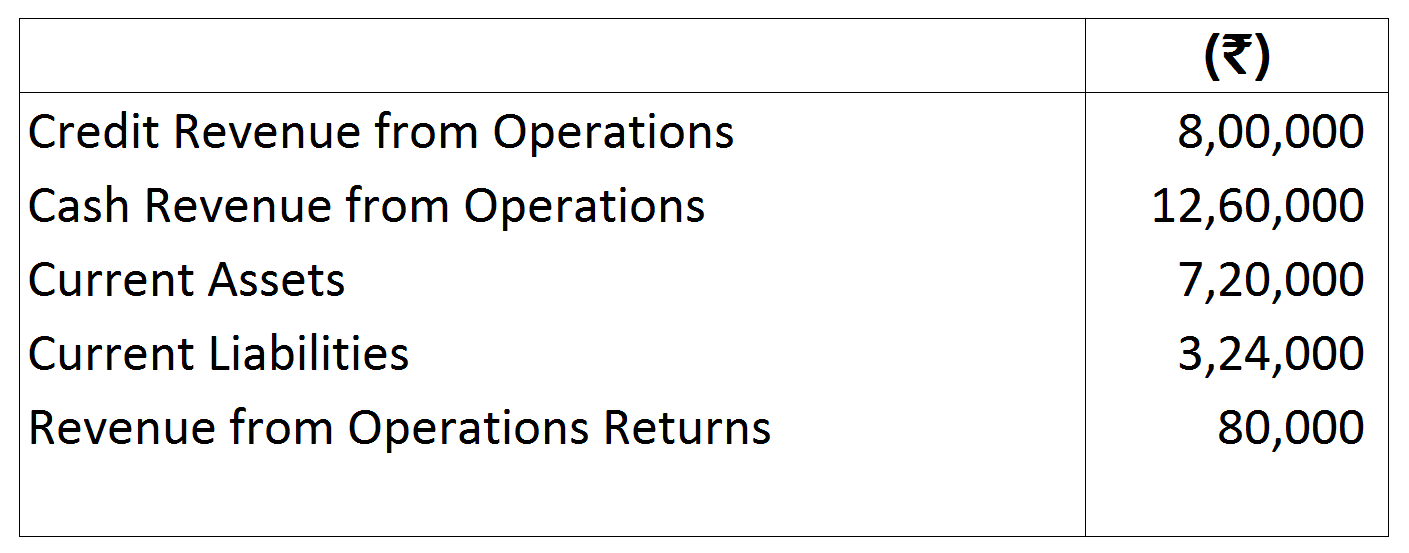
Calculate Working Capital Turnover Ratio from the following:
Answer
Net Revenue from Operations = Credit Revenue from Operations + Cash Revenue from Operations - Revenuefrom Operations Return
₹ 8,00,000 + ₹ 12,60,000 - ₹ 80,000
= ₹ 19,80,000
Working Capital = Current Assets- Current Liabilities
= ₹ 7,20,000 - ₹ 3,24,000 = ₹ 3,96,000
Working Capital Turnover Ratio $=\frac{\text{Net Revenue from Operations}}{\text{Working Capital}}$
$=\frac{₹\ 19,80,000}{₹\ 3,96,000}=5\text{ Times}$
View full question & answer
Question 293 Marks
A Limited's Liquidity Ratio is 2.5 : 1. Inventory is ₹ 6,00,000. Current Ratio is 4 : 1. Find out the Current Liabilities.
Answer
Current Ratio $=\frac{\text{Current Assets}}{\text{Current Liabilities}}=\frac{4}{1}$ Quick Ratio $=\frac{\text{Quick Assets}}{\text{Current Liabilities}}=\frac{2.5}{1}$Let the Current Liabilities be = x
Current Assets = 4x Quick Assets = 2.5x Stock = Current Assets - Quick Assets 6,00,000 = 4x - 2.5x or, x = 4,00,000 Current Liabilities = x = 4,00,000.
View full question & answer
Question 303 Marks
Handa Ltd.has stock of ₹ 20,000. Total liquid assets are ₹ 1,00,000 and quick ratio is 2 : 1. Calculate current ratio.
Answer
Quick Ratio = 2 : 1
Let Current Liabilities = x
Then Quick Assets = 2x or 1,00,000 = 2x,
$\text{x}=\frac{1,00,000}{2}=50,000$
Current Assets = Quick Assets + Stock
= 1,00,000 + 20,000 = 1,20,000
$\text{Current Ratio}=\frac{1,20,000}{50,000}=2.4:1$
View full question & answer
Question 313 Marks
Capital Employed ₹ 10,00,000; Fixed Assets ₹ 7,00,000; Current Liabilities ₹ 1,00,000. There are no Long-term Investments. Calculate Current Ratio.
[Hint: Current Assets = Capital Employed + Current Liabilities - Fixed Assets.]
Answer
Capital Employed = 10,00,000
Fixed Assets = 7,00,000
Current Assets = Capital Employed + Current Liabilities - Fixed Assets
= 10,00,000 + 1,00,000 - 7,00,000 = 4,00,000
$\text{Current Ratio}=\frac{\text{Current Assets}}{\text{Current Liabilities}}$
$=\frac{4,00,000}{1,00,000}=4:1$
View full question & answer
Question 323 Marks
Cash Sales ₹ 2,20,000; Credit Sales ₹ 3,00,000; Sales Return ₹ 20,000; Gross Profit ₹ 1,00,000; Operating Expenses ₹ 25,000; Non-operating Incomes ₹ 30,000; Non-operating Expenses ₹ 5,000. Calculate Net Profit Ratio.
Answer
Net Sales = Cash Sales + Creadit Sales - Sales Return
= 2,20,000 + 3,00,000 - 20,000
= 5,00,000
Net Profit = Gross Profit - Operating Expenses - Non-Operating Expenses + Non-operating Incomes
= 1,00,000 - 25,000 - 5,000 + 30,000
= 1,00,000
Net Profit Ratio = $\frac{\text{Net Profit}}{\text{Net Sales}}\times100$
$=\frac{1,00,000}{5,00,000}\times100=20\%$
View full question & answer
Question 333 Marks
Current Ratio 2 : 1, Quick Ratio 1.5 : 1, Current Liabilities ₹ 1,60,000. Calculate Current Assets, Quick Assets and Inventory.
Answer
Current Ratio $=\frac{\text{Current Assets}}{\text{Current Liabilities}}$
2 (Given) $=\frac{\text{Current Assets}}{₹\ 1,60,000\text{ (Given)}}$
$\therefore$ Current Assets = ₹ 1,60,000 × 2 = ₹ 3,20,000
Acid Test Ratio (Quick Ratio) $=\frac{\text{Liquid Assets}}{\text{Current Liabilities}}$
1.5 (Given) $=\frac{\text{Liquid Assets}}{₹\ \text{1,60,000 (Given)}}$
$\therefore$ Liquid Assets (Quick Assets) = ₹ 1,60,000 x 1.5 = ₹ 2,40,000
Inventory = Current Assets - Liquid Assets
= ₹ 3,20,000 - ₹ 2,40,000 = ₹ 80,000
View full question & answer
Question 343 Marks
Comparison with the help of ratios is not possible if different firms follow different accounting policies.'' Comment.
Answer
Comparison not Possible if Different Firms Adopt Different Accounting Policies, There may be different accounting policies adopted by different firms with regard to providing depreciation, creation of provision for doubtful debts, method of valuation of closing inventory etc. For instance, one firm may adopt the policy of charging depreciation on straight-line basis, while other may charge on written-down value method. Such differences make the accounting ratios incomparable.
View full question & answer
Question 353 Marks
A company had Current Assets of ₹ 4,50,000 and Current Liabilities of ₹ 2,00,000. Afterwards it purchased goods for ₹ 30,000 on credit. Calculate Current Ratio after the purchase.
Answer
Current Assets = ₹ 4,50,000
Current Liabilities = ₹ 2,00,000
Purchase of Goods on Credit for ₹ 30,000 will have two effects:
  1. Increase Stock by ₹ 30,000, Current Assets will thereby increase to ₹ 4,80,000 (₹ 4,50,000 + ₹ 30,000)
  2. Increase Creditors by ₹ 30,000 and therefore Current Liabilities will now be ₹ 2,30,000 (₹ 2,00,000 + ₹ 30,000).
$\text{Current Ratio}=\frac{\text{Current Assets}}{\text{Current Liabilities}}$
$=\frac{4,80,000}{2,30,000}=2.08:1$
View full question & answer
Question 363 Marks
Current Liabilities ₹ 80,000; Working Capital ₹ 1,70,000; Inventory ₹ 85,000 Prepaid Expenses ₹ 5,000 Calculate Quick Ratio.
Answer
Current Assets = Current Liabilities+ Working Capital
= ₹ 80,000 + ₹ 1,70,000
= ₹ 2,50,000
Quick Ratio $=\frac{\text{Liquid Assets}}{\text{Current Liabilities}}$
Liquid Assets = Current Assets - Inventory - Prepaid Expenses
= ₹ 1,50,000 - ₹ 85,000 - ₹ 5,000
= ₹ 1,60,000
Quick Ratio $=\frac{₹\ 1,60,000}{₹\ 80,000}=2:1$
View full question & answer
Question 373 Marks
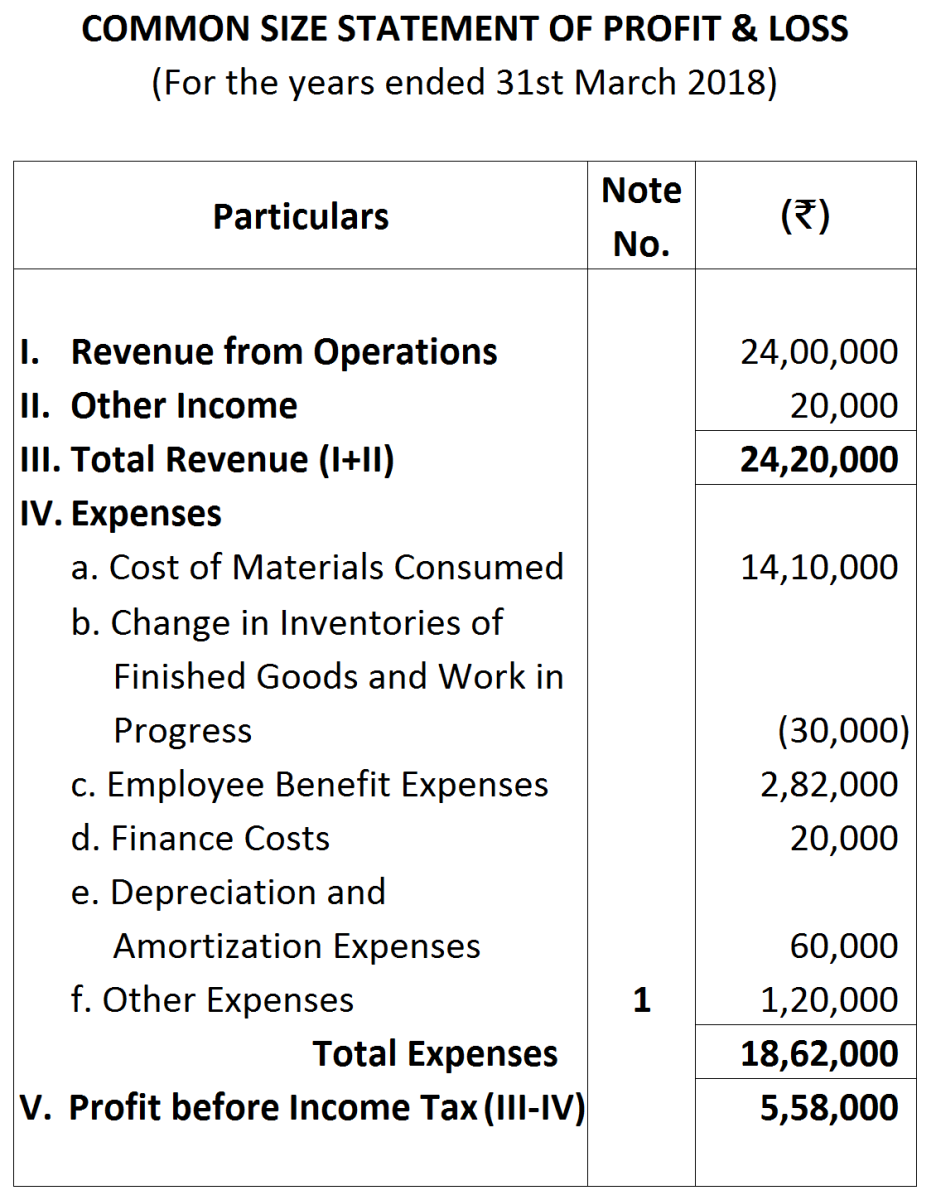
Compute Operating Ratio from the following Statement of Profit and Loss of X Ltd. for the year ended 31st March, 2018:

Answer
Operating Ratio $=\frac{\text{Cost of Revenue from Operations + Operating Expenses}}{\text{Revenue from Operations}}\times100$
Cost of Revenue from Operations = Cost of Materials Consumed + Change in Inventories of Finished Goods and Work in Progress
= ₹ 14,10,000 - ₹ 30,000 = ₹ 13,80,000
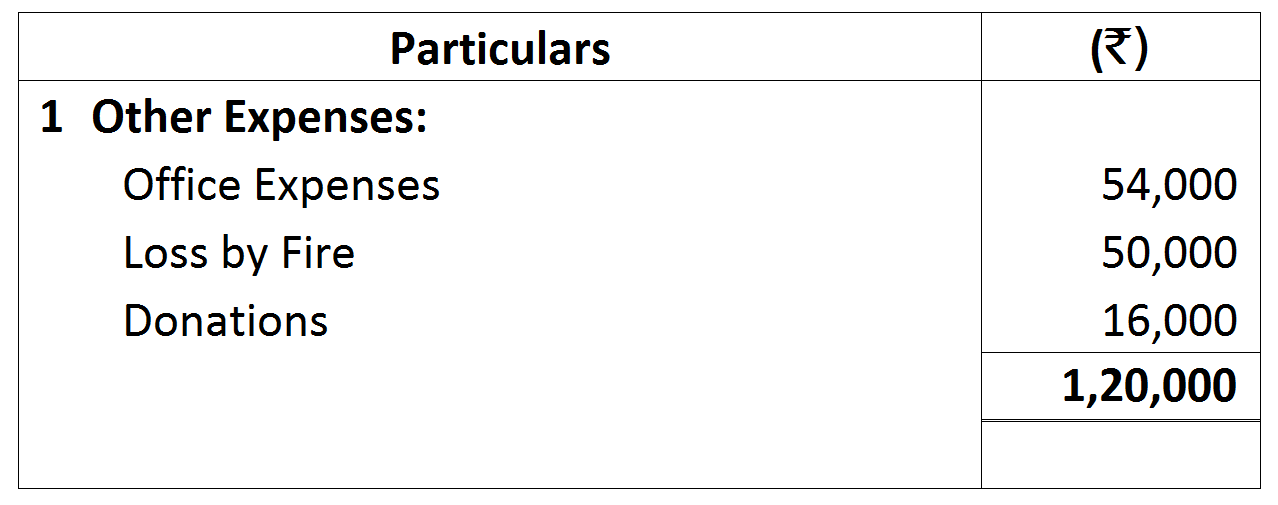
Operating Expenses = Employee Benefit Exp. + Depreciation and Amortization Exp. + Other Exp. (Office Exp.)
= ₹ 2,82,000 + ₹ 60,000 + ₹ 54,000
= ₹ 3,96,000
Operating Ratio $=\frac{₹\ 13,80,000+₹\ 3,96,000}{₹\ 24,00,000}\times100=74\%$
View full question & answer
Question 383 Marks
Current Ratio 2.5 : 1, Quick Ratio 0.95 : 1, Current Assets ₹ 17,00,000. Calculate Current Liabilities, Quick Assets and Inventory.
Answer
Current Ratio $=\frac{\text{Current Assets}}{\text{Current Liabilities}}$
2.5 (Given) $=\frac{₹\ 17,00,000\text{ (Given)}}{\text{Current Liabilities}}$
$\therefore$ Current Liabilities $=\frac{₹\ 17,00,000}{2.5}$
$=17,00,000\times\frac{10}{25}=₹\ 6,80,000$
Acid Test Ratio (Quick Ratio) $=\frac{\text{Liquid Assets}}{\text{Current Liabilities}}$
0.95 (Given) $=\frac{\text{Liquid Assets}}{₹\ \text{6,80,000 (Calculated as above)}}$
$\therefore$ Liquid Assets (Quick Assets) = ₹ 6,80,000 x 0.95 = ₹ 6,46,000
Inventory = Current Assets - Liquid Assets
= ₹ 17,00,000 - ₹ 6,46,000 = ₹ 10,54,000
View full question & answer
Question 393 Marks
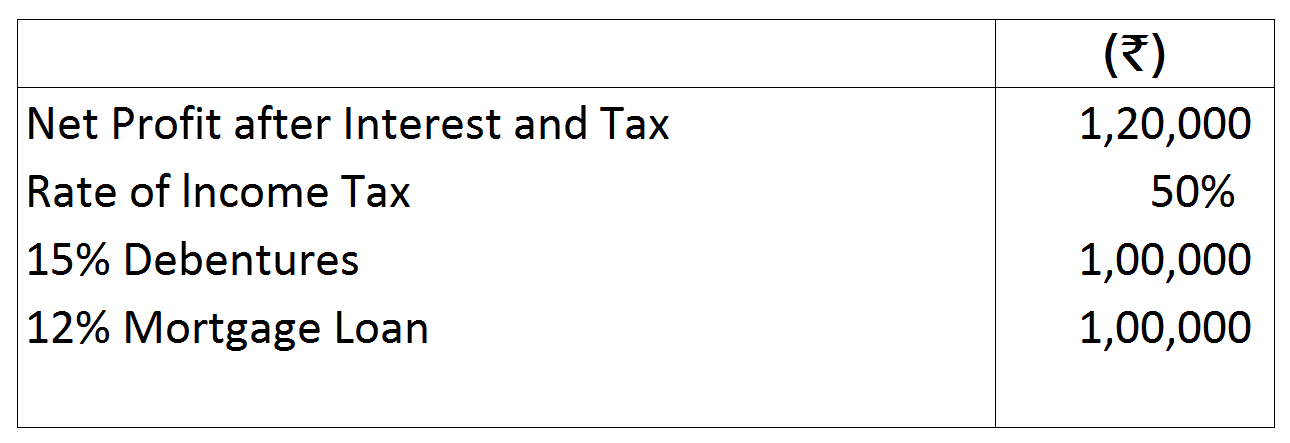
From the following information, calculate interest coverage ratio and give your comments also:
Answer
Interest Coverage Ratio $=\frac{\text{Net profit before Interest & Income Tax}}{\text{Fiixed Interest Charges}}$
In the above question net profit after interest and tax is given, whereas net profit before interest and tax is required to calculate this ratio.
If profit after tax is 50, the profit before tax must be = 100
If profit after tax is 1,20,000, the profit before tax must be
$=\frac{100}{50}\times1,20,000=₹\ 2,40,000$
Interest paid on ₹ 1,00,000 debentures during the year at the rate of 15% amounts to ₹ 15,000 and on ₹ 1,00,000 mortgage loan at the rate of 12% amounts to ₹ 12,000.
Therefore, profit before payment of interest and tax = ₹ 2,40,000 + ₹ 27,000 (Interest) = ₹ 2,67,000.
Interest Coverage Ratio $=\frac{₹\ 2,67,000}{₹\ 27,000}=9.89 \text{ Times}.$
View full question & answer
Question 403 Marks
Calculate 'Debt Equity Ratio' from the following information:
Total Assets ₹ 3,50,000; Total Debt ₹ 2,50,000 and Current Liabilities ₹ 80,000.
Answer
Debt-Equity Ratio $=\frac{\text{Debt}}{\text{Equity}}\text{ or }\frac{\text{Long Term Debt}}{\text{Shareholder's Funds}}$
Long-term Debt = Total Debts - Current Liabilitie
= ₹ 2,50,000 - ₹ 80,000 = ₹ 1,70,000
Shareholder's Fund = Total Assets - Total Debts
= ₹ 3,50,000 - ₹ 2,50,000 = ₹ 1,00,000
Debt Equity Ratio $=\frac{₹\ 1,70,000}{₹\ 1,00,000}=1.7:1$
View full question & answer
Question 413 Marks
Current Ratio 2.5 : 1; Quick Ratio 1 : 1; Current Assets ₹ 5,00,000. Calculate Current Liabilities; Liquid Assets and Inventory.
Answer
Current Ratio $=\frac{\text{Current Assets}}{\text{Current Liabilities}}$
2.5 (Given) $=\frac{₹\ 5,00,000 \text{(Given)}}{\text{Current Liabilities}}$
$\therefore$ Current Assets $\frac{₹\ 5,00,000\text{(Given)} }{2.5}=₹\ 2,00,000$
Acid Test Ratio $=\frac{\text{Liquid Assets}}{\text{Current Liabilities}}$
1 (Given) $=\frac{\text{Liquid Assets}}{₹\ 2,00,000}$
$\therefore$ Liquid Assets = ₹ 2 ,00,000 ×1 = ₹ 2,00,000
Inventory = Current Assets - Liquid Assets
= ₹ 5,00,000- ₹ 2,00,000 = ₹ 3,00,000
View full question & answer
Question 423 Marks
Net Profit after Interest but before Tax ₹ 65,000; Shareholder's Funds ₹ 3,00,000; 15% Long-Term Debt ₹ 1,00,000. Calculate Return on Investment.
Answer
Return on Investment $=\frac{\text{Net profit before Interst & Tax}}{\text{Capital Employed }}\times100$
Calculation of Net Profit before interest and tax:
Profit after interest but before tax 65,000
Interest ( 15% on ₹ 1,00,000) 15,000
Net Profit before interest and tax 80,000
Capital Employed = Shareholder's Funds+ Long Term Debt
= ₹ 3,00,000 + ₹ 1,00,000 = ₹ 4,00,000
Return on Investment $=\frac{80,000}{4,00,000}\times100=20\%$
Note: It is assumed that Shareholder's Funds include current year's profits.
View full question & answer
Question 433 Marks
₹ 1,50,000 is the cost of revenue from operations of a firm for the year 2014. If inventory turnover ratio is 6 times, calculate inventory at the end of the year. Inventory at the end is 1.5 times than that in the beginning.
Answer
Inventory Turnover Ratio $=\frac{\text{Cost of Revenue from Operations }}{\text{Average Inventory }}$
$6\text{ (Given)} =\frac{₹\ 1,50,000\ (\text{Given})}{\text{Average Inventory }}$
Average Inventory $=\frac{₹\ 1,50,000}{6}=₹\ 25,000$
Total of Opening and
Closing Inventory = ₹ 25,000 × 2 = ₹ 50,000
Ratio of Opening Inventory
to Closing Inventory = 1 : 1.5
Therefore, Closing Inventory $=₹\ 50,000\times\frac{1.5}{2.5}=₹\ 30,000$
View full question & answer
Question 443 Marks
From the following particulars determine the Opening Trade Receivables:
Answer
Trade Receivables Turnover Ratio $=\frac{\text{Credit Revenue from Operations}}{\text{Average Trade Receivables}}$
$12=\frac{₹\ 4,32,000}{\text{Average Trade Receivables}}$
$\therefore$ Average Trade Receivables $=\frac{₹\ 4,32,000}{12}=₹\ 36,000$
Calculation of Closing Trade Receivables:
Opening Trade Receivables + Closing Trade Receivables
= Average Trade Receivables × 2
= ₹ 36,000 × 2 = ₹ 72,000
As Closing Trade Receivables are ₹ 40,000, therefore
Opening Trade Receivables= ₹ 72,000- ₹ 40,000 = ₹ 32,000
View full question & answer
Question 453 Marks
Calculate Operating Profit Ratio in the following cases:
i.
Revenue from Operations (Sales) ₹ 7,50,000; Operating Profit ₹ 3,00,000.
ii.
Revenue from Operations (Sales).
Cost of Revenue from Operations.
Operating Expenses.
₹ 15,00,000
₹ 12,40,000
₹ 35,000
iii.
Revenue from Operations (Sales).
Gross Profit.
Operating Expenses.
₹12,00,000
20% on Sales.
₹ 30,000
Answer
Operating Profit Ratio $=\frac{\text{Operating Profit}}{\text{Revenue From Operations}}\times100$
Case I:
Operating Profit Ratio $=\frac{₹\ 3,00,000}{₹\ 7,50,000}\times100=40\%$
Case II:
Operating Profit = Gross Profit - Operating Expenses
= ₹ 15,00,000 - ₹ 12,40,000 - ₹ 35,000
= ₹ 2,25,000
Operating Profit Ratio $=\frac{₹\ 2,25,000}{₹\ 15,00,000}\times100=15\%$
Case III:
Operating Profit = Gross Profit - Operating Expenses
= 20% of ₹ 12,00,000 - ₹ 30,000 = ₹ 2,10,000
Operating Profit Ratio $=\frac{₹\ 2,10,000}{₹\ 12,00,000}\times100=17.5\%$
View full question & answer
Question 463 Marks
Current Assets are ₹ 7,50,000 and Working Capital is ₹ 2,50,000. Calculate Current Ratio.
Answer
Current Assets = ₹ 7,50,000
Working Capital = ₹ 2,50,000
Working Capital = Current Assets - Current Liabilities
2,50,000 = 7,50,000 - Current Liabilities
Current Liabilities = 7,50,000 - 2,50,000 = ₹ 5,00,000
$\text{Current Ratio}=\frac{\text{Current Assets}}{\text{Current Liabilities}}$
$=\frac{7,50,000}{5,00,000}=1.5:1$
View full question & answer
Question 473 Marks
Current liabilities of a company are ₹ 5,60,000, current ratio is 2.5 : 1 and quick ratio is 2 : 1. Find the value of the Inventories.
Answer
Current Liability = ₹ 5,60,000
Current ratio = 5 : 2, Quick ratio = 2 : 1
  1. $\text{Current Liability}=\frac{\text{Current Assets}}{\text{Current Liabilities}}$ or $\frac{5}{2}=\frac{\text{CA}}{5,60,000}$
or 2 × CA = 5 × 5,60,000 or $\text{CA}=\frac{28,00,000}{2}$

CA = ₹ 14,00,000
  1. $\text{Quick Ratios}=\frac{\text{Quick Assets}}{\text{Current Liabilities}}$
or $\frac{2}{1}=\frac{\text{QA}}{5,60,000}$

or QA = 2 × 5,60,000

QA = ₹ 11,20,000
  1. Stock = Current Assets - Quick Assets
= 14,00,000 - 11,20,000 = 2,80,000
View full question & answer
Question 483 Marks
From the following information, calculate Inventory Turnover Ratio:
Purchases ₹ 10,00,000; Revenue from Operations (Sales) ₹ 12,00,000; Direct Expenses ₹ 48,000; Gross Profit Ratio 15% on Revenue from Operations; Closing Inventory ₹ 1,64,000
Answer
Cost of Revenue from Operations = Revenue from Operations (Sales)- Gross Profit
= ₹ 12,00,000 - 15% of ₹ 12,00,000
= ₹ 12,00,000 - ₹ 1,80,000 = ₹ 10,20,000
Cost of Revenue from Operations = Opening Inventory + Purchases + Direct Expenses - Closing Inventoy
₹ 10,20,000 = Opening Inventory + ₹ 10,00,000 + ₹ 48,000 - ₹ 1,64,000
₹ 10,20,000 = Opening Inventory+ ₹ 8,84,000
Opening Inventory = ₹ 1,36,000
Average Inventory $=\frac{\text{Opening Inventory + Closing Inventory}}{2}$
$=\frac{₹\ 1,36,000+₹\ 1,64,000}{2}= ₹\ 1,50,000$
Inventory Turnover Ratio $=\frac{\text{Cost of Revenue from Operations}}{\text{Average Inventory}}$
$=\frac{₹\ 10,20,000}{₹\ 1,50,000}=6.8\text{ times.}$
View full question & answer
Question 493 Marks
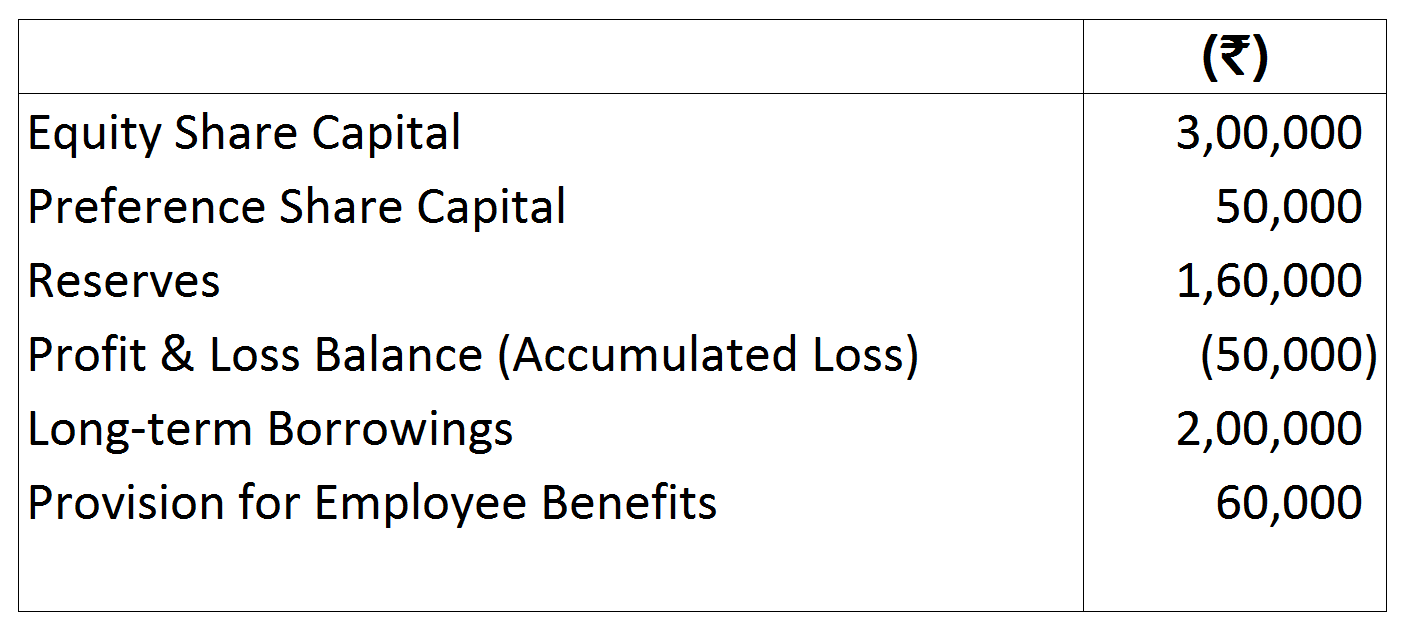
Calculate the Debt Equity Ratio from the following:-
Answer
Debt - Equity Ratio $=\frac{\text{Debt}}{\text{Equity}}\text{ or }\frac{\text{Long term Debts}}{\text{Shareholder's Funds}}$
Long term Debts = Long term Borrowings + Long term Provisions (i.e. Provision for Employee Benefits).
= ₹ 2,00,000 + ₹ 60,000 = ₹ 2,60,000
Shareholder's Funds = Equity Share Capital + Preference Share Capital + Reserves - Profit & Loss Balance
= ₹ 3,00,000 + ₹ 50,000 + ₹ 1,60,000 - ₹ 50,000
= ₹ 4,60,000
Debt Equity Ratio $=\frac{₹\ 2,60,000}{₹\ 4,60,000}=0.57:1.$
View full question & answer
Question 503 Marks
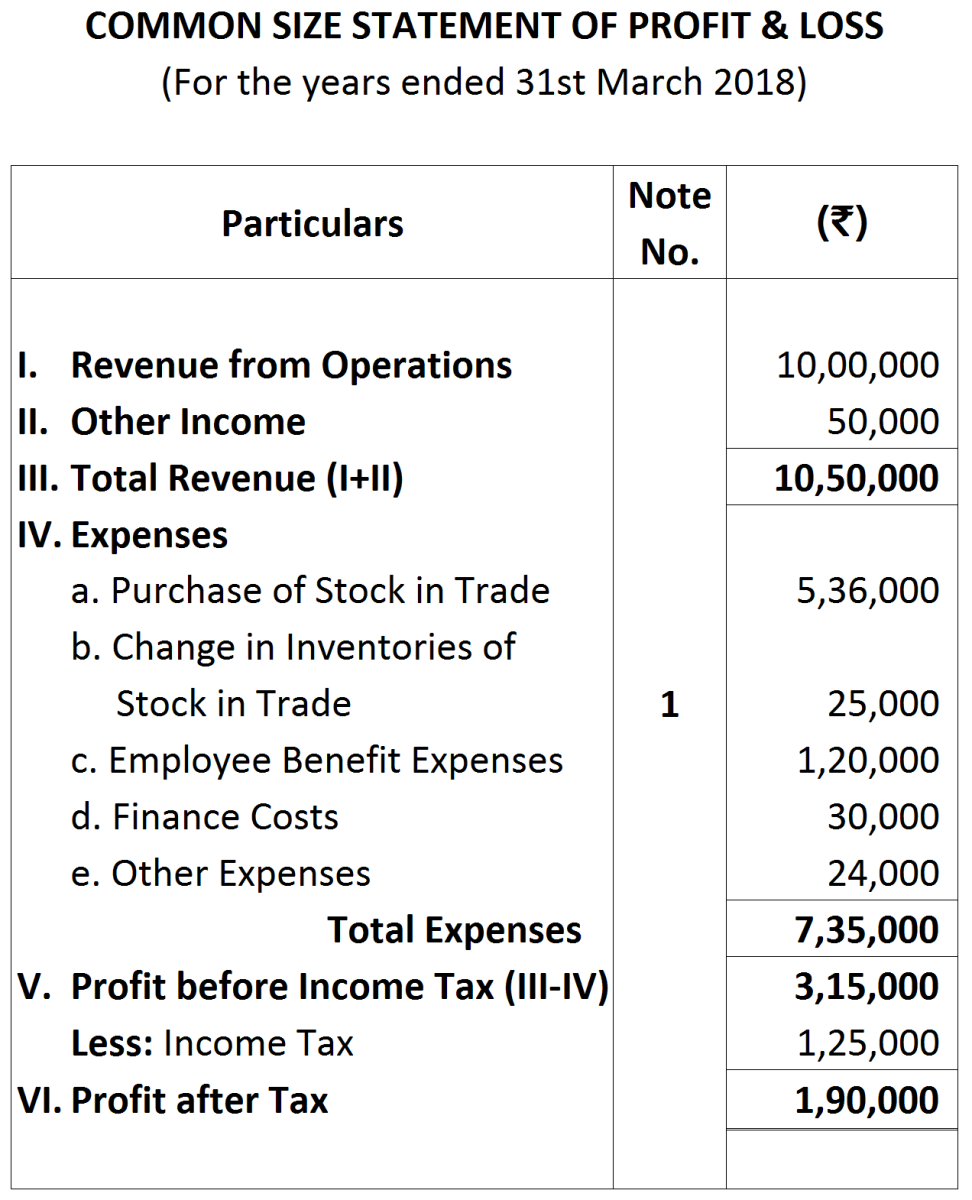
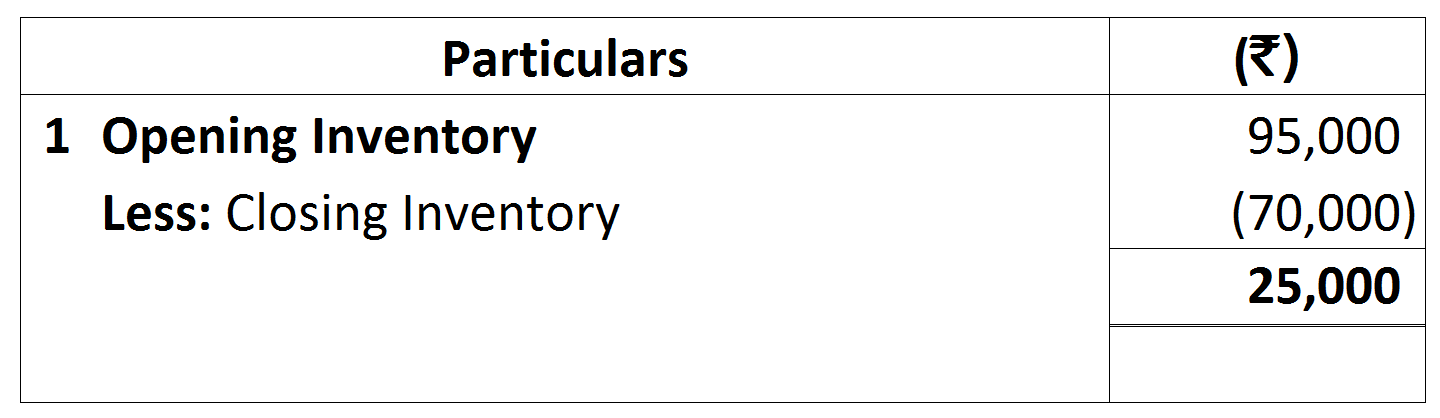
Following is the Statement of Profit & Loss of Triveni Ltd. Calculate Inventory Turnover Ratio: Notes to Accounts:
Answer
Inventory Turnover Ratio $=\frac{\text{Cost of Revenue from Operations}}{\text{Average Inventory}}$
Cost of Revenue from Operations = Purchase of Stock in Trade + Change in Inventory of Stock in Trade
= ₹ 5,36,000 + ₹ 25,000 = ₹ 5,61,000
Average Inventory $=\frac{\text{Opening Inventory + Closing Inventory}}{2}$
$=\frac{₹\ 95,000+₹\ 70,000}{2}=₹\ 82,500$
Inventory Turnover Ratio $=\frac{₹\ 5,61,000}{₹ 82,500}=6.8\text{ times}$
View full question & answer
3 Marks Question - Accountancy STD 12 Commerce Questions - Vidyadip