MCQ
Gauss’s law states that
  • A
    the total electric flux through a closed surface is $\frac{1}{\varepsilon_0}$ times the total charge placed near the closed surface.
  • the total electric flux through a closed surface is $\frac{1}{\varepsilon_0}$ times the total charge enclosed by the closed surface.
  • C
    the total electric flux through an open surface is $\frac{1}{\varepsilon_0}$ times the total charge placed near the open surface.
  • D
    the line integral of electric field around the boundary of an open surface is $\frac{1}{\varepsilon_0}$ times the total charge placed near the open surface.
Answer

Correct option: B.
the total electric flux through a closed surface is $\frac{1}{\varepsilon_0}$ times the total charge enclosed by the closed surface.
b
Gauss's law is applicable only for closed surface and for the charge placed inside it not near it.

Total electric flux, $\phi_{ z }=\frac{1}{\varepsilon_0} Q$

Need a full question paper?

Generate a complete, print-ready paper with questions like this in minutes — across 16+ boards, with answer keys.

Start Generating Free

Similar questions

A small signal voltage $V(t) = V_0\,\, sin \omega \,t$ is applied across an ideal capacitor $C$
The mutual inductance between two coils is $1.25$ $henry$. If the current in the primary changes at the rate of $80$ $ampere/second,$ then the induced $e.m.f$ in the secondary is......$V$
In Bohr's model, the atomic radius of the first orbit is ${r_0}$, then the radius of the third orbit is
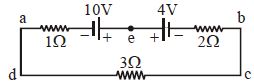
In the circuit diagram shown below, the magnitude and direction of the flow of current respectively would be
The mean life of a radioactive sample are $30\,year$ and $60\,year$ for $\alpha -$ emission and $\beta -$ emission respectively. If the sample decays both by $\alpha -$ emission and $\beta -$ emission simultaneously, then the time after which, only one-fourth of the sample remain is approximately ............ $years$
Mosley's law relates the frequencies of line $X-$ rayswith the following characteristics of the target element
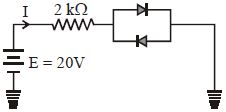
Assuming the diodes to be of silicon with forward resistance zero, the current $I$ in the  following circuit is.......$mA$
A biconvex lens of refractive index $1.5$ has a focal length of $20 \mathrm{~cm}$ in air. Its focal length when immersed in a liquid of refractive index $1.6$ will be:
In a Young's double slit experiment, the separation between the two slits is $d$ and the wavelength of the light is $\lambda$. The intensity of light falling on slit $1$ is four times the intensity of light falling on slit $2$. Choose the correct choice$(s)$.

$(A)$ If $\mathrm{d}=\lambda$, the screen will contain only one maximum

$(B)$ If $\lambda<\mathrm{d} < 2 \lambda$, at least one more maximum (besides the central maximum) will be observed on the screen

$(C)$ If the intensity of light falling on slit $1$ is reduced so that it becomes equal to that of slit $2$ , the intensities of the observed dark and bright fringes will increase

$(D)$ If the intensity of light falling on slit $2$ is increased so that it becomes equal to that of slit $1$ , the intensities of the observed dark and bright fringes will increase

The wavelength of the first line of Balmer series is $6563\;{Å}$. The Rydberg constant for hydrogen is about