Question
Give a brief description of the basic elementary process involved in the photoelectric emission in Einstein’s picture.
When a photosensitive material is irradiated with the light of frequency v, the maximum speed of electrons is given by $v_{max}.$ A plot of $v_{2max}$​​​​​​​ is found to vary with frequency ν as shown in the figure.
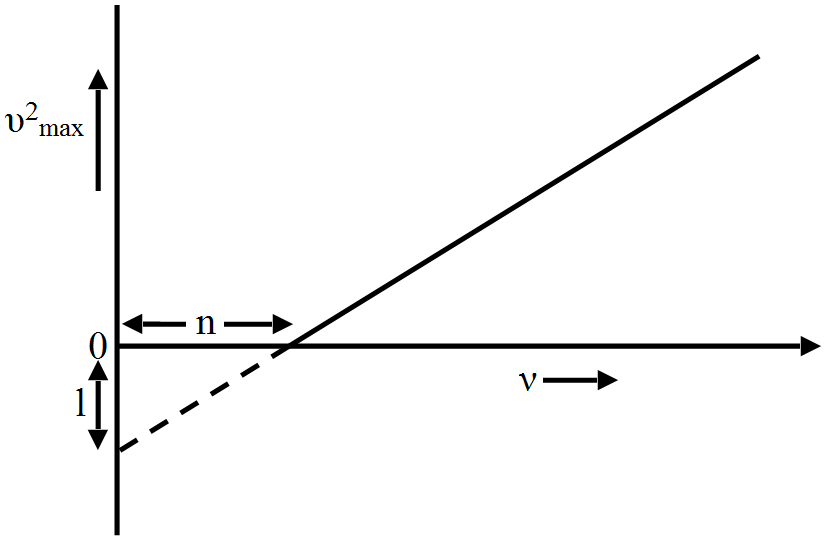
Use Einstein’s photoelectric equation to find the expressions for:
  1. Planck’s constant.
  2. Work function of the given photosensitive material, in terms of the parameters l, n and mass m of the electron.
Answer

  1. Planck’s constant: $\text{h}=\frac{\text{lm}}{2\text{n}}$
  2.  
  • $\nu_1^2$ and $\nu_2^2$ are the velocities of the emitted electrons for radiations of frequencies $v_1 > v$ and $v_2 > v$ respectively. So,
$\text{h}\nu_1=\text{h}\nu+\frac{1}{2}\text{mv}^2_1\dots(\text{i})$
and $\text{h}\nu_2=\text{h}\nu+\frac{1}{2}\text{mv}^2_2\dots(\text{ii})$
From equation (i) and (ii), we get
$\text{h}(\nu_2-\nu_1)=\frac{1}{2}\text{m}(\text{v}^2_2-\text{v}^2_1)$
$\therefore\ \text{h}=\frac{\frac{1}{2}\text{m}(\text{v}^2_2-\text{v}^2_1)}{(\nu_2-\nu_1)}$
Slope of $\text{v}^2_\text{max}$ $v_s$​​​​​​​ frequency graph is,
$\tan\theta=\frac{\text{v}^2_2-\text{v}^2_1}{(\nu_2-\nu_1)}$
$\therefore\ \text{h}=\frac{1}{2}\text{m}.\tan\theta$
From graph $\tan\theta=\frac{1}{\text{n}}$
So, $\text{h}=\frac{1}{2}\text{m}\Big(\frac{\text{l}}{\text{n}}\Big)\dots(\text{iii})$
  • From graph, the work function of the material is,
w = hn ...(iv)
From equations (iii) and (iv), we get
$\text{w}=\frac{1}{2}\text{m}\Big(\frac{\text{l}}{\text{n}}\Big)\times\text{n}=\frac{1}{2}\text{ml}$​​​​​​​

Need a full question paper?

Generate a complete, print-ready paper with questions like this in minutes — across 16+ boards, with answer keys.

Start Generating Free

Similar questions

A solid sphere of mass 0.50kg is kept on a horizontal surface. The coefficient of static friction between the surfaces in contact is $\frac{2}{7}.$ What maximum force can be applied at the highest point in the horizontal direction so that the sphere does not slip on the surface?
A convex lens has a focal length of 10cm. Find the location and nature of the image if a point object is placed on the principal axis at a distance of:
  1. 9.8cm
  2. 10.2cm from the lens.
Determine the 'effective focal length' of the combination of the two lenses having focal lengths $30 \ cm$ and $-20\ cm$ if they are placed $8.0 \ cm$ apart with their principal axes coincident. Does the answer depend on which side of the combination a beam of parallel light is incident? Is the notion of effective focal length of this system useful at all?
Find the current in the sliding rod AB (resistance = R) for the arrangement shown in Fig. B is constant and is out of the paper. Parallel wires have no resistance. v is constant. Switch S is closed at time t = 0.
A capacitor is formed by two square metal-plates of edge a, separated by a distance d. Dielectrics of dielectric constants $K_1$ and $K_2$ are filled in the gap as shown in figure. Find the capacitance.
Do permeability and relative permeability have the same dimensions?
An electron falls through a distance of $1.5 \ cm$ in a uniform electric field of magnitude $2.0 \times 10^4 N C ^{-1} \ [$Fig. $1.10(a)]$. The direction of the field is reversed keeping its magnitude unchanged and a proton falls through the same distance $[$Fig. $1.10(b)]$. Compute the time of fall in each case. Contrast the situation with that of 'free fall under gravity'.
Image
One end of a 10cm long silk thread is fixed to a large vertical surface of a charged nonconducting plate and the other end is fastened to a small ball having a mass of 10g and a charge of $4.0 \times 10^{-5}C$. In equilibrium, the thread makes an angle of 60° with the vertical. Find the surface charge density on the plate.
Find out magnetic force on parallel current carrying conductors and also state their special conditions.
If the reading of the ammeter, $A_1$ in the figure. is 2.4A, what will be the readings of ammeters $A_2$ and $A_3?$ Neglect the resistances of the ammeters.