Question
Give an explanation for the catalytic properties shown by transition metals.

Answer

Transition metals show catalytic property because of their ability to adopt multiple oxidation states. Catalysts at a solid surface involve the formation of bond between reactant molecules and atoms of the surface of the catalyst. This has the effect of increasing the concentration of the reactants at the catalyst surface and also weakening of the bonds in the reacting molecules & the activation energy is lowered, moreover transition metals can change their oxidation state. Transition metals have tendency to form reaction intermediates with suitable reactants. The reaction intermediates decompose yielding products and regenerating the original substance. The transition metals form reaction intermediates due to the presence of vacant orbitals.

Need a full question paper?

Generate a complete, print-ready paper with questions like this in minutes — across 16+ boards, with answer keys.

Start Generating Free

Similar questions

A graph between ln k and $\frac{1}{\text{t}}$ for a reaction is given. Here k is rate constant and T is temperature in Kelvin.

If OA = a and OB = b, answer the following:
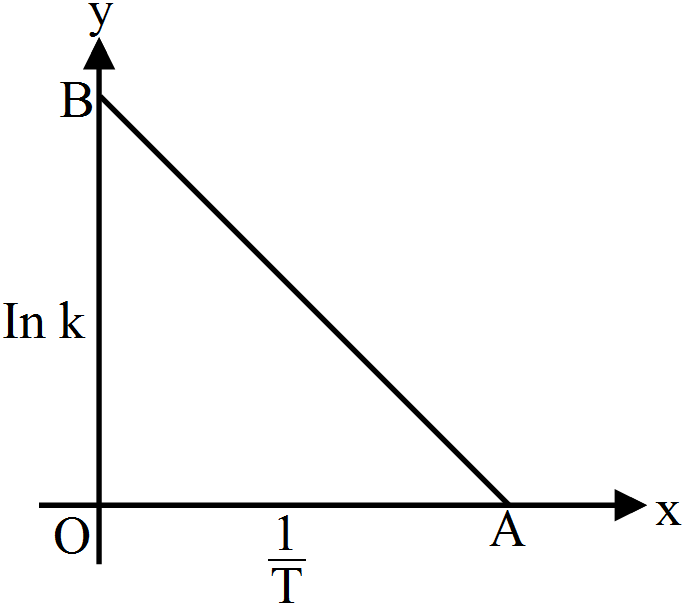
  1. What is the activation energy (Ea) of the reaction?
  2. What is the frequency factor (A) for the reaction?

Classify the following into monosaccharides and disaccharides. Ribose, 2-deoxyribose, maltose, galactose, fructose and lactose.
Transition elements show high melting points. Why?
Cyanide ion acts as an ambident nucleophile. From which end it acts as a stronger nucleophile in aqueous medium? Give reason for your answer.
Why are Fe2+ compounds easily oxidises to Fe3+ as compared to Mn+2 compounds.
A reaction is second order with respect to a reactant. How is the rate of reaction affected if the concentration of the reactant is :
(i) doubled (ii) reduced to half ?
Calculate the 'spin only' magnetic moment for $M _{( aq )}^{2+}( Z =25)$.
Give examples and suggest reasons for the following features of the transition metal chemistry:
A transition metal exhibits highest oxidation state in oxides and fluorides.
Arrange the following in order of property indicated for set.
CH3CHO, CH3CH2OH, CH3OCH3, CH3CH2CH3 (increasing order of boiling points).