Question
Give brief explanation of a semi-conductor diode.

Answer

Image

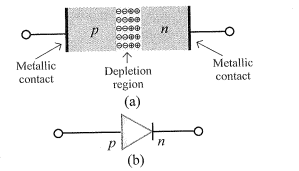
A semiconductor diode is basically a $p-n$ junction with metallic contacts provided at the ends for the application of an external voltage. It is a two terminal device. A $p-n$ junction diode is symbolically represented as shown in fig. (b).
The direction of arrow indicates the conventional direction of current (When the diode is under forward bias.) The equilibrium barrier potential can be altered by an external voltage V across the diode.
The situation of $p-n$ junction diode under equilibrium (without bias) is shown in fig. (a) and (b).

Need a full question paper?

Generate a complete, print-ready paper with questions like this in minutes — across 16+ boards, with answer keys.
Start Generating Free

Similar questions

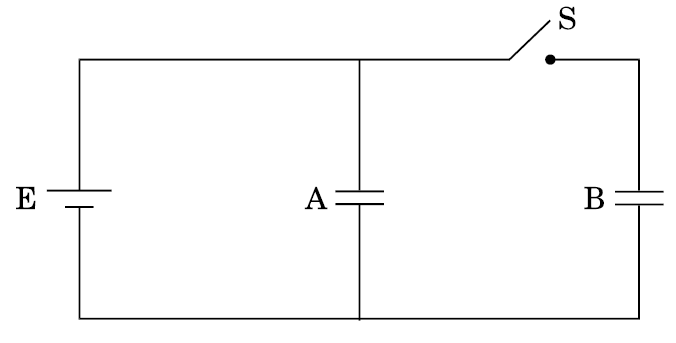
Two identical parallel plate capacitors A and B are connected to a battery of V volts with the switch S closed. The switch is now opened and the free space between the plates of the capacitors is filled with a dielectric of dielectric constant K. Find the ratio of the total electrostatic energy stored in both capacitors before and after the introduction of the dielectric.
An electron and a photon each have a wavelength of 1.00 nm. Find:
  1. Their momenta,
  2. The energy of the photon, and
  3. The kinetic energy of electron.
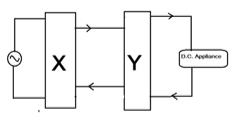
(I) Identify the circuit elements X and Y as shown in the given block diagram and draw the output waveforms of X and Y.

Image

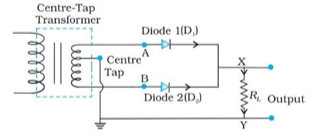
(II) If the centre tapping is shifted towards Diode D1 as shown in the diagram, draw the output waveform of the given circuit.

Image
What is Motional electromotive force $(\text{emf})$ ? Obtain motional emf $(\varepsilon)= B I {v}$ using proper example.
i. Differentiate between three segments of a transistor on the basis of their size and level of doping.
ii. When is a transistor said to be in active state?
iii. Draw a plot of transfer characteristic ($V _0$ vs. $V _{ i }$ ) and show which portion of the characteristic is used in amplification and why?
iv. Draw the circuit diagram of the base bias transistor amplifier in CE configuration and briefly explain its working.
Draw the circuit diagram of a full wave rectifier using two p-n junction
diodes. Explain its working and show input and output voltage variations.
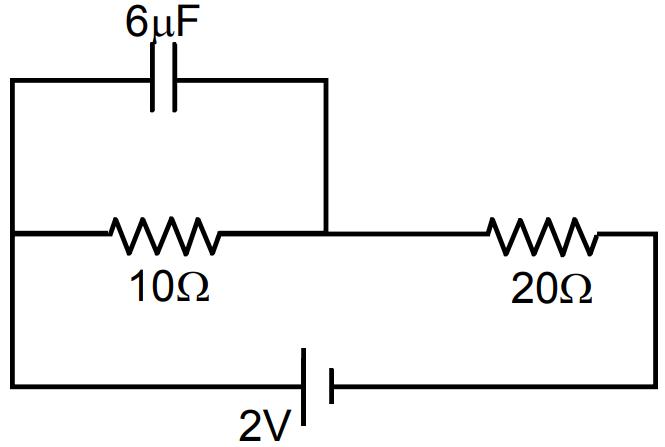
Find the charge on the capacitor shown in figure.
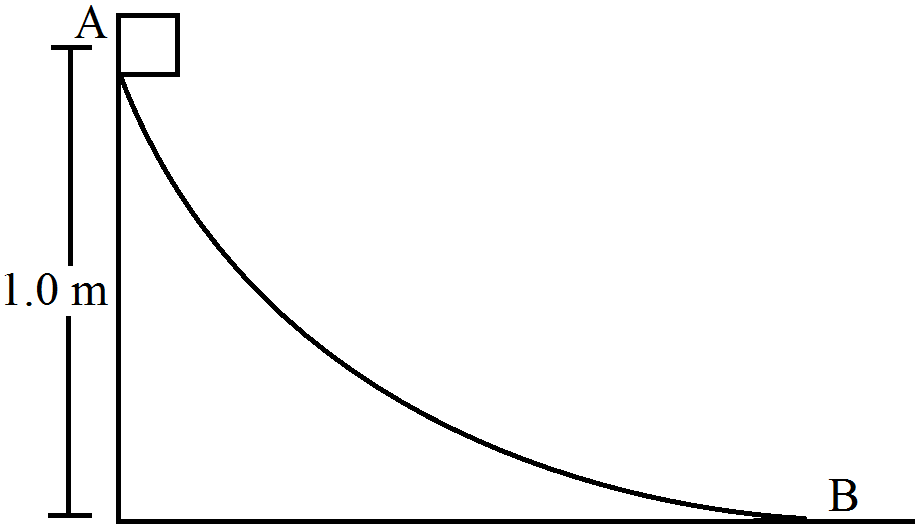
A block weighing 10N travels down a smooth curved track AB joined to a rough horizontal surface (figure). The rough surface has a friction coefficient of 0.20 with the block. If the block starts slipping on the track from a point 1.0m above the horizontal surface, how far will it move on the rough surface?
A circular coil of 200 turns and radius 10 cm is placed in a uniform magnetic field of 0.5 T, normal to the plane of the coil. If the current in the coil is 3.0 A, calculate the
  1. Total torque on the coil.
  2. Total force on the coil.
  3. Average force on each electron in the coil, due to the magnetic field.
Assume the area of cross - section of the wire to be 10–5 m2 and the free electron density is $10^{29}/m^3.$
The magnetic field in a plane electromagnetic wave is given by $\text{B}=(200\mu\text{T})\sin\Big[\big(4.0\times10^{15}\text{s}^{-1}\big)\Big(\text{t}-\frac{\text{x}}{\text{c}}\Big)\Big]$ Find the maximum electric field and the average energy density corresponding to the electric field.