Question
Give information about $\ce{C-O-H}$ bond angle in alcohol, phenol and ether with suitable example.
Answer

$\rightarrow$ In alcohols, the oxygen of $-OH$ group is attached to carbon by a sigma $(\sigma)$ bond formed by the overlap of an $sp^3$ hybridised orbital of carbon with $sp^3$ hybridised orbital of oxygen.
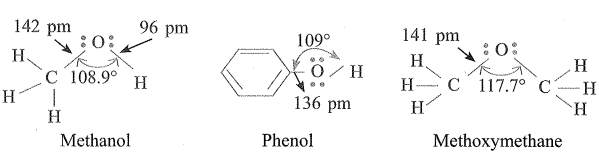
$\rightarrow $ Figure depicts structural aspects of methanol, phenol and methoxymethane.
Image
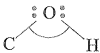
$\rightarrow$ The bond angle​​​​​​​ Imagein alcohols is slightly less than the tetrahedral angle $(109^\circ -28\ ').$
$\rightarrow$ It is due to the repulsion between the unshared electron pairs of oxygen.
$\rightarrow$ In phenols, the $OH$ group is attached to $sp^2$ hybridised carbon of an aromatic ring.
$\rightarrow$ The carbon$-$oxygen bond length $\ce{(136 pm)}$ in phenol is slightly less than that in methanol.
$\rightarrow$ This is due to
$(i)$ partial double bond character on account of the conjugation of unshared electron pair of oxygen with the aromatic ring and
$(ii) sp^2$ hybridised state of carbon to which oxygen is attached.
$\rightarrow$ In ethers, the four electron pairs, i.e., the two bond pairs and two lone pairs of electron on oxygen are arranged approximately in a tetrahedral arrangement.
$\rightarrow$ The bond angle is slightly greater than the tetrahedral angle due to the repulsive interaction between the two bulky $(-R)$ groups.
$\rightarrow$ The $C-O$ bond length $\ce{(141 pm)}$ is almost the same as in alcohols.

Need a full question paper?

Generate a complete, print-ready paper with questions like this in minutes — across 16+ boards, with answer keys.
Start Generating Free

Similar questions

Discuss the formation of amine compounds by reduction of nitrile and amide compounds.
The electrical resistance of a column of $0.05 M KOH$ solution of diameter $1 \ cm$ and length $45·5 \ cm$ is $4.55 \times 10^3 ohm.$ Calculate its molar conductivity.
How much charge is required for the following reductions :
(i) 1 mol of Al3+ to Al?
(ii) 1 mol of Cu2+ to Cu?
(iii) 1 mol of MnO4- to Mn2+?
The conductivity of $0.001028 \ mol \ L^{-1}$ acetic acid is $4.95 \times 10^{-5} S \ cm^{-1}$. Calculate its dissociation constant $\Lambda^{\circ}_{\text{m}}$ if for acetic acid is $390.5 S \ cm^2 \ mol^{-1}.$
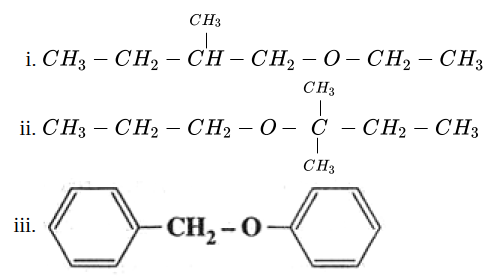
Give the major products that are formed by heating each of the following ethers with HI.
Image
A compound $(X)$ reacts with $PCl_5$ to form compound $Y.$ Compound $Y$ reacts with ethereal solution of magnesium to form compound $(Z),$ which on treating with propanone and further hydrolysis to give $2-$ Methyl propan$-2-ol.$ What are the compounds $X$ and $Y$ and also give the equations of the reactions.
Write down the $\text{IUPAC}$ name for the following complex and indicate the oxidation state, electronic configuration and coordination number. Also give stereochemistry and magnetic moment of the complex:
$\ce{[Co(NH_3)_5Cl-]Cl_2}$
Write down the difference between $SN^1$ and $SN^2$ reaction.
Explain nucleophilic addition reaction of aldehydes and ketones with hydrogen cyanide $\ce{(HCN)}.$
Nalorphene $\left( C _{19} H _{21} NO _3\right)$, similar to morphine, is used to combat withdrawal symptoms in narcotic users. Dose of nalorphene generally given is 1.5 mg. Calculate the mass of $1.5 \times 10^{-3} m$ aqueous solution required for the above dose.