Question
Give the meaning of rebate.
Answer

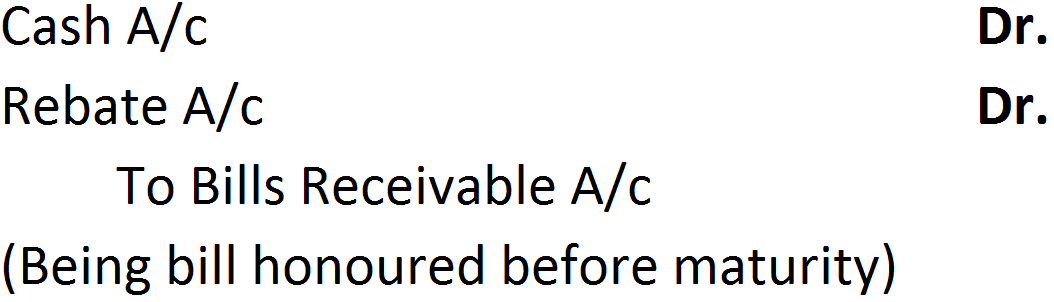
If the drawee expresses his/ her wish to pay the bill before the due date to the holder, and if the holder accepts his/ her request, then on account of the early payment, the holder may give some discount. This discount is termed as rebate. In other words, rebate is a discount given by the holder to the drawee (or acceptor) for his/ her request of early payment of the bill before the due date. It is an expense for the drawer and hence, is debited to the drawer’s books. On the other hand, as it is a gain for the acceptor of bill, so it is credited in the drawee’s books. Entry in the books of drawer of the bill.
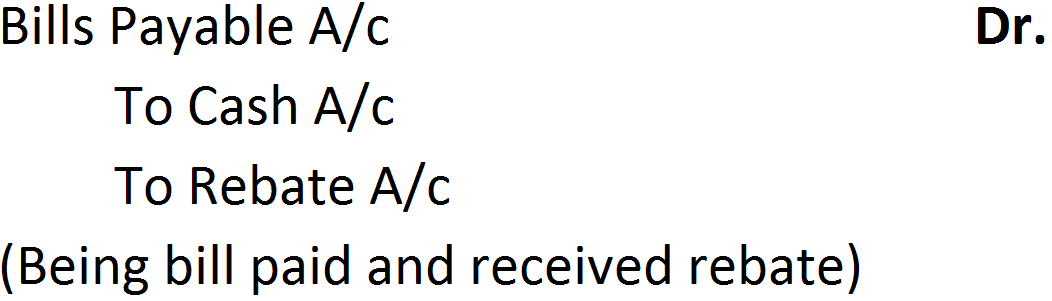
Entry in the books of drawee of the bill.

Need a full question paper?

Generate a complete, print-ready paper with questions like this in minutes — across 16+ boards, with answer keys.

Start Generating Free

Similar questions

Enter the following transaction in a double column cash book of M/s.Mohit Traders for January 2017:
 
 
01
Cash in hand
3,500
 
Bank overdraft
2,300
03
Goods purchased for cash
1,200
05
Paid wages
200
10
Cash sales
8,000
15
Deposited into bank
6,000
22
Sold goods for cheque which was deposited into bank same day
2,000
25
Paid rent by cheque
1,200
28
Drew from bank for personal use
1,000
31
Bought goods by cheque
1,000
X Ltd. purchased a plant on 1st July, 2010 costing ₹ 5,00,000. It purchased another plant on 1st September, 2010 costing ₹ 3,00,000. On 31st December, 2012, the plant purchased on 1st July, 2010 got out of order and was sold for ₹ 2,15,000. Another plant was purchased to replace the same for ₹ 6,00,000. Depreciation is to be provided at 20% p.a. according to Writen Down Value Method. The accounts are closed every year on 31st March.
Show the Plant Account and Provision for Depreciation Account.
M/s Lokesh Fabrics purchased a Textile Machine on April 01, 2011 for ₹ 1,00,000. On July 01, 2012 another machine costing ₹ 2,50,000 was purchased . The machine purchased on April 01, 2011 was sold for ₹ 25,000 on October 01, 2015. The company charges depreciation @15% p.a. on straight line method. Prepare machinery account and machinery disposal account for the year ended March 31, 2016.
What is Double-Entry System? Explain its principles and advantages.
Journalise the following transactions in the Journal of M/s. Gupta Brothers (Prop. Shri R. K. Gupta), Delhi and post them to the Ledger:
2019
 
March 1
Started business with cash
2,00,000
March 2
Opened bank account with SBI
80,000
March 4
Goods purchased from Raj, Jaipur (Rajasthan)
22,000
March 5
Goods purchased for cash
30,000
March 8
Goods sold to Naman, Delhi
12,000
March 10
Cash paid to Raj
22,000
March 15
Cash received from Naman
11,700
Discount allowed
300
March 16
Paid wages
200
March 18
Furniture purchased for office use
5,000
March 20
Withdrawn from bank for personal use
4,000
March 22
Issued cheque for rent
3,000
March 23
Goods taken for household purpose. These goods were purchased from Raj
2,000
March 24
Drawn cash from bank for office use
6,000
March 26
Commission received
1,000
March 27
Bank charges
300
March 28
Cheque issued for life insurance premium of Proprietor
3,000
March 29
Paid salary
10,000
March 30
Cash sales
20,000
Bhushan & Company purchased a Machinery on 1st April, 2015, for ₹ 54,000 and spent ₹ 6,000 on its installation. On 1st December, 2016, it purchased another machine for ₹ 30,000.
On 30th June 2017, the first machine purchased on 1st April, 2015, is sold for ₹ 36,000 and on the same date it purchased a new machinery for ₹ 80,000.
On December 1, 2018, the second machine (purchased on December 1, 2016) was also sold off for ₹ 26,000.
Depreciation was provided on machinery @ 10% p.a. on Original Cost Method annually on 31st March. Give the machinery account for four years.
On 1st January 2017, Hari drew on Gopal, who is his debtor for ₹ 60,000 three bills of exchange: First for ₹ 15,000 at one month, Second for ₹ 20,000 at two months and third for ₹ 25,000 at three months. Gopal accepted all the three bills.
On 5th January 2017, Hari endorsed the first bill to his creditor Satish in full settlement of his account of ₹ 15,200. This bill was duly met on maturity.
On 1st February 2017, the second bill was discounted from the bank @ 12% p.a. This bill was dishonoured on the due date and bank paid ₹ 120 as noting charges. On Gopal's request, Hari drew a fourth bill on Gopal for 2 months for the amount due plus interest @ 15% p.a.
Third bill was paid under a rebate of 12% p.a. one month before maturity. The fourth bill was sent to bank for collection on 4th May 2017 and was duly met on maturity.
Pass Journal entries in the books of Hari, Gopal and Satish.
Rectify the following errors and ascertain the amount of difference in trial balance by preparing suspense account:
  1. Credit sales to Mohan ₹ 7,000 were not posted.
  2. Credit purchases from Rohan ₹ 9,000 were not posted.
  3. Goods returned to Rakesh ₹ 4,000 were not posted.
  4. Goods returned from Mahesh ₹ 1,000 were not posted.
  5. Cash paid to Ganesh ₹ 3,000 was not posted.
  6. Cash sales ₹ 2,000 were not posted.
An extract of Trial balance from the books of Tahiliani and Sons Enterprises on March 31, 2017 is given below:
Name of the Account Debit Amount Credit Amount
 
Sundry debtors 50,000  
Bad debts 6,000  
Provision for doubtful debts   4,000
Additional Information:
  • Bad Debts proved bad but not recorded amounted to ₹ 2,000.
  • Provision is to be maintained at 8% of Debtors.
Give necessary accounting entries for writing off the bad debts and creating the provision for doubtful debts account. Also show the necessary accounts.
Explain the meaning of any three of the following terms:
Consistency.