Question
Give the relationship between $\Delta U$ and $\Delta H$ for gases.

Answer

Let $V _{ A }$ be the total volume of gaseous reactants,
 $V _{ B }$ be the total volume of gaseous product.
Let $n _{ A }$ be the number of moles of the reactant, 
$n _{ B }$ be the number of moles of the product,
At constant pressure and temperature,
$
\begin{aligned}
& p V_A=n_A R T, \\
& p V_B=n_B R T \\
& \Rightarrow pV_{B}-pV_{A}=\left(n_{B}-n_{A}\right) RT \\
& \Rightarrow p \Delta V=(\Delta n)_g RT
\end{aligned}
$
Here, $(\Delta n)_g=n_B-n_A$ is equal to the difference between the number of moles of gaseous products and gaseous reactants. 
We know that,
$
\Delta H=\Delta U+(\Delta n)_g R T
$
Now, $\Delta H = q _{ p }$ (heat change under constant pressure),
$\Delta U = q _{ v }$ (heat change under constant volume).
Therefore, $q_p=q_v+(\Delta n)_g R T$

Need a full question paper?

Generate a complete, print-ready paper with questions like this in minutes — across 16+ boards, with answer keys.

Start Generating Free

Similar questions

Which of the following species, do not show a disproportionation reaction and why?
$ClO ^{-}, ClO _2^{-}, ClO _3^{-}$and $ClO _4^{-}$
Also, write the reaction for each of the species that disproportionate.
Which of the following pairs of elements would have a more negative electron gain enthalpy? 
O or F
The degree of ionization of a 0.1M bromoacetic acid solution is 0.132. Calculate the pH of the solution and the pKa of bromoacetic acid.
10mL of H, combine with 5mL of O2 to form water. When 200mL of H, at STP is passed over heated CuO, the CuO loses 0.144g of its weight. Does the above data correspond to the law of constant composition?
Lifetimes of the molecules in the excited states are often measured by using pulsed radiation source of duration nearly in the nano second range. If the radiation source has the duration of 2 ns and the number of photons emitted during the pulse source is 2.5 × 10¹⁵, calculate the energy of the source.
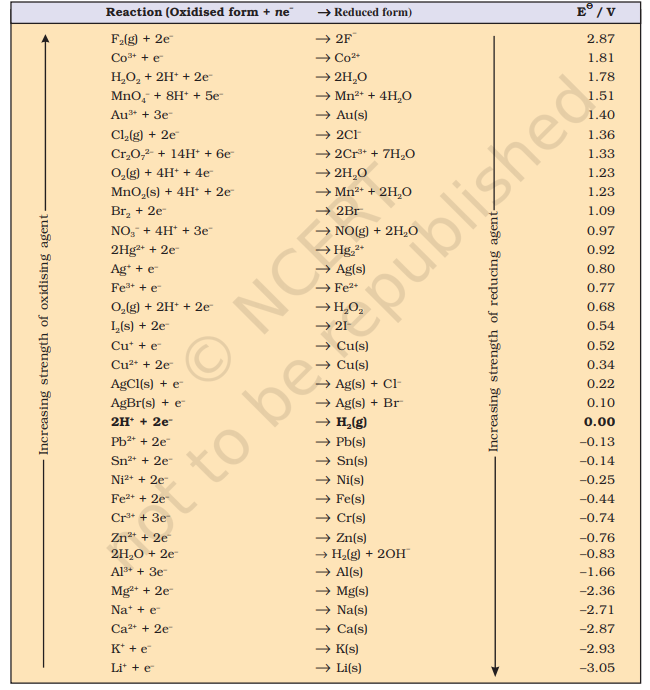
Using the standard electrode potentials given in the Table, predict if the reaction between the following is feasible:

Fe3+(aq) and Cu(s).
For the following bond cleavages, use curved-arrows to show the electron flow and classify each as homolysis or heterolysis. Identify reactive intermediate produced as free radical, carbocation and carbanion.

How much energy is required to ionise a $H$ atom if the electron occupies $n = 5$ orbit? Compare your answer with the ionization enthalpy of H atom (energy required to remove the electron from $n=1$ orbit).
Consider the following structure:
$\ \ \ \ \ \ \ \ \ \ \ \ \ \ \ \ \ \ \ \ \ \ \ \ \ \ \ \ \ {\text{O}}\\\ \ \ \ \ \ \ \ \ \ \ \ \ \ \ \ \ \ \ \ \ \ \ \ \ \ \ \ \ \ \|\\\ ^1\text{C}_3-\ ^2\text{CH}_2-\ ^3\text{C}-\ ^4\text{C}_2-\ ^5\text{C}\equiv\ ^6\text{CH}$
  1. How many σ and π-bonds are present in this compound?
  2. Arrange carbon no. 2, 3, 5 in decreasing order of s-character.
  3. Which atoms have same hybrid state?
How much oxygen and air is required for complete combustion of $8 4 gm$ propene?