MCQ
Given below are two statements: one is labelled as Assertion $A$ and the other is labelled as Reason $R$.

Assertion $A$ : Boric acid is a weak acid

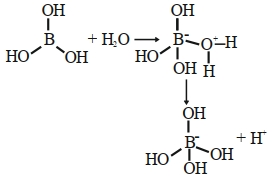
Reason $R$ : Boric acid is not able to release $H ^{+}$ion on its own. It receives $OH ^{-}$ion from water and releases $H ^{+}$ion.

In the light of the above statements, choose the most appropriate answer from the options given below.

  • Both $A$ and $R$ are correct and $R$ is the correct explanation of $A$
  • B
    Both $A$ and $R$ are correct but $R$ is NOT the correct explanation of $A$
  • C
    $A$ is correct but $R$ is not correct
  • D
    $A$ is not correct but $R$ is correct

Answer

Correct option: A.
Both $A$ and $R$ are correct and $R$ is the correct explanation of $A$
a

Need a full question paper?

Generate a complete, print-ready paper with questions like this in minutes — across 16+ boards, with answer keys.

Start Generating Free

Similar questions

If the wavelength for an electron emitted from $H$ atom is $3.3 \times 10^{-10}\,m$, then energy absorbed by the electron in its ground state compared to minimum energy required for its escape from the atom, is $.......$times. (Nearest integer).

[Given $: h =6.626 \times 10^{-34}\,Js$,Mass of electron $=9.1 \times 10^{-31}$ ]

Complete combustion of $0.858\;g$ of compound $X$ gives $2.63\;g$ of $C{O_2}$ and $1.28\;g$ of ${H_2}O$. The lowest molecular mass $X$ can have ............ $\mathrm{g}$
Match the reactions (in the given stoichiometry of the reactants) in List-$I$ with one of their products given in List-$II$ and choose the correct option.

List-$I$ List-$II$
$\mathrm{P}_2 \mathrm{O}_3+3 \mathrm{H}_2 \mathrm{O} \rightarrow$ $\mathrm{P}(\mathrm{O})\left(\mathrm{OCH}_3\right) \mathrm{Cl}_2$
$\mathrm{P}_4+3 \mathrm{NaOH}+3 \mathrm{H}_2 \mathrm{O} \rightarrow$ $\mathrm{H}_3 \mathrm{PO}_3$
$\mathrm{PCl}_5+\mathrm{CH}_3 \mathrm{COOH} \rightarrow$ $\mathrm{PH}_3$
$\mathrm{H}_3 \mathrm{PO}_2+2 \mathrm{H}_2 \mathrm{O}+4 \mathrm{AgNO}_3 \rightarrow$ $\mathrm{H}_3 \mathrm{PO}_4$


Compound $A$ gives $D-$Galactose and $D-$Glucose on hydrolysis. The compound $A$ is:
Ionisation constant of a weak acid $(HA)$ in terms of $\Lambda _m^\infty $ and ${\Lambda _m}$
Noble gases are absorbed by
A gas reacts with $CaO$, but not with $NaHC{O_3}$. The gas is
Which of the following transitions are allowed in the normal electronic emission spectrum of an atom ?
Which of the following compound will form $2^o -$ alcohol when treated with Grignard reagent followed by hydrolysis
Hydrolysis of acetamide produces