MCQ
Given below are two statements : one is labelled as Assertion (A) and the other is labelled as Reason (R).
Assertion (A) : The density of the copper $\left({ }_{29}^{64} \mathrm{Cu}\right)$ nucleus is greater than that of the carbon $\left({ }_{6}^{12} \mathrm{C}\right)$ nucleus.
Reason (R): The nucleus of mass number A has a radius proportional to $\mathrm{A}^{1 / 3}$.
In the light of the above statements, choose the most appropriate answer from the options given below :
  • A
    (A) is correct but (R) is not correct
  • B
    (A) is not correct but (R) is correct
  • C
    Both (A) and (R) are correct and (R) is the correct explanation of (A)
  • D
    Both (A) and (R) are correct but (R) is not correct explanation of (A)
Answer

B. (A) is not correct but (R) is correct
$\quad \rho=\frac{M}{V}=\frac{m_{n} \times A}{\frac{4}{3} \pi R^{3}}=\frac{m_{n} \times A}{\frac{4}{3} \pi A R_{0}^{3}}$
So $\rho$ is almost is constant
$\mathrm{R}=\mathrm{R}_{0} \mathrm{~A}^{1 / 3}$
$R \propto A^{1 / 3}$

Need a full question paper?

Generate a complete, print-ready paper with questions like this in minutes — across 16+ boards, with answer keys.

Start Generating Free

Similar questions

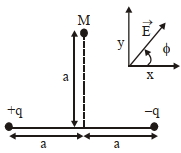
Consider two charges. $+q$ and $-q,(q > 0)$ placed at a distance $2 a$ from each other. At the point $M$ (see figure below), the electric field makes an angle $\phi$ from the $x$ axis. The correct value of $\phi$ is
The limiting value of static friction between two contact surfaces is ........... 
A bungee jumper is jumping with help of elastic ideal rope (Force constant $K$). Jumper steps off the bridge and falls from the rest towards the river below. He does not hit the water. The mass of jumper is $m$, natural length of rope is $l$. Gravity is $g$, assume every thing ideal. then, choose the incorrect option
When a body slides down from rest along a smooth inclined plane making an angle of $30^{\circ}$ with the horizontal, it takes time $T$. When the same body slides down from the rest along a rough inclined plane making the same angle and through the same distance, it takes time $\alpha {T}$, where $\alpha$ is a constant greater than $1 .$ The co-efficient of friction between the body and the rough plane is $\frac{1}{\sqrt{{x}}}\left(\frac{\alpha^{2}-1}{\alpha^{2}}\right)$ where ${x}=..... .$
In the experimental setup of meter bridge shown in the figure, the null point is obtained at a distance of $40\,cm$ from $A$. If a $10\,\Omega $ resistor is connected in series with $R_1$, the null point shifts by $10\,cm$. The resistance that should be connected in parallel with $\left( {{R_1} + 10} \right)\,\Omega $ such that the null point shifts back to its initial position is .............. $\Omega$
The length of the tube of a microscope is $10\, cm$. The focal lengths of the objective and eye lenses are $0.5\, cm$ and $1.0 \,cm$. The magnifying power of the microscope is about
Under the influence of a uniform magnetic field a charged particle is moving in a circle of radius $R$ with constant speed $v$. The time period of the motion
A long solenoid has $200$ turns per cm and carries a current of $2.5\, amps$. The magnetic field at its centre is $({\mu _0} = 4\pi \times {10^{ - 7}}\,weber/amp{\rm{ - }}m)$
The tangent galvanometer, when connected in series with a standard resistance can be used as
If error in measuring diameter of a circle is $4\%$, the error in circumference of the circle would be