MCQ
Given below are two statements : One is labelled as Assertion $A$ and the other is labelled as Reason $R$.

Assertion $A$ : $n - p - n$ transistor permits more current than a $p-n-p$ transistor

Reason $R$ : Electrons have greater mobility as a charge carrier

Choose the correct answer from the options given below

  • Both $A$ and $R$ true. and $R$ is correct explanation of $A$
  • B
    Both $A$ and $R$ are true but $R$ is $NOT$ the correct explanation of $A$
  • C
    $A$ is true but $R$ is false
  • D
    $A$ is false but $R$ is true

Answer

Correct option: A.
Both $A$ and $R$ true. and $R$ is correct explanation of $A$
a
Theory

Need a full question paper?

Generate a complete, print-ready paper with questions like this in minutes — across 16+ boards, with answer keys.

Start Generating Free

Similar questions

The specific resistance of a rod of copper as compared to that of thin wire of copper is:
The magnetic field of a plane electromagnetic wave is given by

$\overrightarrow{ B }=2 \times 10^{-8} \sin \left(0.5 \times 10^{3} x +1.5 \times 10^{11} t \right) \hat{ j } T$ The amplitude of the electric field would be.

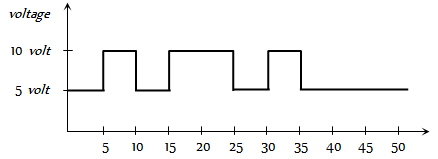
In a negative logic the following wave form corresponds to the
A beam of light consisting of two wavelengths $650\, nm$ and $520\, nm$ is used to illuminate the slit of a Young’s double slit experiment. Then the order of the bright fringe of the longer wavelength that coincide with a bright fringe of the shorter wavelength at the least distance from the central maximum is
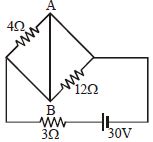
Considering the following circuit, select the correct alternative
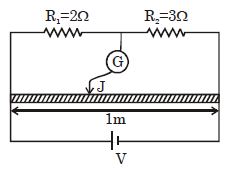
In a meter bridge experiment, initially the jockey is at null point. Now resistance $R_1$  $\&$ $R_2$ is interchanged. Shift in the position of jockey is  ................ $cm$
A galvanometer is used in laboratory for the null point in electrical experiments. If, on passing a current of $6 \,m A$ it produces a deflection of $2^{\circ},$ its figure of merit is close to :
A point electric dipole placed at the origin has a potential given by $V(r, \theta)=\frac{p \cos \theta}{4 \pi \varepsilon_0 r^2}$, where $\theta$ is the angle made by the position vector with the direction of the dipole. Then,
If an $\alpha$-particle and a proton are accelerated from rest by a potential difference of 1 megavolt then the ratio of their kinetic energy will be
A light beam is being reflected by using two mirrors, as in a periscope used in submarines. If one of the mirrors rotates by an angle q, the reflected light will deviate from its original path by the angle