MCQ
Given below are two statements :

$Statement$ $(I)$ : Planck's constant and angular momentum have same dimensions.

$Statement$ $(II)$ : Linear momentum and moment of force have same dimensions.

In the light of the above statements, choose the correct answer from the options given below :

  •  Statement $I$ is true but Statement $II$ is false
  • B
    Both Statement $I$ and Statement $II$ are false
  • C
     Both Statement $I$ and Statement $II$ are true
  • D
     Statement $I$ is false but Statement $II$ is true

Answer

Correct option: A.
 Statement $I$ is true but Statement $II$ is false
a
$ {[\mathrm{h}]=\mathrm{ML}^2 \mathrm{~T}^{-1}} $

$ {[\mathrm{~L}]=\mathrm{ML}^2 \mathrm{~T}^{-1}} $

$ {[\mathrm{P}]=\mathrm{MLT}^{-1}} $

$ {[\tau]=\mathrm{ML}^2 \mathrm{~T}^{-2}}$

(Here $\mathrm{h}$ is Planck's constant, $\mathrm{L}$ is angular momentum, $\mathrm{P}$ is linear momentum and $\tau$ is moment of force)

Need a full question paper?

Generate a complete, print-ready paper with questions like this in minutes — across 16+ boards, with answer keys.

Start Generating Free

Similar questions

A body moves in a circular orbit of radius $R$ under the action of a central force. Potential due to the central force is given by $V(r)=k r$ ( $k$ is a positive constant). Period of revolution of the body is proportional to
The air density at Mount Everest is less than that at the sea level. It is found by mountaineers that for one trip lasting a few hours, the extra oxygen needed by them corresponds to $30,000\ cc$ at sea level (pressure $1$ atmosphere, temperature $27^oC).$ Assuming that the temperature around Mount Everest is $-73^oC$ and that the oxygen cylinder has capacity of $5.2\ litre,$ the pressure at which $O_2$ be filled (at site) in cylinder is ..... $atm$
Which of the following quantities are always negative in a $SHM$
The equation $\frac{{dV}}{{dt}} = At - BV$ is describing the rate of change of velocity of a body falling from rest in a resisting medium. The dimensions of $A$ and $B$ are
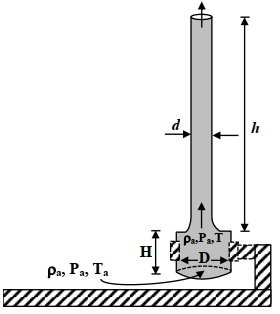
A cylindrical furnace has height $(H)$ and diameter $(D)$ both $1 \mathrm{~m}$. It is maintained at temperature $360 \mathrm{~K}$. The air gets heated inside the furnace at constant pressure $P_a$ and its temperature becomes $T=360 \mathrm{~K}$. The hot air with density $\rho$ rises up a vertical chimney of diameter $d=0.1 \mathrm{~m}$ and height $h=9 \mathrm{~m}$ above the furnace and exits the chimney (see the figure). As a result, atmospheric air of density $\rho_a=1.2 \mathrm{~kg} \mathrm{~m}^{-3}$, pressure $P_a$ and temperature $T_a=300 \mathrm{~K}$ enters the furnace. Assume air as an ideal gas, neglect the variations in $\rho$ and $T$ inside the chimney and the furnace. Also ignore the viscous effects.

[Given: The acceleration due to gravity $g=10 \mathrm{~ms}^{-2}$ and $\pi=3.14$ ]

(image)

($1$) Considering the air flow to be streamline, the steady mass flow rate of air exiting the chimney is

. . . . .$\mathrm{gm} \mathrm{s}^{-1}$.

($2$) When the chimney is closed using a cap at the top, a pressure difference $\Delta P$ develops between the top and the bottom surfaces of the cap. If the changes in the temperature and density of the hot air, due to the stoppage of air flow, are negligible then the value of $\Delta P$ is. . . . .$\mathrm{Nm}^{-2}$.
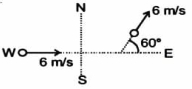
A particle is moving eastwards with a speed of $6 \,m / s$. After $6 \,s$, the particle is found to be moving with same speed in a direction $60^{\circ}$ north of east. The magnitude of average acceleration in this interval of time is ....... $m / s ^2$
An organ pipe ${P_1}$ closed at one end vibrating in its first overtone and another pipe ${P_2}$ open at both ends vibrating in its third overtone are in resonance with a given tuning fork. The ratio of lengths of ${P_1}$ and ${P_2}$ is
Two oscillating systems; a simple pendulum and a vertical spring-mass-system have same time period of motion on the surface of the Earth. If both are taken to the moon, then-
The temperature at which the speed of sound in air becomes double of its value at ${27^o}C$ is ... $^oC$
In an experiment four quantities $a, b, c$ and $d$ are measured with percentage error $1\%, 2\%, 3\%$ and $4\%$ respectively. Quantity $w$ is calculated as follows $w\, = \,\frac{{{a^4}{b^3}}}{{{c^2}\sqrt D }}$  error in the measurement of $w$ is .......... $\%$