Question
Given below is a diagram representing a stage during mitotic cell division in an animal cell examine it carefully and answer the questions which follow.
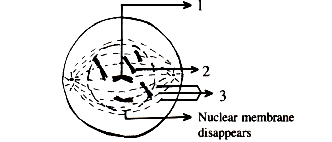
a) Identify the stage. Give one reason in support of your answer.
b) Name the cell organelle that forms the ‘aster’
c) Name the parts labelled 1, 2 and 3.
d) Name the stage that follows the one shown above, how is that stage identified?
e) Mention two differences between mitosis and meiosis with regards to:
(i) The number of daughter cells produced.
The chromosome number in the daughter cells.
Answer

(a) Late prophase. Because the nuclear membrane and nucleolus have disappeared.
(b) Centrioles
(c) 1 – Centromere
2 - Chromatids.
3 - Spindle fibre.
(d) Metaphase.
The centromeres of chromosomes are drawn to the equator by equal pull of two chromosomal spindle fibres that connects each centromere to the opposite poles, forming a metaphasic plate.
  Mitosis   Meiosis
1. Two daughter cells are produced. 1. Four daughter cells are produced.
2. It is equational division i.e. the number of chromosome in the daughter cells or parent cells remains the same. 2. It is reductional division i.e. the number of chromosomes is reduced to half in the daughter cells.

Need a full question paper?

Generate a complete, print-ready paper with questions like this in minutes — across 16+ boards, with answer keys.

Start Generating Free

Similar questions

Discuss the health hazards associated with the pollution.
List the events taking place in the photo-chemical phase of Photosynthesis.
How would you demonstrate that green plants release oxygen when exposed to light?
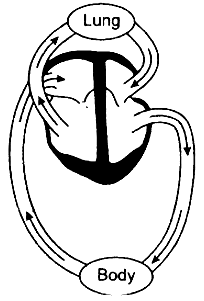
The diagram represents the ‘closed system’ or ‘double circulation’ of blood in mammals.

Justify the above statement.
State two structural and two functional differences between the arteries and veins.
State the changes in the composition of blood as it passes through the following organs:
(a) Lungs (b) Gut (c) Liver (d) Kidneys.
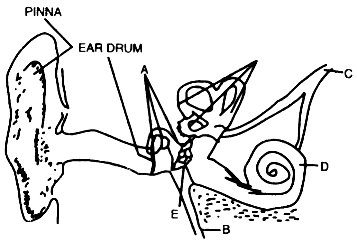
Given below is the diagram of the human ear. Study the same and answer the questions that follow:
(i) Give the biological term for the part labeled ‘A’ and state its function.
(ii) Name the part labeled ‘B’ and state its function.
(iii) Name the part labeled ‘C’ and state its function.
(iv) Give the function of ear wax.
What is circulatory system? Describe the circulatory system of humans.
Match the Columns:
Column 2 is a list of items related to ideas in Column 1. Match the term in Column 2 with the suitable idea given in Column 1.
Column 1Column 2
(i) Family Planning(a) Counting of population
(ii) Vasectomy(b) Sterilization in female
(iii) Tubectomy(c) T.R. Malthus
(iv) Census(d) Sterilization in male
(v) Malthusian theory(e) Red triangle.
Name the three types of transpiration.
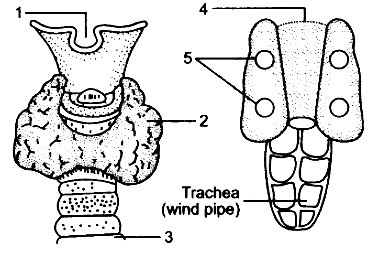
Given alongside are the diagrammatic sketches of some endocrine glands. Observe the figures and answer the following questions:
(i) Label the parts numbered 1 to 5.
(ii) Name the hormones secreted by (2) and (5).
(iii) Which chemicals in our body are greatly affected by hormones?
(iv) What is the chemical nature of hormones?
(v) Name the elements related to the functioning of hormones secreted by the structure (2) and (5).
Differentiate between:
genotype and phenotype