Question
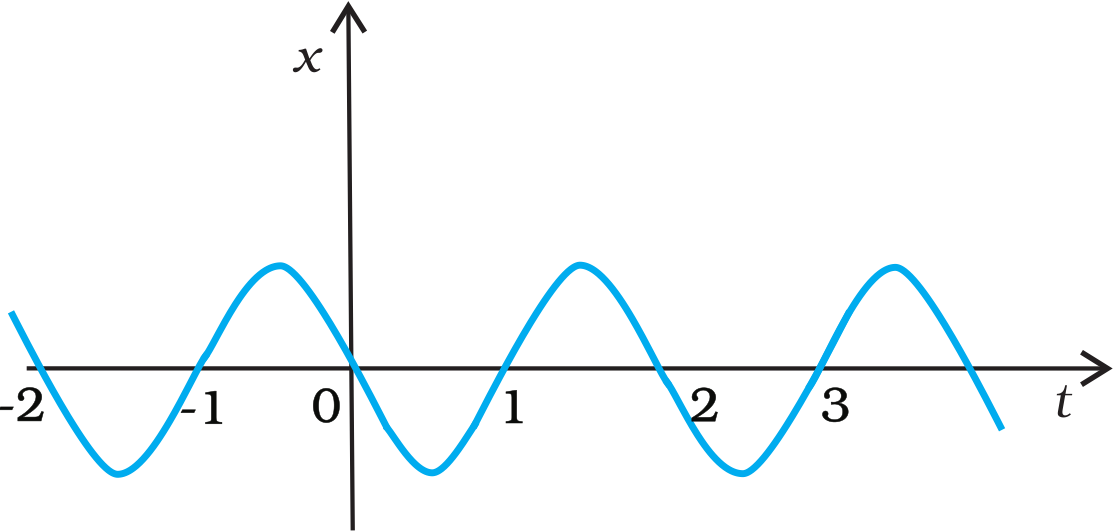
Gives the x-t plot of a particle executing one-dimensional simple harmonic motion. (You will learn about this motion in more detail in Chapter 14). Give the signs of position, velocity and acceleration variables of the particle at t = 0.3 s, 1.2 s, – 1.2 s.
Answer

For simple harmonic motion (SHM) of a particle, acceleration (a) is given by the relation: $\text{a}=-\omega^2\text{x}$ Where $\omega$ = angular frequency t = 0.3s In this time interval, x is negative. Now the slope of the x-t plot is negative. Therefore, both position and velocity are negative. Acceleration of the particle using (i) will be positive. t = 1.2s In this time interval, x is positive. Now the slope of the x-t plot is positive. Therefore, both position and velocity are positive. Acceleration of the particle using (i) will be negative. t = – 1.2s In this time interval, x is negative. Now the slope of the x-t plot is positive. Therefore, position is negative and velocity is positive. Acceleration of the particle using (i) will be positive.

Need a full question paper?

Generate a complete, print-ready paper with questions like this in minutes — across 16+ boards, with answer keys.

Start Generating Free

Similar questions

A rain drop of radius $2mm$ falls from a height of $500m$ above the ground. It falls with decreasing acceleration (due to viscous resistance of the air) until at half its original height, it attains its maximum (terminal) speed, and moves with uniform speed thereafter. What is the work done by the gravitational force on the drop in the first and second half of its journey? What is the work done by the resistive force in the entire journey if its speed on reaching the ground is $10 m s^{-1}$?
A body cools from 60°C to 50°C in 10 minutes. Find its temperature at the end of the next 10 minutes if the room temperature is 25 °C. Assume Newton's law of cooling.
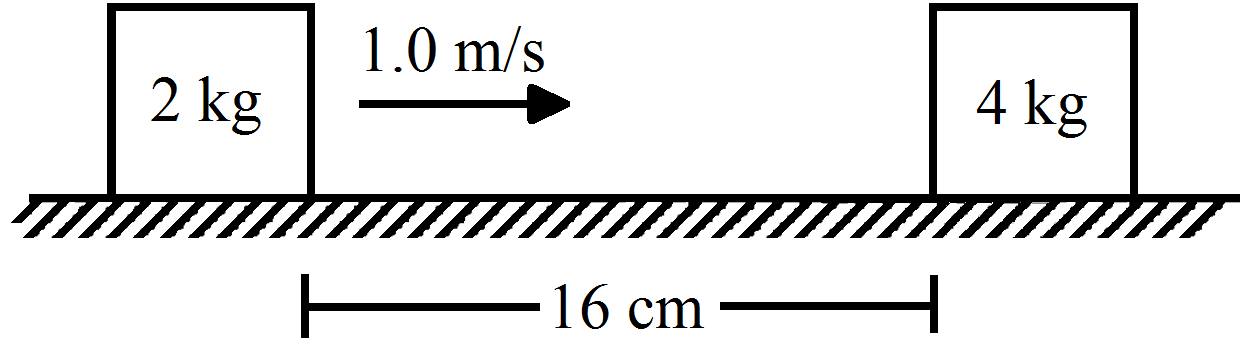
The friction coefficient between the horizontal surface and each of the blocks shown in figure is 0.20. The collision between the blocks is perfectly elastic. Find the separation between the two blocks when they come o rest. Take $g = 10 m/s^2.$​​​​​​​
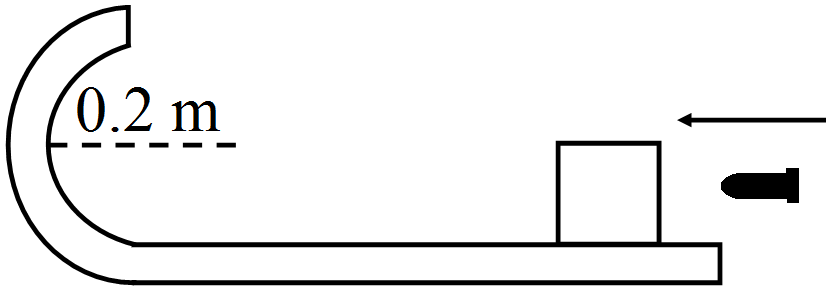
A bullet of mass $10g$ moving horizontally at a speed of $5017m/s$ strikes a block of mass $490g$ kept on a frictionless track as shown in figure. The bullet remains inside the block and the system proceeds towards the semicircular track of radius $0.2m$. Where will the block strike the horizontal part after leaving the semicircular track ?
A rigid bar of mass $15kg$ is supported symmetrically by three wires each $2.0m$ long. Those at each end are of copper and the middle one is of iron. Determine the ratios of their diameters if each is to have the same tension.
A block of mass M is kept on a rough horizontal surface. The coefficient of static friction between the block and the surface is $\mu.$ The block is to be pulled by applying a force to it. What minimum force is needed to slide the block? In which direction should this force act?
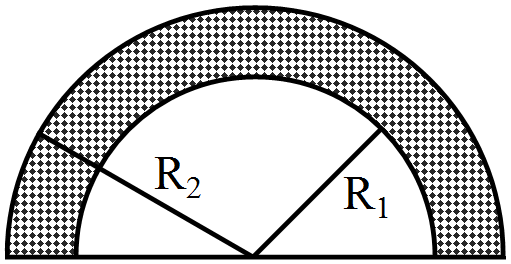
Find the centre of mass of a uniform plate having semicircular inner and outer boundaries of radii $R_1$ and $R_2$.
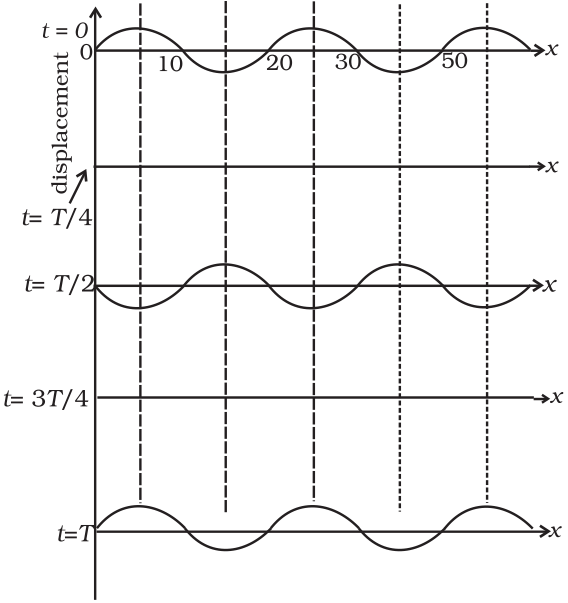
The wave pattern on a stretched string is shown in Interpret what kind of wave this is and find its wavelength.
Consider a cycle tyre being filled with air by a pump. Let V be the volume of the tyre (fixed) and at each stroke of the pump $\Delta\text{V}(<<\text{V})$ of air is transferred to the tube adiabatically. What is the work done when the pressure in the tube is increased from $P_1$ to $P_2$?
Explain Doppler effect in sound. Obtain an expression for apparent frequency of sound when source moves and listener is at rest.