Question
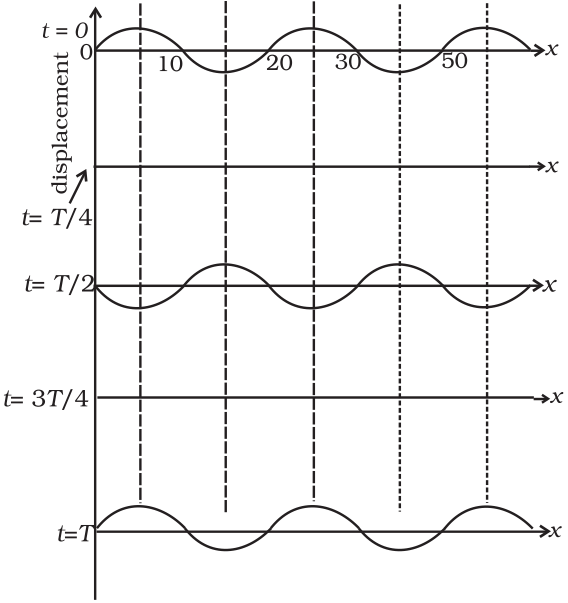
The wave pattern on a stretched string is shown in Interpret what kind of wave this is and find its wavelength.
Answer

The displacement of medium particlles at distance 10, 20, 30, 40, and 50cm are always rest which is the property of nodes in stationary wave.
$\text{AT}\ \text{t}=\frac{\text{T}}{4}$ and $\frac{\text{3T}}{4}$ all particle are at rest wgich is in stationary wave when the particle crossrs its mean position.
so thet praph of wave shos stationaty wave.
The wave at $\text{x}=10,\ 20,\ 30,\ 40\text{cm}$ there are nodes and distance between successive nodes is $\frac{\lambda}{2}$
$\therefore\frac{\lambda}{2}=(30-20)$ or $\lambda=20\text{cm.}$

Need a full question paper?

Generate a complete, print-ready paper with questions like this in minutes — across 16+ boards, with answer keys.
Start Generating Free

Similar questions

Explain by making a labelled diagram of two dimensional collision or oblique collision.
A block of mass $200g$ is released from P which slides down without friction till it reaches a point Q of a circular path of radius $2.0m$. Find.
  1. The velocity of the block at point Q and.
  2. The coefficient of friction if the block comes to rest $2.0m$ from Q, assuming the horizontal part of the path is rough. Take $g = 10ms^{-2}$.
A car starting from rest, accelerates uniformly with $5m/s^2$ for sometime and then decelerates to come to rest with $3m/s^2$. Find the maximum velocity attained during the motion and the distance covered in a total time of 6 seconds of the journey.
A capacitor of capacitance $2.0\mu\text{F}$ is charged to a potential difference of $12V$. It is then connected to an uncharged capacitor of capacitance $4.0\mu\text{F}$ as shown in figure. Find:
  1. The charge on each of the two capacitors after the connection.
  2. The electrostatic energy stored in each of the two capacitors.
  3. The heat produced during the charge transfer from one capacitor to the other.
Prove that with constant angular speed a radius the perpendicular to the point of rotation of a person rotating in a circular path performs simple harmonic motion. Also find the equation of this motion.
Given below are densities of some solids and liquids. Give rough estimates of the size of their atoms:
Substance
Atomic Mass(u)
Density $(10^3kgm^{-3})$
Carbon (diamond)
Gold
Nitrogen (liquid)
Lithium
Fluorine (liquid)
12.01
197.00
14.01
6.94
19.00
2.22
19.32
1.00
0.53
1.14
$\big[$Hint: Assume the atoms to be ‘tightly packed’ in a solid or liquid phase, and use the known value of Avogadro’s number. You should, however, not take the actual numbers you obtain for various atomic sizes too literally. Because of the crudeness of the tight packing approximation, the results only indicate that atomic sizes are in the range of a few $\mathring{\text{A}}\big].$
  1. State the laws of limiting friction.
  2. Calculate the amount of work done in moving a body up a rough inclined plane. (The object is moved very slowly.)
OR
  1. Why has a horse to pull a cart harder during the first few steps of its motion?
  2. How does banking of roads reduces wear and tear of the tyres?
  3. Find the maximum speed at which a car can take turn round a curve of $30m$ radius on a level road, if the coefficient of friction between tyres and road is 0.4. $(g = 10ms^{-2})$
Show that for a particle in linear SHM the average kinetic energy over a period of oscillation equals the average potential energy over the same period.
Figure. shows a cylindrical tube of length 30cm which is partitioned by a tight-fitting separator. The separator is very weakly conducting and can freely slide along the tube. Ideal gases are filled in the two parts of the vessel. In the beginning, the temperatures in the parts A and B are 400K and 100K respectively. The separator slides to a momentary equilibrium position shown in the figure. Find the final equilibrium position of the separator, reached after a long time.
You are riding in an automobile of mass $3000\  kg$. Assuming that you are examining the oscillation characteristics of its suspension system. The suspension sags $15\ cm$ when the entire automobile is placed on it. Also, the amplitude of oscillation decreases by $50\%$ during one complete oscillation. Estimate the values of $(a)$ the spring constant $k$ and $(b)$ the damping constant b for the spring and shock absorber system of one wheel, assuming that each wheel supports $750\ kg.$