Glucose gives many reactions of aldehyde, because
Medium


Download our appand get started for free
Experience the future of education. Simply download our apps or reach out to us for more information. Let's shape the future of learning together!No signup needed.*
Similar Questions
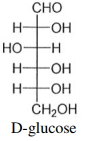
- 1The Fischer presentation of $D$-glucose is given below. The correct structure(s) of $\beta$-$L$-glucopyranose is (are)View Solution
- 2Which of the following statement is incorrect about $ \alpha -D-$ glucopyranose & $ \beta -D-$ glucopyranoseView Solution
- 3The given structure of $\alpha - $ amino acid will exist at which $pH$ ?View Solution
$\,\begin{array}{*{20}{c}}
{\,\,\,\,\,\,\,\,\,\,\,\,\,\,\,\,\,\,\,\,\,\,COOH}\\
{\,\,\,\,\,\,\,\,\,|}\\
{\mathop {N{H_3}}\limits^{\,\, \oplus } - C - H}\\
{\,\,\,\,\,\,\,\,\,\,|}\\
{\,\,\,\,\,\,\,\,\,\,R}
\end{array}\,\,\,$ - 4View SolutionThe vitamin which is water soluble and antioxidant is
- 5View SolutionWhich of the following is not an amino acid
- 6View SolutionThymine is
- 7For a double strand $DNA$, one strand is given below:View Solution
The amount of energy required to split the double strand $DNA$ into two single strands is . . . .kcal $mol ^{-1}$.
[Given: Average energy per $H$-bond for $A - T$ base pair $=1.0 kcal mol ^{-1}, G - C$ base pair $=1.5 kcal mol ^{-1}$, and $A - U$ base pair $=1.25 kcal mol ^{-1}$. Ignore electrostatic repulsion between the phosphate groups.]

- 8View SolutionIdentify correct statement for sucrose
- 9Match List $I$ with List $II$View Solution
List $I$ List $II$ $A$ $\alpha$-Glucose and $\alpha-$Galactose $I$ Functional isomers $B$ $\alpha$-Glucose and $\beta-$-Galactose $II$ Homologous $C$ $\alpha$-Glucose and $\alpha$-Galactose $III$ Anomers $D$ $\alpha$-Glucose and $\alpha$-Galactose $IV$ Epimers Choose the correct answer from the options given below:
- 10View SolutionThe secondary structure of a protein refers to