MCQ
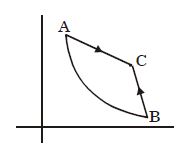
Graph $A-B$ is an adiabatic curve. Choose the correct statement
  • A
    Process $AC$ and $BC$ , both are exothermic
  • Process $AC$ and $BC$ , both are endothermic
  • C
    Process $AC$ is endothermic, $BC$ is exothermic
  • D
    Process $AC$ is exothermic, $BC$ is endothermic
Answer

Correct option: B.
Process $AC$ and $BC$ , both are endothermic
b

Need a full question paper?

Generate a complete, print-ready paper with questions like this in minutes — across 16+ boards, with answer keys.

Start Generating Free

Similar questions

A lamina is made by removing a small disc of diameter $2 \ R$ from a bigger disc of uniform mass density and radius $2 \ R$, as shown in the figure. The moment of inertia of this lamina about axes passing through $O$ and $P$ is $I _0$ and $I _{ p }$, respectively. Both these axes are perpendicular to the plane of the lamina. The ratio $\frac{ I _{ P }}{ I _0}$ to the nearest integer is:
Two vectors $\overrightarrow a $ and $\overrightarrow b $ are at an angle of $60^o$ with  each other. Their resultant makes an angle of $45^o$ with $\overrightarrow a $ . If $|\overrightarrow b | = 2\,units$ then $|\overrightarrow a |$ is:-
The temperature inside and outside of refrigerator are $260\, K$ and $315\, K$ respectively. Assuming that the refrigerator cycle is reversible, calculate the heat  delivered to surroundings for every joule of work done.
The temperature at which the surface tension of water is zero
Who gave the law of equipartition of energy?
A pendulum bob on a $2\, m$ string is displaced $60^{°}$ from the vertical and then released. What is the speed of the bob as it passes through the lowest point in its path .......... $m/s$
A ring of mass $m$ and radius $r$ rotates about an axis passing through its centre and perpendicular to its plane with angular velocity $\omega$. Its kinetic energy is
A force of $10$ Newton acts on a body of mass $20kg$ for $10 \,seconds$. Change in its momentum is  ........... $kg\,m/s$
A sinusoidal progressive wave is generated in a string. It’s equation is given by $y = (2\,\, mm) sin (2\pi x - 100 \pi t + \pi /3)$. The time when particle at $x = 4$ $m$ first passes through mean position, will be
A body is moving with a uniform acceleration covers $40\,m$ in the first $4\,s$ and $120\,m$ in next $4\,s.$ Its initial velocity and acceleration are