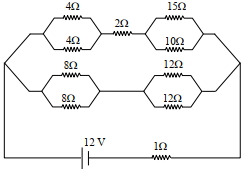
Heat produced in a wire of resistance $R$ due to current flowing at constant potential difference is proportional to
Easy
Download our app for free and get started
(b) At constant p.d., heat produced $ = \frac{{{V^2}}}{R}\,i.e.\,H \propto \frac{1}{R}$

Download our appand get started for free
Experience the future of education. Simply download our apps or reach out to us for more information. Let's shape the future of learning together!No signup needed.*
Similar Questions
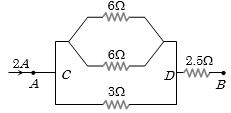
- 1The equivalent resistance and potential difference between $A$ and $B$ for the circuit is respectivelyView Solution
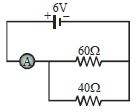
- 2The measurement of ammeter in the following circuit is ................... $A$ (Assuming ideal ammeter)View Solution
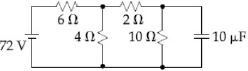
- 3Determine the charge on the capacitor in the following circuit ................ $\mu C$View Solution
- 4View SolutionAssertion : In a simple battery circuit, the point of the lowest potential is negative terminal of the battery.
Reason : The current flows towards the point of the higher potential, as it does in such a circuit from the negative to the positive terminal.
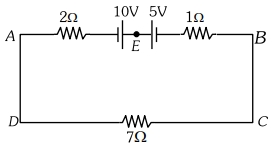
- 5View SolutionThe magnitude and direction of the current in the following circuit is :-
- 6$A$ brass disc and a carbon disc of same radius are assembled alternatively to make a cylindrical conductor. The resistance of the cylinder is independent of the temperature. The ratio of thickness of the brass disc to that of the carbon disc is [$\alpha$ is temperature coefficient of resistance and Neglect linear expansion ]View Solution
- 7$32$ cells, each of $emf$ $3V$, are connected in series and kept in a box. Externally, the combination shows an $emf$ of $84\, V$. The number of cells reversed in the combination isView Solution
- 8Wheatstone bridge principle is used to measure the specific resistance $\left(S_1\right)$ of given wire, having length $L$, radius $r$. If $X$ is the resistance of wire, then specific resistance is: $S_1=X\left(\frac{\pi r^2}{L}\right)$. If the length of the wire gets doubled then the value of specific resistance will be :View Solution
- 9With a potentiometer null point were obtained at $140\, cm$ and $180\, cm$ with cells of $emf$ $1.1 \,V$ and one unknown $X\, volts$. Unknown $emf$ is .............. $V$View Solution
- 10The voltage drop across $15\, \Omega$ resistance in the given figure will be $.....V.$View Solution