Question
  1. Heat(q) and work done (W) individually are not state functions but their sum is always a state function. Explain why?
  2. Calculate the standard enthalpy change $(\Delta_\text{r}\text{H}^\theta)$ and standard internal energy change $(\Delta_\text{r}\text{U}^\theta)$ for the following reaction at 300K:
$OF_2(g) + H_2O(g) + O_2(g) + 2HF(g)$
Standard enthalpy of formation $(\Delta_\text{r}\text{H}^\theta)$ of e n various species are given below:
$\Delta_\text{f}\text{H}^\theta\text{kJ mol}^{-1}: OF_2(g) = 23.0, H_2O(g)= -241.8, HF(g) = -268.6, R = 8.314 JK^{-1}mol^{-1}$.
Answer

 
  1. 'q’ is not a state function because it depends upon path.
'w' is not a state function because it depends upon path.
$\text{q}+\text{w}=\Delta\text{U}$ which is a state function because it is independent of path.
  1. $\text{OF}_2(\text{g})+\text{H}_2\text{O(g)}\overrightarrow{\ \ \ \ \ \ \ }\ \text{O}_2(\text{g})+2\text{HF(g)}$
$\Delta\text{n}=1+2-2=1$
$\Delta_\text{r}\text{H}^\circ=\sum\Delta_\text{f}\text{H}^\circ(\text{products})-\sum\Delta_\text{f}\text{H}^\circ(\text{reactants})$
$=\Delta_\text{f}\text{H}^\circ(\text{O}_2)+2\Delta_\text{f}\text{H}^\circ(\text{HF})-\Delta_\text{f}\text{H}^\circ(\text{OF}_2)\\-\Delta_\text{f}\text{H}^\circ(\text{H}_2\text{O})$
$=0+2\times(-268.6)-23.0-(-241.8)$
$=537.2-23.0+241.8$
$=-318.4\text{kJ}$
$\Delta_\text{f}\text{H}^\circ=\Delta_\text{r}\text{U}^\circ+\Delta\text{nRT}$
$-318.4\text{kJ}=\Delta_\text{r}\text{U}^\circ+\frac{1\times8.314\times300}{1000}\text{kJ}$
$-318.4\text{kJ}=\Delta_\text{r}\text{U}^\circ+2.4942\text{kJ}$
$\Delta_\text{r}\text{U}^\circ=-320.8942\text{kJ}$

Need a full question paper?

Generate a complete, print-ready paper with questions like this in minutes — across 16+ boards, with answer keys.

Start Generating Free

Similar questions

  1. Calculate the kinetic energy of an electron in second Bohr orbit of hydrogen atom. [$a_0$ is Bohr radius].
  2. Out of the d-orbials which does not have four lobes?
  3. What is physical significance of $\Psi^2?$
What is photoelectric effect? State the result of photoelectric effect experiment that could not be explained on the basis of laws of classical physics. Explain this effect on the basis of quantum theory of electromagnetic radiations.
Statues and monuments in India are affected by acid rain. How?
Attempt any five of the following:
1. What is electrophile in sulphonation?
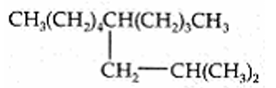
2. Write IUPAC name of following:
Image
3. Write IUPAC name: $CH _3 CH - C \left( CH _3\right)_2$
4. Methane does not react with chlorine in dark. Why?
5. How would you convert ethene to ethane molecule?
6. What is Huckel rule?
7. What is decarboxylation? Give an example.
Match the species in Column I with the type of hybrid orbitals in Column II.
 
Column I
 
Column II
i.
$H_3O^+$
a.
Linear
ii.
$HC = CH$
b.
Angular
iii.
$\text{ClO}^{-}_{2}$
c.
Tetrahedral
iv.
$\text{NH}^{+}_{4}$
d.
Trigonal bipyramidal
 
 
e.
Pyramidal
Discuss the factors affecting electron gain enthalpy and the trend in its variation in the periodic table.
What is the principle of adsorption chromatography? Explain column chromatography and thin layer chromatography with diagram.
Derive the relationship between $\Delta\text{H}$ and $\Delta\text{U}$ for an ideal gas. Explain each term involved in the equation.
What are significant figures? State rules to determine it.
  1. A sample of salt has the following percentage composition
Fe = 36.76%, S = 21.11 % and O = 42.14%
Calculate the empirical formula of the compound
  1. What happens if the compound is heated? Write the balanced chemical equation.