MCQ
Heavy water is
  • A
    Water at ${4^o}C$
  • Compound of deuterium and oxygen
  • C
    Compound of heavy oxygen and heavy hydrogen
  • D
    Water, in which soap does not lather

Answer

Correct option: B.
Compound of deuterium and oxygen
b
Heavy water is water that contains heavy hydrogen or deuterium. Deuterium differs from the hydrogen usually found in water, protium, in that each atom of deuterium contains a proton and a neutron. Heavy water may be deuterium oxide, $D _2 O$ or it may be deuterium protium oxide,$DHO$. Heavy water occurs naturally, although it is much less common than regular water.

Need a full question paper?

Generate a complete, print-ready paper with questions like this in minutes — across 16+ boards, with answer keys.
Start Generating Free

Similar questions

The energy equivalent of $0.5\, g$ of a substance is$........J$
A light beam is incident on a denser medium whose refractive index is $1.414$ at an angle of incidence . Find the ratio of width of refracted beam in a medium to the width of the incident beam in air
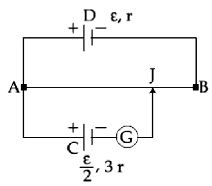
A potentiometer wire $AB$ having length $L$ and resistance $12\, r$ is joined to a cell $D$ of $emf$ $\varepsilon $ and internal resistance $r$. A cell $C$ having $emf$ $\varepsilon /2$ and internal resistance $3r$ is connected. The length $AJ$ at which the galvanometer as shown in figure shows no deflection is
A spherical conductor of radius $10\, cm$ has a charge of $3.2 \times 10^{-7} \,C$ distributed uniformly. What is the magnitude of electric field at a point $15 \,cm$ from the centre of the sphere?

$\left(\frac{1}{4 \pi \in_{0}}=9 \times 10^{9} Nm ^{2} / C ^{2}\right)$
The ratio of the intensity at the centre of a bright fringe to the intensity at a point one-quarter of the distance between two fringe from the centre is
From a supply of identical capacitors rated $8\  \mu F$, $250\  V$, the minimum number of capacitors required to form a composite $16$ $\mu F$, $1000$ $V$ is :
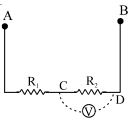
Resistances $R_1$ and $R_2$ each $60\,\Omega$ are connected in series as shown in figure. The Potential difference between $A$ and $B$ is kept $120$ volt. Then what ............. $V$ will be the reading of voltmeter connected between the point $C$ and $D$ if resistance of voltmeter is $120\,\Omega .$
$A$ thin wire of length $2m$ is perpendicular to the $xy$ plane. It is moved with velocity $\vec v = (2\hat i + 3\hat j + \hat k)\,m/s$ through $a$ region of magnetic induction $\vec B = (\hat i + 2\hat j)\,\,Wb/{m^2}$. Then potential difference induced between the ends of the wire :........$volts$
The magnetic compass is not useful for navigation near the magnetic poles because
A regular hexagon of side $10\; cm$ has a charge $5 \;\mu\, C$ at each of its vertices. Calculate the potential at the centre of the hexagon.