MCQ
Highest viscosity will be:
  • of mercury
  • B
    of water
  • C
    of oxygen
  • D
    of hydrogen

Answer

Correct option: A.
of mercury
A

Need a full question paper?

Generate a complete, print-ready paper with questions like this in minutes — across 16+ boards, with answer keys.
Start Generating Free

Similar questions

A parachutist after bailing out falls $50\, m$ without friction. When parachute opens, it decelerates at $2\, m/s^2$. He reaches the ground with a speed of $3\, m/s$. At what height, did he bail out  ........... $m$
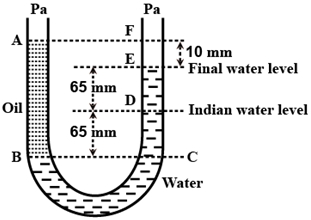
A $U$ tube with both ends open to the atmosphere, is partially filled with water. Oil, which is immiscible with water, is poured into one side until it stands at a distance of $10\,\, mm$ above the water level on the other side. Meanwhile the water rises by $65\,\, mm$ from its original level (see diagram). The density of the oil is ......... $kg/m^3$
The trajectory of a projectile in a vertical plane is $y =\alpha x -\beta x ^{2},$ where $\alpha$ and $\beta$ are constants and $x \& y$ are respectively the horizontal and vertical distances of the projectile from the point of projection. The angle of projection $\theta$ and the maximum height attained $H$ are respectively given by :-
A train moves from rest with a uniform acceleration $a$ . Attaining a maximum speed $v$ it  starts moving with uniform retardation $a$ . Assuming $s$ = total distance covered in the  unidirectional motion of the train, its total time of journey and maximum speed are  (respectively).
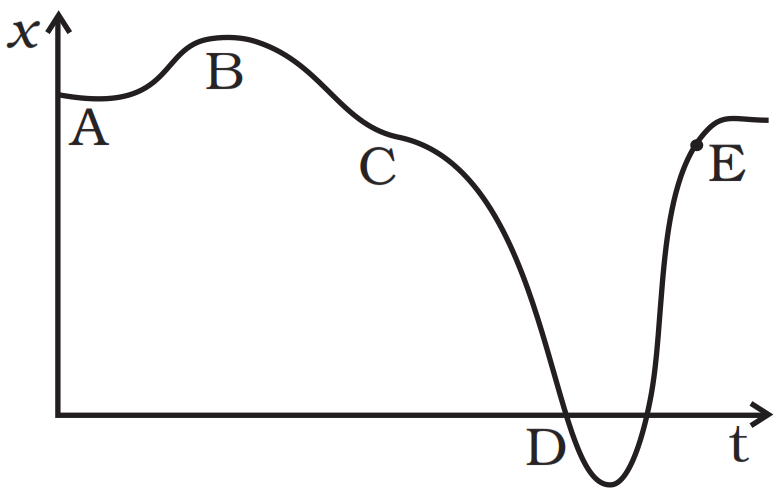
A graph of x versus t is shown in Fig. Choose correct alternatives from below:

  1. The particle was released from rest at t = 0.
  2. At B, the acceleration a > 0.
  3. At C, the velocity and the acceleration vanish.
  4. Average velocity for the motion between A and D is positive.
  5. The speed at D exceeds that at E.
A ball is released from certain height. It loses $50\%$ of its kinetic energy on striking the ground. It will attain a height again equal to
A cannon on a level plane is aimed at an angle $\theta $ above the horizontal and a shell is fired with a muzzle velocity ${v_0}$ towards a vertical cliff a distance $D$ away. Then the height from the bottom at which the shell strikes the side walls of the cliff is
A block of mass $2 kg$ slides down an incline plane of inclination $30^o$. The coefficient of friction between block and plane is $0.5$. The contact force between block and plank is :
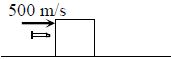
A bullet of mass $20\, g$ travelling horizontally with a speed of $500 \,m/s$ passes  through a wooden block of mass $10.0 \,kg$ initially at rest on a surface. The bullet  emerges with a speed of $100\, m/s$ and the block slides $20 \,cm$ on the surface  before coming to rest, the coefficient of friction between the block and the surface. $(g = 10\, m/s^2)$
Work done by a Carnot engine operating between temperatures $127^{\circ}\,C$ and $27^{\circ}\,C$ is $2\,kJ$. The amount of heat transferred to the engine by the reservoir is $........\,kJ$