MCQ
$HOCH_2·CH_2OH$ on heating with periodic acid gives
- A$2HCOOH$
- B$CHO-CHO$
- ✓$2\begin{array}{*{20}{c}}
{^H\backslash } \\
{_H/}
\end{array}C = O$ - D$2CO_2$
Generate a complete, print-ready paper with questions like this in minutes — across 16+ boards, with answer keys.

| List $I$ Oxide | List $II$ Type of Bond |
| $A$ $N _2 O _4$ | $I$. $1 N = O$ bond |
| $B$ $NO _2$ | $II$. $1 N - O - N$ bond |
| $C$ $N _2 O _5$ | $III$. $1 N - N$ bond |
| $D$ $N _2 O$ | $IV$. $1 N = N / N \equiv N$ bond |
Choose the correct answer from the options given below:
$\begin{array}{*{20}{c}}
{C{H_3}\,\,\,} \\
{|\,\,\,\,\,\,\,\,} \\
{C{H_3} - C - CHC{H_3}} \\
{\,|\,\,\,\,\,\,\,\,\,\,|} \\
{\,\,H\,\,\,\,\,\,\,Br}
\end{array}$ $\xrightarrow{{C{H_3}OH}}$
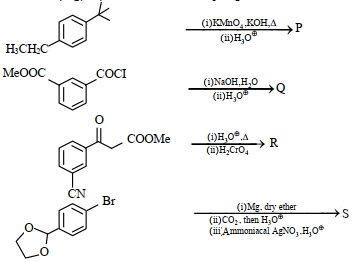
The correct statement ($s$) about $P, Q, R$, and $S$ is (are)
($A$) $P$ and $Q$ are monomers of polymers dacron and glyptal, respectively.
($B$) $P, Q$, and $R$ are dicarboxylic acids.
($C$) Compounds $Q$ and $R$ are the same.
($D$) $R$ does not undergo aldol condensation and $S$ does not undergo Cannizzaro reaction.