MCQ
Hole is:
- AAn anti-particle of electron.
- BA vacancy created when an electron leaves a covalent bond.
- CAbsence of free electrons.
- DAn artifically created particle.
Solution:
Concept of holes in the semiconductor:
Generate a complete, print-ready paper with questions like this in minutes — across 16+ boards, with answer keys.
$\text{v}=\frac{\text{v}_1+\text{v}_2}{2}$
$\text{v}=\sqrt{\text{v}_1\text{v}_2}$
$\frac{2}{\text{v}}=\frac{1}{\text{v}_1}+\frac{1}{\text{v}_2}$
$\frac{1}{\text{v}}=\frac{1}{\text{v}_1}+\frac{1}{\text{v}_2}$
Assertion : For best contrast between maxima and minima in the interference pattern of Young’s double slit experiment, the intensity of light emerging out of the two slits should be equal.
Reason : The intensity of interference pattern is proportional to square of amplitude.
|
(a) If both assertion and reason are true and the reason is the correct explanation of the assertion. |
|
(b) If both assertion and reason are true but reason is not the correct explanation of the assertion. |
|
(c) If assertion is true but reason is false. |
|
(d) If the assertion and reason both are false. |
In a sample of radioactive material, what percentage of the initial number of active nuclei will decay during one mean life
|
(a) 69.3% |
(b) 63% |
(c) 50% |
(d) 37% |
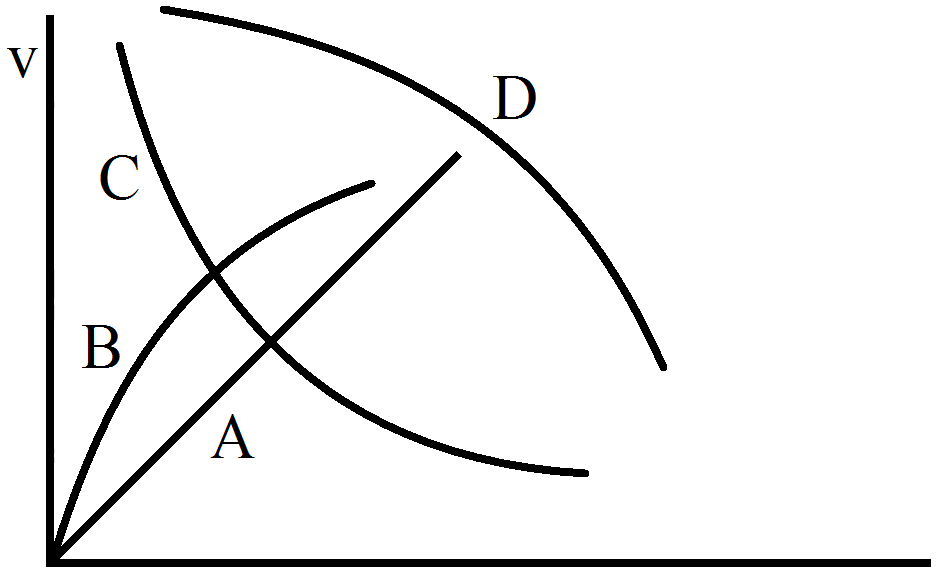
In a transformer, number of turns in the primary are 140 and that in the secondary are 280. If current in primary is 4A then that in the secondary is
|
(a) 4 A |
(b) 2 A |
(c) 6 A |
(d) 10 A |
If the speed of light were 2/3 of its present value, the energy released in a given atomic explosion will be decreased by a fraction
|
(a) 2/3 |
(b) 4/9 |
(c) 3/4 |
(d) 5/9 |
Which of the following is used to produce radio waves of constant amplitude
|
(a) Oscillator |
(b) FET |
(c) Rectifier |
(d) Amplifier |
An alternating voltage of 141.4V (rms) is applied to a vacuum diode as shown in the figure. The maximum potential difference across the condenser will be

|
(a) 100 V |
(b) 200 V |
(c) 100 |
(d) 200 |
