Question
How are DNA molecule replicate? Describe it.###Describe the process of DNA replication.

Answer

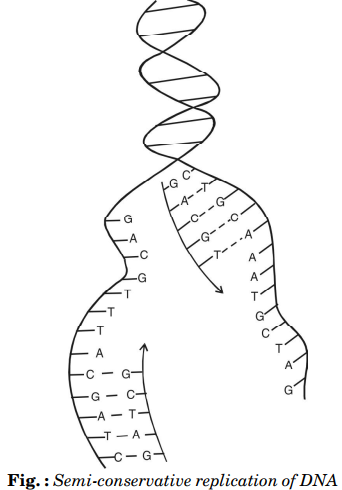
DNA Replication : DNA is the only molecule on earth which is capable of self-replication. It occurs during S-phase of the cell cycle when chromatin remain in extended form. During replication, the weak hydrogen bonds between complementary nitrogenous bases break thus separate and uncoil two polynucleotide strands of DNA molecule. Each strand act as a template for synthesis of new complementary strands. After the completion of replication, each daughter DNA molecule has one parental and one newly synthesized strand thus restoring 50% characteristics of parent DNA. This scheme of replication of DNA is known as 'Semi-conservative DNA replication'.
Image
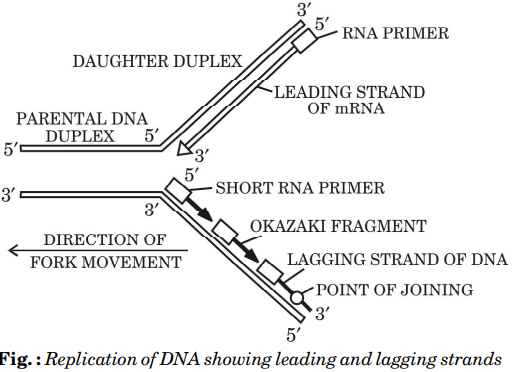
The Mechanism of DNA Replication : DNA replication is a complex process involving many enzymes. The first step is unwinding of DNA molecule at a specific point called initiation point. The enzyme topoisomerase helps in making a nick in the DNA molecule. The two strands of DNA start separating by breaking of hydrogen bonds between complementary nitrogenous bases. Each strand serve as a template for synthesis of new strand. The point of origin is marked as replication fork as it resamble a fork on either side of point of replication specific initiator proteins recognise point of initiation on DNA. RNA polymerase initiates synthesis of RNA primer on DNA template.
With the help of enzyme DNA polymerase a new DNA strand is synthesized in 5'-3' direction on 3'-5' template DNA. This is called leading strand and it is synthesized as one piece. On the other parent 5'-3' strand short DNA segments are formed in 5'-3' direction starting from RNA primer. These DNA segments are called Okazaki fragments and have 1000-2000 nucleotides. These fragments are later joined together forming a continuous lagging strand. The enzyme DNA ligase help in joining the fragments. (fig.)
Image

Need a full question paper?

Generate a complete, print-ready paper with questions like this in minutes — across 16+ boards, with answer keys.

Start Generating Free

Similar questions

  1. Name two types of satellite DNA. Mention the basis for such a classification.
  2. Show only diagrammatically the process of transcription in bacteria.
  1. How does a chromosomal disorder differ from a Mendelian disorder?
  2. Name any two chromosomal aberration associated disorders.
  3. List the characteristics of the disorders mentioned above that help in their diagnosis.
Match the sex-chromosome complements in Column I with the male/ female organisms in Column II.
S.No
Column I
S.No
Column II
A.
XO
1.
Human male
B.
XX
2.
Male bird
C.
XY
3.
Male grasshopper
D.
ZZ
4.
Female Drosophila
 
 
5.
Female bird
Why are colour blindness and thalassemia categorised as Mendelian disorders? Write the symptoms of these diseases seen in people suffering from them.
Compare and contrast the advantages and disadvantages of production of genetically modified crops.
Name the functions of the following:
  1. Corpus luteum.
  2. Endometrium.
  3. Acrosome.
  4. Sperm tail.
  5. Fimbriae.
Describe the structure of DNA.###Describe the DNA proposed by Watson and Crick.
Study the figure of vector pBR322 given below in which foreign DNA is ligated at the Bam HI site of tetracyline resistance gene.
Image
Answer the following questions:
i. Mention the function of rop.
ii. What will be the selectable marker for this recombinant plasmid and why?
iii. Explain transformation.
What is post-fertilization event? Describe the structure of plant endosperm. Also draw a well labelled diagram of dicot embryo.
The following is the illustration of the sequence of ovarian events (a – i) in a human female.

Draw a labelled sketch of the structure of a human ovum prior to fertilisation.