Question
  1. How are electromagnetic waves produced? Explain.
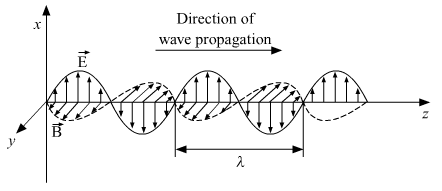
  2. A plane electromagnetic wave is travelling through a medium along the +ve z-direction. Depict the electromagnetic wave showing the directions of the oscillating electric and magnetic fields.
Answer

  1. Electromagnetic waves are formed as a result of accelerating (electric) charges under electric field. Electric charge exhibit electrostatic behaviour and once they start moving magnetic effects come into play. As a result of this a duality is established which is called electromagnetism. The electromagnetic waves are emitted by those charged particles. These waves move with the velocity of light
  2. The cross product of electric and magnetic field vectors i.e.$\vec{E}\times\vec{B}$  gives the direction in which the wave travels.
It is given that wave is propagating along the +z-axis. This means that electric field vector is oscillating in positive x- direction and magnetic field vector in positive y-direction.
The propagation of electromagnetic wave in +z direction is shown here:

Need a full question paper?

Generate a complete, print-ready paper with questions like this in minutes — across 16+ boards, with answer keys.
Start Generating Free

Similar questions

The short wavelength limit for the Lymann series of the hydrogen spectrum is 913.4 Å. Calculate the short wavelength limit for Balmer series of the hydrogen spectrum.
What is called P-N junction? Name the methods of making P-N junction. Explain the diffusion method of making $P - N$ junction.
A semiconductor has equal electron and hole concentration of $2 \times 10^8/m^3$.
On doping with a certain impurity, the hole concentration increases to $4 \times 10^{10}/m^3$.
  1. What type of semiconductor is obtained on doping?
  2. Calculate the new electron and hole concentration of the semiconductor.
  3. How does the energy gap vary with doping?
A convex lens of focal length 20 cm is placed coaxially with a convex mirror of radius of curvature 20 cm. The two are kept 15 cm apart. A point object is placed 40 cm in front of the convex lens. Find the position of the image formed by this combination. Draw the ray diagram showing the image formation.
How does Maxwell modify Ampere's circuital law? Explain.
A copper rod of length 1.0m is clamped at its middle point. Find the frequencies between 20Hz - 20,000Hz at which standing longitudinal waves can be set up in the rod. The speed of sound in copper is 3.8km/s.
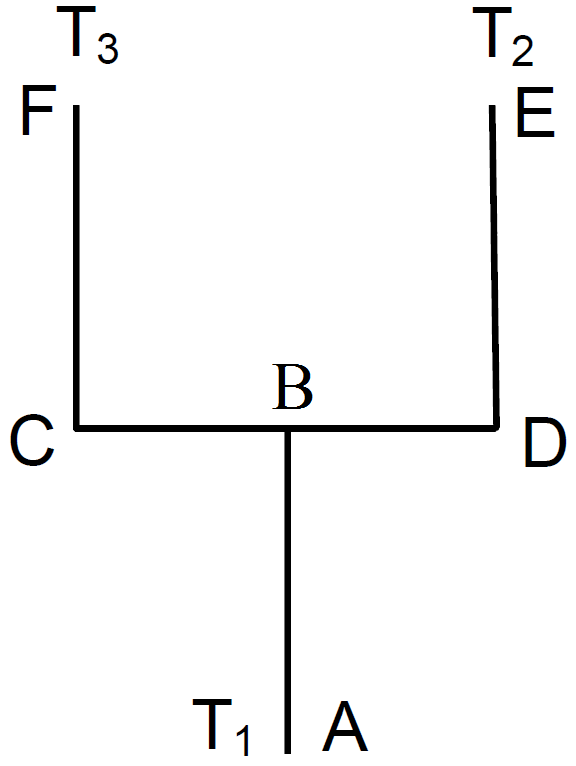
Four identical rods $AB, CD, CF$ and $DE$ are joined as shown in figure. The length, cross$-$sectional area and thermal conductivity of each rod are $l, A$ and $K$ respectively. The ends $A, E$ and $F$ are maintained at temperatures $T_1, T_2$ and $T_3$ respectively. Assuming no loss of heat to the atmosphere, find the temperature at $B.$​​​​​​​
Answer the following questions:
If χ-stands for the magnetic susceptibility of a given material, identity the class of materials for which $(\text{i})-1 \geq\text{X} < 0 (\text{ii}) 0< \text{X} < \varepsilon 0 (\varepsilon$ is a small positive number).
  1. Write the range of relative magnetic permeability of these materials.
  2. Draw the pattern of the magnetic field lines when these materials are placed on an strong magnetic field.
The decay constant of $^{238}U$ is $4.9 \times 10^{-18} S^{-1}.$
  1. What is the average$-$life of $^{238}U$?
  2. What is the half$-$life of $^{238}U$?
  3. By what factor does the activity of a $^{238}U$ sample decrease in $9 \times 10^9$ years?
​​​​​​​
Answer the following$:$
  1. Name the em waves which are suitable for radar systems used in aircraft navigation$-$ Write the range of frequency of these waves.
  2. If the earth did not have atmosphere, would its average surface temperature be higher or lower than what it is now? Explain.
  3. An em wave exerts pressure on the surface on which it is incident. Justify.